
Every day, digital transformation in manufacturing becomes a bigger priority. With new machine capabilities come rethinking the role of maintenance technicians.
This article was originally published in Global Trade Magazine.
Machines are at the heart of manufacturing. They affect every aspect of production — efficiency, output, quality, consistency — and form the basis of manufacturing performance. So it comes as no surprise that many use cases for digital transformation in manufacturing focus on machinery. It’s where the transformation manifests itself.
How it manifests itself is more complicated than it seems, however. Some may think that the primary goal of digital transformation in manufacturing is to make machines better at their intended purposes — by using digital technology to help them run faster, longer, or with greater precision. This is one goal, but digital transformation is also about much more than that. Another crucial component is giving machines new capabilities and greater purpose.
Here’s an example: When machines are equipped with internet-connected sensors that can collect machine health data and send it to a centralized platform, then each machine becomes an indicator of the overall health of the production line. Studying the parts reveals the condition of the whole, whether that’s a single production line, an entire factory, or a global supply chain.
This wasn’t possible prior to the new technologies of industry 4.0 because manufacturers had no way to monitor machine health remotely and comprehensively. But it’s possible now, and it’s changing expectations around digital transformation in manufacturing.
Driving Digital Transformation of Machine Maintenance
With additional machine capabilities should also come a rethinking of the role of maintenance technicians. They’re not just the on-site problem-solvers anymore — they’re the ones who move digital transformation forward as they keep machines up, running, and evolving. Technicians may not be the architects of digital transformation in manufacturing, but they are the drivers of it.
In that context, it’s time to consider upgrading the roles of the technicians closest to the machines. The maintenance of the past isn’t appropriate for the factories of the future. Technicians need new skills, tools, and processes to leverage the advanced capabilities being added to machines. They also need a new mindset, mission, and role within the factory. To put it differently, maintenance technicians need to transform as much as the machines they work on. Here’s how manufacturing leaders can help:
1. Change Your Mindset From Maintenance to Risk Avoidance
In the past, when technicians serviced machines because of a breakdown or because of a service schedule, the entire focus was on minimizing machine downtime. Fewer failures and faster fixes meant the maintenance department was doing its job.
Instead of focusing on solving problems after they occur, however, maintenance teams should focus on preventing them. When maintenance sees its primary purpose as risk avoidance, it puts everything technicians do into a new perspective. The team is focused on intervening early and effectively so that minor issues don’t develop into downtime.
Risk avoidance (rather than minimization) is possible when maintenance teams shift from reactive and preventive maintenance, which lag behind problems, to predictive and prescriptive maintenance, which lead ahead of them. Machine health monitoring sensors make that possible while also showing the maintenance team where, when, why, and how their agile efforts helped to prevent disasters.
2. Think About Digitizing Maintenance as a Skill Set Upgrade, Not Just Another Tool
Digital transformation in manufacturing is about more than just adding a bunch of new digital tools to your technicians’ tool belts. If you just give them better ways to do what they were already doing, you won’t see dramatic improvements from digital transformation efforts.
Instead, think of digitization as more than a bonus tool. Think of it holistically as a whole skill set upgrade for your team. Digital tools will allow maintenance technicians to spend less time on menial, repeatable tasks and transition that energy instead to higher-value knowledge work like prescriptive maintenance that can keep machines running better for longer.
3. Improve Your Collaboration Capabilities
Digital transformation in manufacturing maintenance is largely about improving collaboration capabilities. Maintenance teams are using technology to help them spread their resources around as quickly, widely, and effectively as possible. All three of those depend on maintenance teams working collaboratively.
In practice, that means each technician, team, and site has access to the same data and alerts. Everyone works from a single source of truth so that wires don’t get crossed, warnings never get ignored, and resources move everywhere efficiently. However digital transformation affects maintenance, increased collaboration should be the goal.
Every day, digital transformation in manufacturing becomes a bigger priority. Many manufacturers will discover that in their race to digitize, they forgot to update maintenance at the same pace. Those that do the opposite will discover something as well: Digitizing maintenance propels the broader transformation effort forward because it allows machines to do more than they ever have.
Learn more about how Augury offers shortcuts to digital transformation.

On the appropriately named Reimagine Stage, Augury hosted a panel to chart out the monumental shift taking place in manufacturing due to Industry 4.0 technologies. In short, big changes are due for the production process, the workforce and society at large.
Machine Health Rising
Manufacturing is currently undergoing a new Industrial Revolution driven by technologies such as IoT and AI. We are in the early stages of insight-driven manufacturing, where manufacturers use automated insights from technologies like Machine Learning to make better decisions across the operation.
To address the sweeping changes ahead, Augury organized the panel ‘The Next Industrial Revolution: Era of AI, IoT and Machine Learning’. It took place this past June at the Dublin Tech Summit 2021.
Featuring 5,000 delegates and 100+ speakers, Europe’s fastest-growing tech conference brings together the most influential business and tech leaders from across the globe.
Experts On Manufacturing’s Digital Transformation
Moderated by Augury’s Director of Content, Ciara Byrne, the panel was quick to deep dive into the current challenges facing manufacturers. Everyone agrees: instilling agility and flexibility is the only way forward.
The expert insiders also have insights into how digital transformation is playing out differently in manufacturing than in other industries. They also offer advice on how to jumpstart long-term workforce transformation.
Turning Data Into Actionable Information
“With layers and layers of data, we need to learn to extract the right information,” says Warren Pruitt, VP of Global Engineering Services at Colgate-Palmolive. He also noted his company’s digitalization process was sped up by three years in response to the Covid-19 pandemic.
Based on immediate benefits, Colgate-Palmolive is now scaling their machine health program. However, the company also recognizes the need to link this with an equally robust change management program.
Maximizing Flexibility and Agility
“The operators are no longer part of the machinery. Now, there’s a platform doing all the ‘listening’ and gathering of data,” observes Ed Ballina, former VP of Manufacturing and Warehousing at PepsiCo.
“So, people need to be retrained for higher-value work. They need to become less of a technician and more of a translator of data. In this way the work becomes more satisfying – as it goes from being reactive to proactive.”
Syncing Operations and Outcomes
“Through all these new insights and the hybridization of roles, we can then actually bring operations and business outcomes in sync,” says Artem Kroupenev, VP of Strategy at Augury.
With as a result: better quality at less cost. Everyone wins.

From the hopeful demise of greenwashing to the promising birth of micro-factories… Augury listens to machines. But we also listen to the world. This helps us to better know our place in making it a better place. Here’s a round-up of some of the manufacturing-related press from the last month that caught our eye – and why it mattered.
The Wobbly Road To Driving Change
Looking at the news of June, much of it seems to confront the big news of May: ‘“Powerful Signal”: In A Single Day, Big Oil Suffers Historic Blows on Climate’. Meanwhile, more such lawsuits are reaching the courts.
Meanwhile, scientists are claiming they can now directly link actions taken by individual companies with subsequent global climate change. In addition, more non-fringe voices are arguing that capitalism needs a reset: so that success is no longer defined purely by profit and growth, but also by social and environmental metrics. Others continue to warn us that some ‘solutions’ turn out to create as much CO2 as their fossil fuel equivalents.
Certainly, mitigating climate change requires many different innovations that involve the individual and collaborative efforts of academia, the business world and policymakers. Together, we can drive change.
Away From “So-So” Technologies
“For one of the most distinguished critics of automation, MIT economist Daron Acemoglu has been, ironically, cranking out research on the subject lately like he’s a machine,” according to ‘A New Way to Understand Automation’.
And yes, his research shows a clear net loss of jobs from automation in the US. Of course, automation has many benefits, but these seem to be decreasing over the last decades. Part of the problem, according to Acemoglu, is how much of the automation being implemented today is “so-so”. Namely, these actions are not actually leading to increased productivity. Think: self-checkout kiosks at supermarkets that only just lead to increased frustration.
“Businesses are using machines to kill jobs without generating significantly lower production costs, he says, while also imposing all the costs on society that comes with greater unemployment and lower wages.” In short, we must get smarter about automation.
“Last year, Acemolgu testified before Congress and urged them to reform the tax code, invest more in R&D, and play a bigger role in directing the future of technology.”
The Right To Repair
“The UK government recently announced legislation aimed at tackling premature obsolescence. Expected to come into force from this summer, the new rules will mean manufacturers of white goods will need to build spare parts so products can be easily repaired,” according to ‘Ending Planned Obsolescence Is A “Brilliant Opportunity” For Designers’.
The lifespan of goods is expected to increase by up to a decade by these measures.
“To ensure compliance, consumer goods manufacturers will need to invest in expertise across a range of disciplines; from product design to supply chains, retail and branding.”
Of course, many brands are already ahead of the game. “Dutch company, Fairphone, for example, produces modular mobiles that can be easily repaired and updated. Rather than having to buy a new smartphone every two years – contributing to the UK’s 1.45 million tons of annual electrical waste – Fairphone owners can simply upgrade their existing handset.”
“Manufacturers of all types have a lot to learn from its modular approach.”
Enter: Arrival.
Re-Inventing The Wheel Factory
Arrival is taking a very modular approach as they develop an affordable commercial EV, according to ‘To Make a New Kind of Electric Vehicle, First Reinvent the Factory’. In fact, the company is approaching automotive not as a separate category but as “a device on wheels”.
“In the process, Arrival hopes to solve two of the great problems of car-making in the 21st century: how do we make electric vehicles that don’t create almost as much CO2 as their petrol equivalents? And how do we dismantle the massive assembly lines that define today’s automotive industry, along with the environmental and social issues they bring?”
For example, steel stamping and the painting are the two most costly, polluting and energy-intensive parts of automobile production. So why not replace these with pigment injected thermoplastics reinforced with glass fiber?
And what happens if you can’t afford the massive capital investment of setting up a massive factory? Why not make the factory modular as well?
“We’re offering an electric vehicle at a competitive price, but we’re also offering the chance to have factories in small cities that serve community needs,” says one of Arrival’s founders. “You can have a factory in a church hall if you only want a few vans a year. Post-industrialization moved factories around the world. This is bringing it back to communities. So it’s cheaper, the owner has more control and understanding, you can have factories in every city, there’s no supply chain… The old system isn’t working any more. It’s time we made a change.”
Buckle your seatbelts. It looks like we’re in for a ride.
Interested in reading ‘Manufacturing – The News, May 2021’?
Frost & Sullivan has awarded Augury top spot for Best Practices in the category ‘Global AI-Based Machine-Health-as-a-Service Market’. What excites us most about this announcement is the prize report. It eloquently captures the widespread impact and value realization that Augury’s Machine Health has on industrial enterprise customers.
Augury won the Best Practices Global Product Leadership Award 2021 for consistently developing “new growth strategies based on a visionary understanding of the future,” according to Frost & Sullivan’s prize report.
We’ll take that. Thank you!
“Best Quality, Reliability and Performance in the Industry”
“Best Practices Awards recognize companies demonstrating outstanding achievement and superior performance. The Global Product Leadership Award recognizes the company that offers a product or solution with attributes that deliver the best quality, reliability, and performance in the industry.”
We are particularly honored to receive this prize since Frost & Sullivan obviously dove in deep when writing their report. Their Growth Pipeline analysts ably describe the thinking behind our strategy and actions in “creating a world where people can always rely on the machines that matter”. The report also provides a sharp overview of the rapidly emerging Machine Health sector – and why it’s particularly relevant for current realities.
Full-stack For Full Digital Transformation
Frost & Sullivan uses a deeply analytical process across two dimensions to determine their prize winners. Essentially, they evaluate why a particular company is at the right place at the right time with the right stuff to have real-world business impact.
“Manufacturing companies require solutions that can guarantee the reliability of machines that matter. Augury’s full-stack, artificial intelligence (AI)-based Machine Health-as-a-Service software successfully addresses this need. With its highly accurate prescriptive diagnostics, scalability, and guaranteed outcomes, Augury drives insight-driven manufacturing,” according to the report.
“While competitors offer standalone point solutions that do not suffice to address today’s machine health challenges, Augury delivers sensing and AI as a service. Moreover, the company does not take responsibility for just diagnostics or analytics but to drive guaranteed outcomes.”
“Moreover, customers average 3X their return on investment within months. Augury is so autonomous, effective, and transformative that it drives behavioral impact and change management across an organization, from the plant floor to the corporate office. The company’s vision to cover all machines that matter, including less critical secondary equipment, further enhances its already unparalleled customer value proposition.”
Conclusions For The Future?
“The beauty of Augury is that it delivers not only business impact but also behavioral impact. Due to its ability to drive data-driven decision-making to the operational production floor level, it is accelerating digitization efforts,” says Sankara Narayanan, a Senior Industry Analyst and the lead writer of the report.
The report’s conclusion: “For its strong overall performance, Augury earns Frost & Sullivan’s 2021 Global Product Leadership Award in the AI-based Machine Health-as-a-Service market.”
Our takeaway? Gratitude. Backed by the hope that many read this wonderful report.
Read ‘The Global AI-based Machine Health-as-a-Service Market: Excellence in Best Practices’.
Augury listens to machines. But we also listen to the world. This helps us to better know our place in making it a better place. Here’s a round-up of some of the manufacturing stories from the last month that caught our eye – and why they mattered.
Vaccine Manufacturing is Not Like Making Orange Juice
Is the worst over with the COVID-19 crisis? We hope so. ‘A COVID-19 vaccine life cycle: from DNA to doses’ is an insider view on the daunting challenges related to vaccine production. “I was really excited,” said one facility manager when he heard his plant was going to manufacture COVID-19 vaccine. “I’ve been working in pharmaceutical manufacturing for almost 40 years and I’ve never been on a project like this. I sat down on the couch and a half-hour later I was horrified. My head was spinning.”
“Vaccine manufacturing is an endeavor where an almost infinite combination of things have to work perfectly,” said one expert.
“It’s not like (making) orange juice,” said another.
“It is science with established principles, but sometimes is more idiosyncratic than art,” said a third.
But now tens of millions of doses later, the facility manager and his team have “achieved the impossible”. They cut their production time by half. “I’m really proud that we’ve been able to get to this place,” he says. “When you get everybody pulling in the same direction with the same goal, it’s like magic. Stuff really can happen fast.”
Bumps on the Road
But yes, there can still be bumps on the road. “The newness of some of the technology and gaps in global preparedness have led to bottlenecks,” according to ‘How are Covid vaccines produced and why have there been delays?’.
“The effort to create new vaccines has been amazing, but along the way it’s as if some of the fundamentals have fallen by the wayside – the bread-and-butter stuff that makes scaling up possible,” said one academic. “I really do think people were so focused on the vaccines, they didn’t think further about what needs to come with it to make happen.”
Innovation Matters
‘The 10 most innovative manufacturing companies of 2021’ is a dazzling round-up – even though they forgot to add Augury to slot #1.
“From manufacturing a better vial to carry COVID-19 vaccines in, to devising a biodegradable packaging, to offering on-demand fabrication that reduces waste, these companies are creating a better world by rethinking the ways we create product.”
We were particularly impressed by old dogs, the Ford Motor Co., for pivoting their century-plus of production know-how to pump out tens of millions of masks, face shields and self-designed ventilators.
Size Matters
Meanwhile, there’s a project in India that mirrors the vast ambition of the early days of Ford when they were jumpstarting the automobile manufacturing business. Ola Electric is building the world’s largest two-wheeler factory, according to ‘First Ola Electric vehicle will be launched in June once factory is ready: Bhavish Aggarwal’.
The AI- and automation-driven plant will pump out an eye-watering 10 million EVs a year. “We will have 15% of the world’s production capacity in this single factory and it is going to be fully integrated,” says Aggarwal.
Shall we arrange a Zoom date, Mr Aggarwal?
Turning That Drop in the Bucket into a River of Change
Similar mass ambition should be being applied to providing clean and safe drinking water infrastructures, according to the inspiring ‘How AI and data turn city water management from an art to a science’. In the US alone, a trillion dollars needs to be invested in its ageing water systems – and in the very short-term.
More municipal water managers are embracing innovations similar to what Augury has to offer. “If you use sensors and can detect that potential fracture before it ever occurs, it’s cheaper to fix, you’ve not wasted a lot of water, you’ve not disrupted a city and you’ve taken care of a problem before it actually occurs,” says one.
But many hearts and minds still need to be won over in one of the least disrupted industries on the planet. “We find consistently in our research that people are at the heart of a successful adoption of new technology,” said one expert. “The real value comes from the insights it provides to help them to do their work more effectively.”
We’ll drink to that.
Manufacturing and Toilet Paper in the Limelight. Again
And speaking of flow, all eyes were recently on the Suez Canal blockage – and its staggering costs.
The COVID-19 pandemic had already inspired people to take manufacturing less for granted. (Though it’s somewhat disheartening that it took the fear of running out of toilet paper to turn the term “supply chain” into a household word.)
The blockage worked to further amplify the importance of manufacturing. It also inspired some hilarious memes and quality journalism.
“The Ever Given isn’t stuck anymore, but it will delay tea, dildos, and more,” according to ‘The fallout from the Suez Canal ship is coming to a store near you’. Augury CEO Saar Yoskovitz was quoted in the article saying that not only goods but also raw materials and spare parts were being held up, which could have a negative impact on manufacturing for months to come.
“[Yoskovitz] points to one of the great supply chain incidents of our time — the great toilet paper shortage of 2020 — as a prime example of this: Wood pulp was one of the materials that was severely delayed.”
Let’s hope in the case of wood pulp, the worst is also over.
Interested in reading more news about Augury?
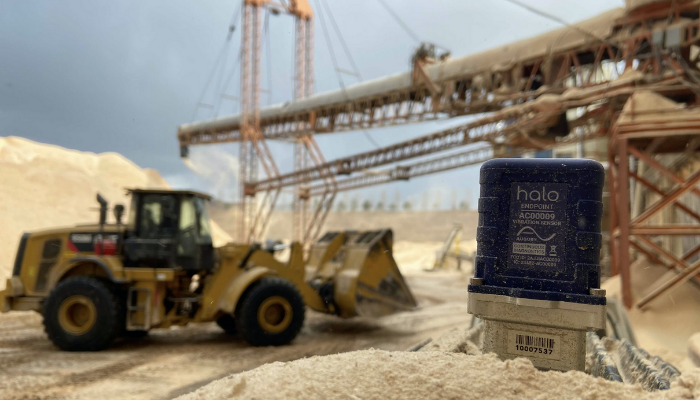
Roseburg’s Brian Richmond spent 20 years in the military, hopscotching across the world to Europe, Asia and other far flung places. So how did he end up back on a farm in Louisiana not far from where he grew up?
“I was born about 45 miles from where we live now,” Richmond says of his decision to take a position with Roseburg in Simsboro, Louisiana. “It’s been a very long journey to get back here, but it was kind of a weird journey I didn’t see coming. I’m glad to be back.”
As a regional reliability manager for Roseburg Forest Products, Richmond is responsible for process improvement, budgets, training, and much more.
Before arriving at Roseburg, Richmond spent two decades in the U.S. Navy, planning maintenance work on nuclear submarines and developing training programs for engineers. Richmond earned an MBA from Excelsior College, then relocated from the West Coast to Simsboro, Louisiana.
Here, in an interview, he discusses his career trajectory, how he unwinds during the pandemic in his “man cave” and the ways in which Augury and machine data have helped him transform Roseburg’s reliability programs.
You began your career in the Navy. What did you learn from your time there?

Brian in the Navy
I got to see all kinds of different cultures. We spent a lot of time over in Japan and Germany learning some of their techniques and processes. Underway on a submarine you don’t get a whole lot of spare parts so the reliability of your equipment is really one of the foremost things you’re trying to maintain.
My upward mobility in the Navy was very quick. By the time I had been in for five years, I had a department that I was responsible for and a lot of people who worked for me that were significantly older than I was.
It’s really hard to argue with experience. But what I learned quickly is that you have to have data. The person with the most accurate data and the most data can usually prevent an argument from even occurring. A lot of people with experience will be overbearing with you and say, “This is the way we’ve done it” and “This is how we’ve done it.” That’s really how I learned how important that data aspect is.
You’re from Louisiana. How did you end up back there working in a position with Roseburg?
After 20 years in the Navy, I really had no clue what I was going to do. The only job that really correlated to what I did there was power generation. Six months after I retired from the Navy, I was contacted by Roseburg to come work for them as a superintendent for a powerhouse in Oregon, then as a sawmill maintenance manager. I moved from Oregon to Louisiana and was promoted into a regional reliability manager role overseeing plants in Louisiana, Arkansas, Mississippi, South Carolina, Canada, Oregon, Montana and California.
I grew up in a farming community. We have land and animals. My kids are very wrapped up in animals, and my wife is applying to vet school this year because she’s very into taking care of animals. I moved from Oregon to Louisiana and most of the animals we have now, we had in Oregon. It is kind of weird to roll down the Las Vegas strip with two horse trailers, a llama, cattle and a bunch of horses. You get some weird looks.
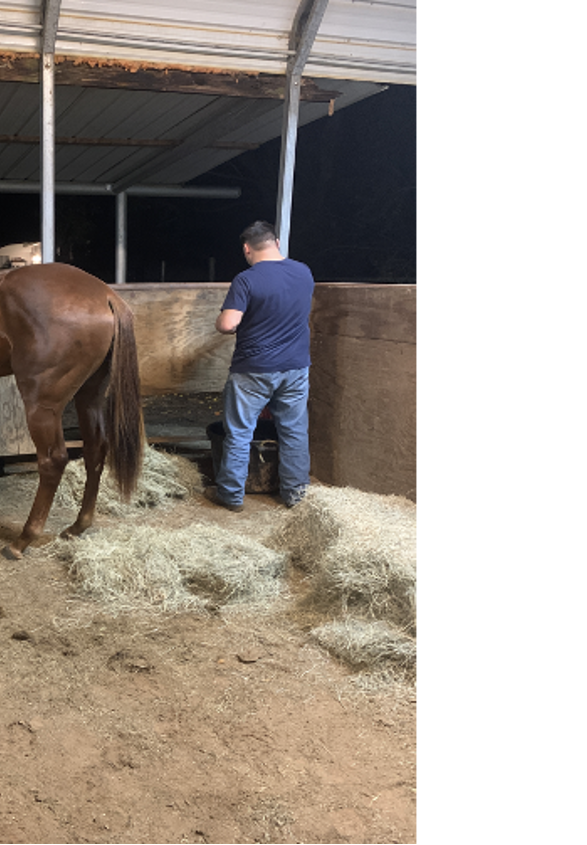
Brian Cleaning a Stall
In this picture, I’m supposed to be cleaning that stall. I’m not doing very good because it’s of course one of those nights where I got home and about 10 minutes into the night, I get a phone call about a piece of equipment that’s broken. Really making that call, do I need to turn around and go back?
How does a typical day at work begin for you?
Every morning I’m usually up between 4:30 and 5:00. I would like to say that I go out and help with the animal chores, but I don’t. I usually start thinking and looking at my phone and figuring out what emails I need to answer. My wife basically makes my coffee and throws me out the door by about 5:15 or 5:30.
I have about a 35 to 45 minute commute to work. And in that drive, that’s when I do a lot of my thinking about what’s going to happen that day, what needs to happen that day. What problems didn’t I solve the day before?
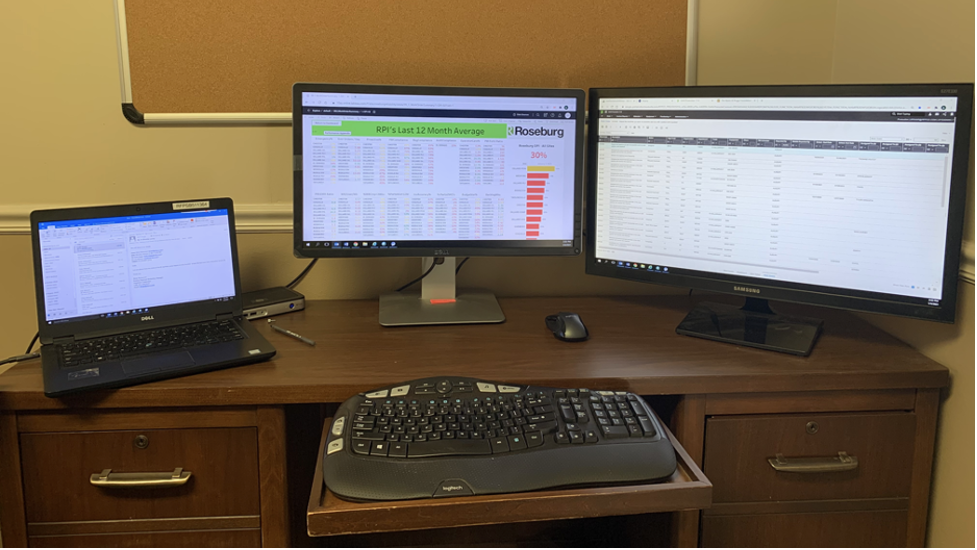
Brian’s Desk
I log into my emails, and I go onto our dashboard to see what things I need to answer and what questions people have. I’m looking to see what my technicians are worried about. What did they fight last night? What help do they need?
My dashboard gives me the site overview for all our plants. This is critical because it allows me to figure out what plant I need to look at right now. If something came up in Augury or Tableau or on any one of our other systems that says, “Hey, we had a failure last night,” I’m going to go straight to it. I’ll make a phone call to the maintenance manager of the plant and say, “Hey, what happened with this? And what do you need?”
How did the COVID-19 pandemic impact you, your business and your employees?
One of the blessings we have as an organization is that during the COVID crisis, we didn’t shut any plants down. Our technicians and operations group all rely on us to really function day to day. We did tailor back some of our production times, but the wood products industry has done very well in general.
It was critical that we were able to keep the plants running, because most of our technicians are part of dual-income families. They needed to be able to rely on at least one of them, because one probably wasn’t going to last. We were able to fulfill that by proving our reliability by increasing our uptime, honestly, and by changing our profit margin to some extent.

Brian’s man cave and home schoolroom
A lot of times when I am stressed, I just want to work out. I’m an avid boxer, and I have a punching bag and boxing equipment. I also like billiards and darts. You look at this room and you see a man room but my two youngest kids are both homeschooled and it’s really turned into a great teaching base for them as well.
This whole (Covid-19) thing makes me able to help teach them, where in the past I was stuck in an office. It’s amazing how much physics you can teach a seven year old on a pool table. I’m grateful for the fact that we were not in a bad way and were forced to spend more time together at home because we couldn’t go places. That has really been a blessing to us.
How have data and technology improved the quality of life for your team?
One of the things we do is we patch things. We don’t really fix them. And we do that because we don’t see the break coming. We don’t see the failure coming and we have to get running right now. And if you get six or seven or eight of those patches on, when your failure occurs, it becomes catastrophic and now your downtime is significant. Technicians don’t want downtime. Downtime means they have to go there to work on it.
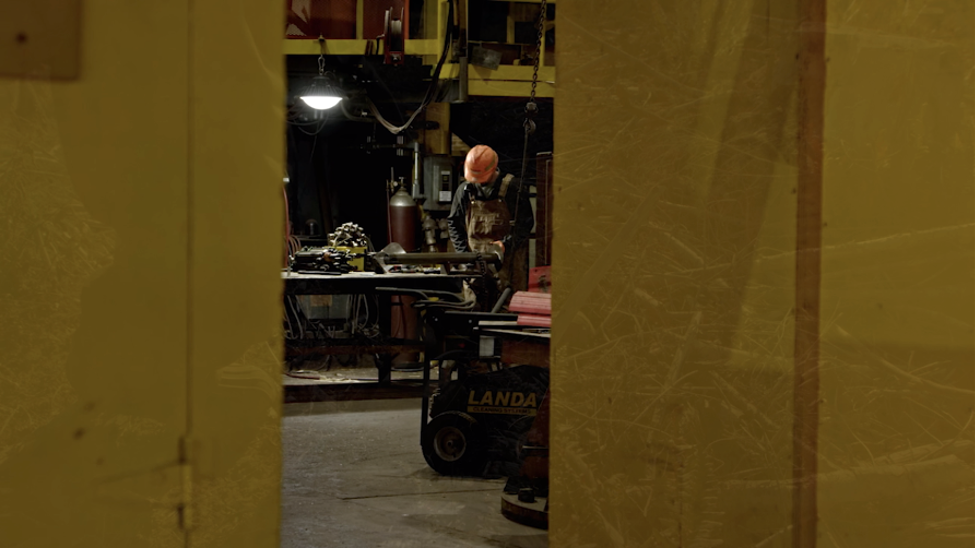
Roseburg wheelwright doing an emergency repair
My first customer is always going to be the technicians on the floor to make sure they get what they need. So part of my job is showing our technicians how new technologies and new ideas can not only make their job easier but make their life better.
When you start showing people how data and new technologies can be used to outline the health level of their equipment and improve planning, it doesn’t just affect their quality of life. It affects their family’s quality of life. On Saturday, when someone’s son has a baseball game or he wants to take his son deer hunting over the weekend, he can plan on that and not plan on being called in. My technicians don’t have to answer the phone at two o’clock in the morning anymore.
Also, look at the safety factor of what it’s like to work at night compared to what it’s like to work in planned evolution in daylight. Most of the equipment at manufacturing facilities is stored outside, and it’s usually not very well lit. Anytime you’re forced to work on something at night, you’re having to bring in more lights and more people. It takes longer. Executives don’t want to see downtime.
How have you been able to use Augury’s platform to train your team?
I am grateful to the dashboard we have. We’ve built a lot of our training requirements off of what we found on it. We had to explain to our technicians that an alarm doesn’t mean it was failing right now. The danger means that we probably need to look at it. We had to give guidelines.
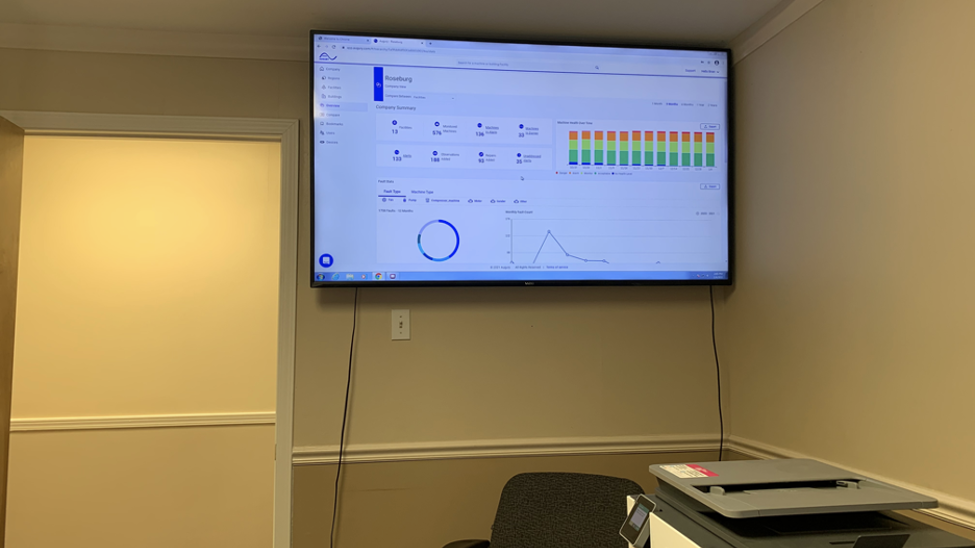
Roseburg’s Augury Dashboard
Being able to do that is huge. It was really hard for people to understand that everything’s not an emergency. It’s data, and how you use that data is what really matters. We can make our lives simple with the data or we can make our life miserable if we attack everything.
Has that helped you at all with hiring?
Yes. When we hired a maintenance manager in Simsboro, that was one of the things we sold him on: the fact that we’re not using antiquated technologies. We’re trying to find out what’s out there, what’s new, and we’re willing to invest. We’re willing to invest in new technology in order to improve our quality of life and our product. We absolutely do use it as a selling point and as a retention and recruiting aspect.
Want to learn more? Just reach out and contact us!

In manufacturing, safety is everyone’s responsibility. Safety incidents and workplace injuries directly impact workers, morale, productivity, company reputation, and the bottom line.
“All plants say safety is their top priority,” says Ron Moore, an internationally renowned expert on manufacturing excellence with over 45 years of experience. “It’s a nice thing to say, but often it isn’t backed up by actions.” Moore’s research shows that actions that improve reliability actually improve safety too.
Reliable Machines are Safer Machines
Every human-machine interaction can potentially cause an injury. Yet there’s still limited awareness of the link between the reliability of machines and the safety of the people that work with them. Moore has collected data that clearly demonstrates the relationship between worker safety and machine reliability. His research maps worker injury rates against Overall Equipment Effectiveness (OEE) and Asset Utilization (AU) in manufacturing facilities.

As facilities improve their OEE and AU, their worker injury rate goes down, and according to Moore, this pattern is consistent across all manufacturing industries from food and beverage to oil and gas.
Reactive Works Causes Injuries
Moore’s research also shows that plants with more reactive work orders have more injuries. When maintenance teams do unplanned repair work in response to a failure, they are under pressure from the production team to get machines back up and running as fast as possible and are more likely to take shortcuts.

A rushed repair is never as safe or effective as a repair done during a planned shutdown. As Moore points out, no task is so urgent that it cannot be done safely. Manufacturers should do everything in their power to reduce the number of human-machine interactions overall, but reactive work in particular, in order to limit the risk to their maintenance workers. What’s more, Moore’s work shows that reducing reactive maintenance increases OEE and AU while cutting maintenance costs.
The most effective way to avoid reactive work is to eliminate unplanned failures in the first place. Ideally, every repair should be scheduled and planned ahead of time-based on identified defects, and assigned to properly skilled technicians who have all of the necessary parts and tools readily available.
Prioritize Reliability to Improve Safety
Maintenance departments often bear an unfair amount of the blame for machine failures. According to data Moore’s gathered over the years, nearly ⅔ of equipment failures are not caused by maintenance practices, but by problems upstream. “Companies don’t seem to understand the whole series of things that occur before downtime happens,” he says.
Reliability should shift the focus from the immediate repair and the associated maintenance costs, to the causes of a downtime event. The full Reliability Process includes how companies design, buy, store, install, operate and maintain their equipment. Using this process model, manufacturers can identify where machine failures originate and improve machine reliability across the organization.
Some questions to ask yourself include: Did something in the system design create this problem? Was the right equipment purchased? How was the asset stored and was it installed properly? Was the asset being operated with care? Is our maintenance team trained to identify and prevent these issues?
“Corporate leaders need to treat reliability the same way as safety with systems, measurements and rewards, “ says Moore. Senior manufacturing leaders can prove their commitment to worker safety by taking reliability programs as seriously as safety programs.
Healthy Machines Keep Workers Safe
Better safety training, checklists, safety gear, and proper tool use make human-machine interactions safer, but reducing the need for your employees to interact with dangerous machines in the first place is the ultimate goal.
Machine Health uses IoT and AI to predict and prevent machine failures. It eliminates unnecessary maintenance tasks, cuts the number of human-machine interactions, shifts more of the maintenance team’s work from reactive to proactive mode, and improves OEE.
Healthy machines are safer and more reliable. As facilities improve Machine Health, they also ensure worker safety. A reliable plant truly is a safer plant.
Want to learn more? Just reach out and contact us!
Before COVID-19, the concept of remote work hadn’t caught on in manufacturing as it had in other industries, and for fairly obvious reasons: people need to be on-site to accomplish most tasks. But manufacturing is experiencing a virtual shift that can positively impact the way manufacturers work even after the pandemic recedes.
The term “virtual shift” refers to work that was formerly confined to the factory floor but can now take place in virtual environments. The maintenance department, in particular, has embraced the virtual shift as a way to both extend and improve their efforts to keep machines in optimal shape.
At first, it sounds counter-intuitive that maintenance staff would perform better by interacting with machines virtually rather than physically. But machine health monitoring systems make the virtual approach efficient by supplying technicians with a steady stream of data including key machine health metrics like temperature and vibration. With prescriptive alerts that analyze minute aspects of machine health, technicians know when problems will happen and can intervene early — either personally or by directing someone else on-site.
Here’s an example: A piece of equipment produced in Italy breaks down inside an American factory. The factory could pay to import a master technician to diagnose the problem directly, but that comes at a huge cost and means the fix is days or weeks away. With a machine health monitoring system in place, however, Italian experts could review the data, diagnose the problem, and then walk on-site technicians through the fix — all without leaving their desks.
Thanks to the virtual shift, fixing the problem takes less time, costs less money, and returns production to normal faster. It’s an unorthodox approach to servicing equipment with positive implications for the entire industry.
The Future of Advanced Manufacturing
The virtual shift best describes the transition from the basic manufacturing of the past to the advanced manufacturing of the future. That’s because it allows factories to optimize all their critical resources, mechanical and human, through remote collaboration.
On the human front, advanced manufacturing technologies like a machine health monitoring system can allow one dedicated reliability engineer to serve multiple facilities. Instead of having a specialist stationed in each factory, a single person can monitor data coming from several sites, thereby cutting labor costs and making up for talent shortages. And by having someone monitor that data consistently, remote technicians can catch small problems before they lead to breakdowns — optimizing the effectiveness of equipment and minimizing the time and money spent on maintenance.
Moving forward, factories will be less driven by the resources they have on-site. Instead, they will rely on a network of experts and partners who have visibility into individual factories and specific pieces of equipment. Put simply, every factory will do more with less thanks to the power of remote collaboration to seamlessly deliver valuable resources wherever the demand exists.
Machine Health Data: The Missing Link
Manufacturers need the will to experiment with the virtual shift, but even more importantly, they need the underlying technology to make it possible. Without this technology, off-site locations are simply out of the loop. Remote collaboration can’t work unless those involved, especially those off-site, have access to real-time machine health data as broadly and deeply as possible.
Currently, most manufactures have symptom-level data that reveals the presence of a problem but does nothing to indicate the root cause. This data is basically useless to an off-site technician because to make any useful determinations, the technician would still need to travel to the factory to engage directly with the machine. Remote collaboration becomes impossible.
The missing link is the right machine health monitoring system to first track machine health data on a granular level and analyze it for early warnings of potential problems, then distribute that data to off-site observers. These two capabilities can bring the machine (and the underlying malfunction) into stark relief.
With all the right pieces in place, advanced manufacturing arrives sooner than many thought possible. Early adopters will be both the first to reap the rewards and the benefit the most in the long term. All it takes is an investment in the right advanced manufacturing technologies and a serious commitment to trying something new.
Want to learn more? Just reach out and contact us!

New Year’s resolutions are part of what makes us human–the desire to get better, to make a bigger impact on our jobs and lives. But what about the machines that we rely on for our food, water, medicines and goods? Do they make resolutions? And if so, what are their resolutions for 2021?
Augury’s Machine Health technology listens to machines, to know how they are doing. Our customers use our solutions to reduce downtime and improve capacity. But we figured maybe those machines could tell us more, if we just asked. So we surveyed 1000 machines in manufacturing facilities around the world to see what’s on their minds for 2021 resolutions. Here’s what their list looks like (hint: it’s a lot like most of ours) – and some great gift ideas to help the machines in your life achieve their goals for 2021.
Resolution #1: Stay healthy.
Machines don’t like to have health issues that cause them to miss work or perform below their best any more than people do. They want to feel good, work hard and stay strong no matter what’s being asked of them. Our machine health solution gives machines – and the people that care for them – the data they need to be healthy and prevents breakdowns that can injure performance. Think of it as a Fitbit for the machines that matter.
Resolution #2: Communicate better.
Machines know a lot about what’s happening on your manufacturing floor, and they want to share what they know with you. Our machine health platform makes it easy for your machines to give you real-time insight into their reliability and performance. Want to know if your production lines are at risk? Just ask those closest to the work – the machines that are doing it. It’s like a regular zoom call for your extended machine family. Find out how we can keep your machines and team performing at their best
Resolution #3:Work smarter, not harder.
Your machines want to sport the coolest digital tools as much the rest of us. Machine health takes even your oldest, least cool machines and makes them digital natives overnight, connecting them to our advanced analytics and to you and your team. Give them the machine health gift they want this holiday season and they – and you – will be the coolest kids on the manufacturing block. That can help manufacturers increase productivity by using real-time insight to eliminate unnecessary maintenance and improve processes. And get invited to all the best parties.
Resolution #4: Ask for help.
Too often many of us suffer in silence because we’re not willing or able to ask for help. It looks like machines have the same issue – but they want to change as much as we do. They want to contribute more to the team and make themselves better by asking for help when they need it. Machine health gives them the tools to do just that – not just letting them tell you when they think they’re struggling, but letting you know what the issue is and how you can help resolve it. Even your machines can use a little help from a friend – give it to them with machine health and let them help you prevent unplanned downtime and reduce costs.
Resolution #5: Don’t Waste Money.
Machines know that when they break or when you over-maintain them, it’s a waste of money for your manufacturing plants. They want to be as smart with money as the rest of us. Fortunately, our machine health solution provides actionable insights to help your team eliminate unplanned downtime and reduce unnecessary maintenance. When it comes to saving money, Machine health is money in the bank. Think of this gift as a budgeting lesson for the machines that care.
Resolution #6: Learn a new skill.
Machines know they are capable of more and they want to see what else they can do. They want to go beyond just producing the materials you need – they want to be part of the team that makes your processes better, creates better formulas and changes how you work for the digital world. Machine health lets them share their data and insights with your other production and operational data to create new kinds of value for your business and customers. It’s like giving your machines a promotion (but you won’t have to pay them more!)
Resolution #7: Do more for the environment.
Nobody likes polluting, and machines know they’re often the bad guys in the environmental story, wasting electricity and materials when they’re not working at their best. But they want to do their part for the planet too. Machine Health solutions help your machines work more efficiently by letting you know when something’s wrong that’s slowing them down and gumming up the production works. Machine health can even help them show you the signs that you’re wasting materials (and money). Machine Health turns even your grimiest machines bright green – it’s like a Prius for your pumps (or a Tesla for your turbines?)
Resolution #8: Mentor a Co-worker.
Machines know the world is changing – even the most traditional roles in maintenance, reliability and manufacturing are evolving to be more connected and more digital. They want to be part of the change, helping their human co-workers transform to succeed in a digital world, giving people the tools, insights and practices they need to succeed and grow. Machine health makes machines a participant in your digital transformation – and provides a platform to change how maintenance and reliability are done, using real-time data, not years-old documentation. With machine health your people will base maintenance decisions on insight not hindsight, and your connected workers will have a connected machine as a partner.
Want to learn more? Just reach out and contact us!

The U.S. manufacturing sector is often thrust into the spotlight as a point of conversation and as an indicator of the country’s overall economic health. The ongoing pandemic has only increased the light shown on this industry due to production shortages and supply chain disruptions that continue to have a ripple effect on consumers, and in some instances permanently changing buying habits.
To get a true pulse on how the American consumer views the manufacturing industry and how their purchasing patterns may have changed, we issued a survey to 1,000 U.S. adults (18 and older) and their responses may surprise you.
U.S. Manufacturing Viewed As Important, But Not Strong
Jobs. Jobs. Jobs. One thing the majority of respondents strongly agreed on (83%) is that it is important to increase the amount of U.S. manufacturing jobs. However, we went deeper to explore views on if automation can help create jobs and how strong the industry currently is.
- Only 37% of respondents view the state of U.S. manufacturing as “strong” or “very strong”
Eighteen percent of respondents between the ages of 25 and 34 stated that U.S. manufacturing is “weak” or “very weak.” This figure jumps up to 38% in the age bracket of 55-64, indicating a more critical outlook on the industry.
Automation Key to Job Creation
Utilizing the most advanced manufacturing technologies available is critical to enabling the U.S. to compete on a global scale and to reshoring production that is currently conducted overseas. The general consumer is beginning to understand this important concept.
- Sixty-two percent of Americans believe increasing automation in the manufacturing sector will help bring manufacturing jobs back to the U.S.
- Respondents between the ages of 55 and 64 felt the most strongly about this concept, agreeing at a rate of 70%. This was 20 points higher than the youngest age bracket surveyed, 18-24, who agreed with this notion at a rate of 50%.
Changes in Consumer Buying Habits
The ongoing pandemic created a situation that many Americans had never experienced before – the inability to purchase an item they sought due to an unexpected shortage. In fact, more than half of consumers (52%) disclosed that they had on at least one occasion stocked up on food or other items due to the pandemic. However, this wasn’t the only notable change in consumer purchasing habits.
- Respondents aged between 25 and 34 had the biggest change in brand loyalty. Forty-two percent noted that they became less brand loyal during the pandemic, compared to 28% of overall respondents.
- Thirty percent of consumers between 18 and 24 started using Amazon less due to the safety concerns of workers during the pandemic and 37% of that same age group became more aware of the origin of their products.
American-Made Holds Value
The survey showed that price isn’t the ultimate factor when consumers are determining whether or not to purchase a good. Three in four consumers (76%) are willing to pay more for American-made products. The real question is: how much more?
- Twenty percent of respondents noted they’d be willing to spend 5% more to buy an American-made product, 25% were willing to pay 10% more, and 31% would be willing to pay more than 10%.
- Younger populations will pay more for American-made. Forty percent of respondents 18-44 are willing to pay 15% or more for an American-made product, compared to 22% of respondents that were 45+.
This year continues to be like no other in the terms of the challenges that all industries have faced. The strength of the manufacturing industry hinges on manufacturers’ ability to deliver the products consumers need and want under any condition. Machine Health is key to helping manufacturers boost productivity and reliability across their production lines, and helping ensure products make it onto store shelves in order to maintain consumer satisfaction and loyalty. It is the necessary foundation of accelerating digital transformation within the sector and strengthening U.S. manufacturing capabilities.