Industry Week Report

The State of Production Health 2026

As AI moves from pilot to production, what’s separating manufacturers who are seeing results from those still waiting for them?

Get the Report

Fourth-annual survey finds industrial AI embedded across manufacturing operations, but data quality gaps and workforce pressures are testing how far it can go.

AI investment is up. Pilot projects are scaling. More than half of manufacturers can now quantify the business impact of predictive maintenance. And yet, the pressures bearing down on production (unplanned downtime, staffing constraints, poor data infrastructure) haven’t eased. They’ve intensified.

This year’s State of Production Health survey draws on responses from 501 manufacturing leaders across the U.S., U.K., Germany, and France, surfacing what’s working, what’s blocking progress, and where the industry is placing its next bets.

Download the report to discover:
  • Why predictive maintenance jumped 22 points in adoption, and what industries are leading the charge
  • How workforce constraints became the single biggest limiting factor, and why 94% believe AI can help
  • Why poor data quality is now the top roadblock to AI adoption, up 20 points from last year
  • How generative and agentic AI are used on the plant floor
  • How sustainability goals are becoming production goals and why manufacturers are starting to measure both the same way
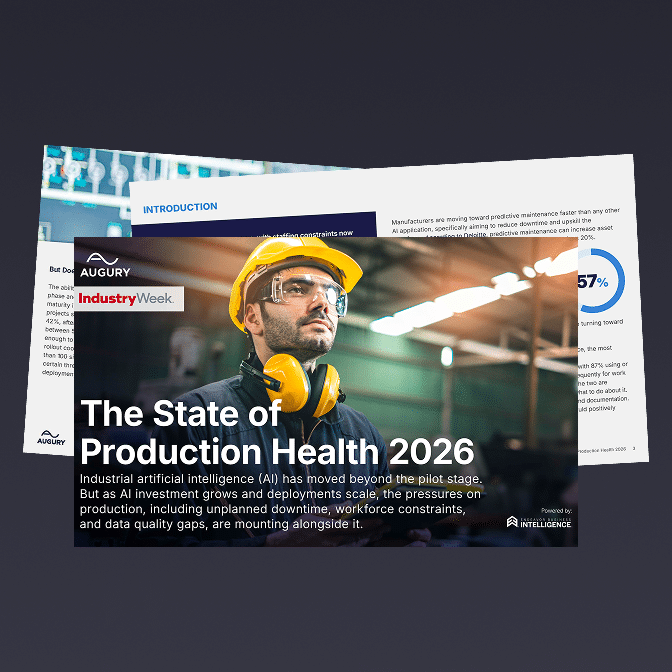
  • A man in a hard hat and safety glasses stands in a factory. Text reads: The State of Production Health 2026. In the background, a report page with charts and statistics is visible.

    The pilot phase is over.

    A year ago, 14% of manufacturers had scaled AI across more than half their sites. Today, that number is 42%. The question for 2026 isn’t whether industrial AI works. It’s about whether your organization is moving fast enough to stay competitive with those already running it at scale.
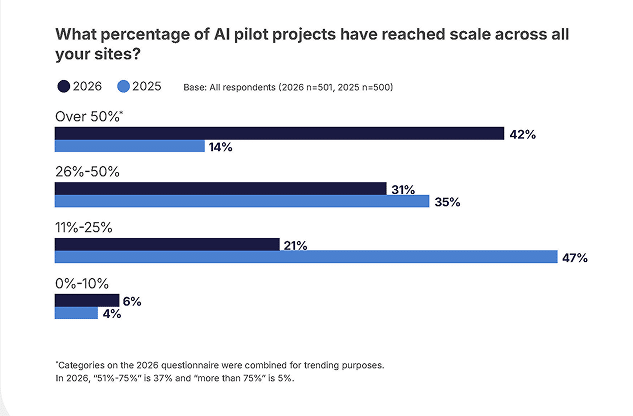
    Bar chart showing the percentage of AI pilot projects reaching scale across sites in 2025 and 2026. In 2026: 42% over 50%, 31% at 26-50%, 21% at 11-25%, 4% at 0-10%. In 2025: 14%, 35%, 47%, and 4%, respectively.