
Products and their manufacturing processes are only becoming more complicated. Hence, collaboration has become more important for sharing risks, costs and specialty skills. Now as more governments smell the long-term gains to be made in innovation, they are investing in evermore hubs for startups and corporates to work together. But is it really a fair trade-off? Read all about it!
Imagine: you’ve come up with a sensor that scavenges its own power, or a solar panel that generates electricity at night. Such paradigm-shifting products can change the world. But it’s also very possible that the dream gets smashed – like Google Glass.
So, what do you do? You bring in collaborators to share in the pleasure and/or pain.
Healthcare is already one sector where innovations are achieved by the coming together of a whole rainbow of disparate players – academia, big pharma, startups, care facilities, government bodies, etcetera. This only makes sense. A single medicine can take 10 years and a couple of billion dollars before it actually starts helping people. And now such trajectories are becoming more common across many industries.
Go For It: Save The World
For instance, one chemicals company took a decade to go from being an academic spin-off to manufacturing and first sales, according to ‘We Commercialized A Methane Capture Technology In Ten Years — Here’s How’.
“That sounds like a long time, but it’s actually fast. In our field of industrial chemistry, it often takes up to 20 years to get a product out of the lab and on to the market,” says one of the founders. “Most prototypes fail at the first hurdle – getting industry backing. Patents last for only 20 years, making it a race against time.”
And yes: “Beyond an exciting product, it needs time, money, business management and collaboration across many sectors.” And if your innovation has international potential, you should try to pull in international partners. “These open up funding channels, areas of expertise and markets. Conferences and exhibitions are good places to connect.”
“Finally, find collaborators wherever conditions are most favourable. For example, we benefited from working with partners in Australia for IP generation, a German manufacturer who supplied specialized raw materials, and gas companies in China for processing and commercial demonstration.”
They have one final piece of advice: Just go for it! Especially if you foresee making positive real-world impact. In this case: “Methane accounts for 16-20% of global greenhouse-gas emissions, and is more potent at trapping heat in the atmosphere than carbon dioxide.”
See The Light. Share The Vision
“Faster, lighter, more durable, and, at the end of the day, also much cheaper: the benefits of photonic circuits are considerable, for a wide range of applications. And the Netherlands plays an important role, globally, in the development and application of this key technology,” according to ‘Shared Innovation Is An Essential Condition In The World Of Photonics’.
“The development of new technologies is so complex and expensive that companies cannot do it alone. What’s more, the necessary knowledge is often spread across research institutes and companies. It is part of the strength of the Netherlands to collectively enable developments which we would not get done individually.”
And startups are often a smart choice as collaborator. They’re also easily dispensible: “If something doesn’t work, we pull the plug.”
Corporates And Startups: Is It Really A Match Made In Heaven?
Today “co-innovation” hubs are popping up like so many pimples on an adolescent boy. Governments are indeed stepping up to make long-term investments for the greater good down the road (and the potentially dizzying ROI).
It’s certainly working for Singapore: ‘How Co-Innovation Is Driving Industrial Transformation in Singapore’s Manufacturing Sector’. (And yes, this article is an advertorial but a rather informative one.)
“The success of the partnership speaks to the power of open innovation, with a large corporate combining its own industry expertise and scale with the skills and innovation that a start-up partner can bring to the table. […] “It is an ecosystem that promises to benefit both sides hugely, enabling start-ups to grow at pace through tackling real-world issues at scale, and multinationals to tap into an incredible and ever-growing pool of cutting-edge innovation and talent.”
But the process is not all sunshine. “Both parties need to understand the tedious process of having multiple iterations to reach consensus on the right functionality.”
Step Up. Or Lose Opportunity
Almost three-quarters of manufacturing leaders in the UK say collaborating with startups is part of their long-term strategy to stimulate innovation. However, many are not making it a priority over the next year, according to ‘How Manufacturers Are Turbo Charging Innovation Through Start-Ups’.
Many see this as a risk-adverse – and short-sighted – response to COVID-19. And in actual fact, “manufacturers can insulate themselves from it by managing projects closely and working in collaboration with suppliers to help define scope and detailing project milestones. The risk/reward is heavily in favour of using start-ups who normally revolve around a committed team who work hard and are keen to succeed.”
After all: “Nobody excels by doing the same as everyone else.”
Read: ‘Manufacturing – The News: The Rise Of Radical Modularity’.
The second episode of ChangeOver – the home to the Machine Health Movement – deep dives into the state of Career Health. Expert guests include a legendary former VP of Manufacturing, his sons following in his footsteps, a MIT social scientist and the ‘Manufacturing Millennial’. Together, they chart out how current technologies not only improve operations but also work to create meaningful and lucrative career opportunities.
Manufacturing As Attractive Career Choice
Today, manufacturers face dual questions:
1) How can we fight the perfect storm of worker and skills shortages?
2) How can we inspire young people to join the manufacturing workforce – and make them as adept with a tablet as with a toolbox?
The answer for both is technology, according to ChangeOver host Jason Silva of National Geographic’s ‘Brain Games!’ fame.
“Technologies like machine health, AI and IIoT give frontline workers higher value and more interesting work, while supplementing overstretched and under-skilled teams and improving the quality of life on the factory floor,” says Jason. “New tech also allows manufacturing workers to gain digital skills that open up entirely new career paths. In other words, machine health really is career health.”
And such digital transformations are proving effective: “A recent survey of Gen Z manufacturing workers showed that 92% were satisfied with their jobs, and said those jobs pay well and have a strong technology focus.”
Watch the full episode on-demand now!
Home of The Machine Health Movement
The second episode of ChangeOver took place on 3 March 2022 with the title ‘Boots on the Ground, Heads in the Cloud: High-Tech Manufacturing Workforce’. While the first edition was a general overview on how machine health contributes to improving careers, businesses and supply chains, this 35-minute episode focuses on the current challenges related to the manufacturing workforce.
Industry legend Eduardo (Ed) Ballina and his two sons who followed in his footsteps are on hand to share their insights, along with MIT social scientist Ben Armstrong and ‘The Manufacturing Millennial’ Jake Hall. They all agree: with the right technologies backed by the right training, the future of manufacturing looks bright – for both manufacturers and workers.
A huge shout-out for all the folks that work in supply chain. They really are the heroes.
The Flying Ballina Family
It’s educational and entertaining to witness former PepsiCo VP for Manufacturing and Warehousing Ed Ballina talk shop with his two sons Eddie and David. In fact, they deserve their own reality show.
The two brothers followed their dad into manufacturing but only after taking their own circuitous routes – routes that were obviously not stress-free for their parents. “Actually, I think I committed an injustice,” says Ed, “pushing the idea that to be successful, you have to go to college, get a degree and run up mountains of debt.”

In the end, while many young people are lured by the simpler work and similar starting pay offered by the Amazons and Walmarts, the brothers were attracted to the challenges and salary potential of manufacturing. “At the end of the tunnel, you can make six figures a year as a mechanic in aviation. But yes, the startup is a little rough,” says Eddie.
Today, all three Ballinas are champions of machine health, with Ed bringing in the historical perspective. “I remember following around this guy, Bob Bauer. He would grab a broomstick and put one end on the bearing block and the other against his muffs. I realized he was using it as a stethoscope! It was vibration analysis, but the old-fashioned way. Now fast forward to today, we have sensors that can pick that information up, along with a lot of other info, and with a much higher degree of accuracy,” says Ed. “And now with all these Bob Bauers retiring, machine health is only going to be more important.”
The Ballina Family panel concludes with “a huge shout-out for all the folks that work in supply chain. They really are the heroes,” says Ed. “They work long hours with a lot of stress to get products on the shelves day-in-day-out. And they can’t Zoom it in.” The sons agree vigorously.
Getting Creative With Training and Upskilling
Ben Armstrong is a research scientist and interim executive director at MIT’s Industrial Performance Center, where he examines how manufacturing workers, firms and regions adapt to technological change.
Ben notes how manufacturing wages have not adjusted to inflation since the 1980s – and this is the main reason why the industry is largely “no longer upwardly mobile, stable, a path to the middle class”. He believes investment into new technologies, backed by the proper training, as the way to reestablish this upward mobility – while also working to replenish the workforce.
You can learn while you earn.
Traditionally, manufacturers have tried to minimize training their workers out of fear they’d be poached by competitors. However, Ben points to new forms of apprenticeships that may offer a workaround. For instance, the Alliance For Working Together in Ohio brings together mostly SMEs to share expertise and learning sessions to cut investment costs. It also stops poachers since “it essentially leads to them being ostracized from this community of manufacturers,” says Ben.
Ben also sees a lot of potential in Manufacturing USA, which links innovation institutes across the country. “It builds on American strengths,” says Ben. “Because it tries to mix the US competitiveness in R&D with manufacturing.”
The Light At The End Of The Tunnel: Manufacturing
“There is a lot of opportunity in manufacturing,” says Jake Hall – aka ‘The Manufacturing Millennial’ – during his rallying-cry conclusion. “You can learn while you earn. Meanwhile, manufacturers need to better communicate their purpose. No longer is it just this dark, dirty, dangerous and dull environment. The industry is in fact full of opportunity.”
The above article only touches on a few of the many offered insights during this edition of ChangeOver. So watch the full 35-minute episode on-demand.
And please follow ChangeOver where we will continue to chart out the Machine Health Movement.
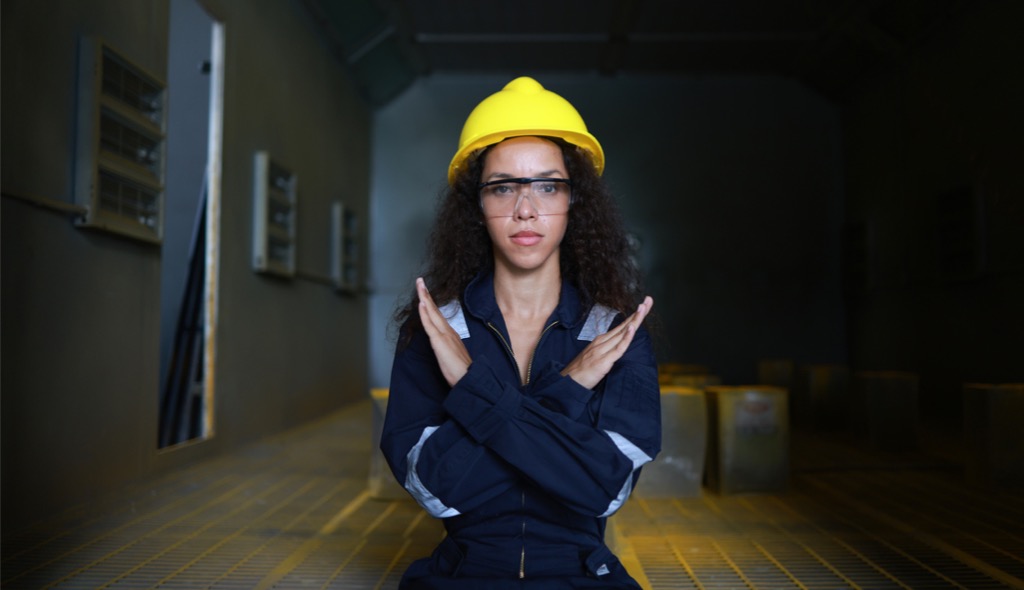
To help celebrate International Women’s Day 2022, we at Augury have brought together some inspirational quotations from women working in manufacturing. Now, let’s all work together and ‘Break The Bias’.
The theme for this year’s International Women’s Day on 8 March 2022 is particularly apt for the manufacturing industry: #BreakTheBias.
As the organization formulates it: “Imagine a gender equal world. A world free of bias, stereotypes and discrimination. A world that’s diverse, equitable, and inclusive. A world where difference is valued and celebrated. Together we can forge women’s equality. Collectively we can all celebrate women’s achievement. Raise awareness against bias. Take action for equality.”
We’ll stand behind that! Over the last months we’ve profiled a whole range of different women who work in maintenance and reliability at Augury and beyond. Here are some of their insights…
Follow Your Passion
“It was amazing: seeing the impact of what I was doing. I was part of helping make someone’s life better by providing a product that went to maintaining their home. I was hooked.” – Amanda Reineck, Operations Manager at US’s largest roofing manufacturer GAF.
“We came in and fixed it and made a huge difference for production. It was high stakes and showed the impact our department can have.” – Shelby Gagliardi, Maintenance Engineer at GAF.
“When they see me, they don’t expect it. Some think it’s a bit odd. But for me, it’s my passion. And it doesn’t take long for people to see that passion, and the effort that I put into my work.” – Corinne Nielsen, a Reliability Success Manager at Augury.
“In a way, I see the wireless condition monitoring of industrial or manufacturing machines as a similar job as that of a doctor. We’re listening like they do with a stethoscope – but continuously. We’re constantly scanning for any kind of change. If something abnormal comes up, we review, evaluate and inform the customer. While a doctor might recommend vitamins or more bloodwork, we might suggest adding oil, tightening a bolt or replacing a part to help extend the life of the asset or prevent an unexpected failure.” – Elise Morse, a Vibration Analyst at Augury
Stay Focused
“Here, I’m treated with the same respect as my male colleagues. But I would say when you first start in your career in a male-dominated industry, it’s just naturally intimidating, because you’re working with people that maybe have a different mindset or background. But if you work for the right company that really values diversity and gender inclusion, then your experience at work can be extremely rewarding.” – Amanda
“If anyone is interested in Maintenance & Reliability, I just say ‘Do it!’ Because, unlike other fields, you’ll always be learning new things. And there are so many different options and avenues to specialize in.” – Corinne
“I just put my nose to the grindstone and decided: this is what I enjoy doing so I am going to do it. But I’ve been in situations where I’ve been laughed at in my face. That’s when you have to just be professional, ignore it and say ‘show me your asset’ and get to work. It’s the only way you can rise above it all. You can’t let them slow you down.” – Elise
Share The Love
“During my first co-op and job experiences, there was always a female I could kind of lean on and bounce stuff off, which made it a lot less scary. You can watch how they handle themselves. So, I think it’s important to seek out these kinds of mentors.” – Shelby
“I think it’s these past experiences that explain why I would love to be mentoring more folks in the future – especially those new to the industry. I was lucky to find one mentor along the way: a very smart and technical man who answered my questions and shared his 20-plus years of experience. I could just keep asking him questions – it was invaluable.” – Elise
“I think communication is a big aspect for this. You need to get the word out: to let women know, especially in colleges, what opportunities are out there. We need more of these conversations.” – Shelby
“The more that you can encourage diversity and women in leadership, the better. The more variety and perspectives, the better – from the top to the bottom. I think it just helps spawn creativity.” – Amanda
Read the full profiles:
‘Corinne Nielsen, Reliability Success Manager at Augury’
‘Elise Morse, Vibration Analyst at Augury’
‘Operations Manager Amanda Reineck and Maintenance Engineer Shelby Gagliardi From GAF’
‘Women in Engineering Day: A Tribute to Heroes’
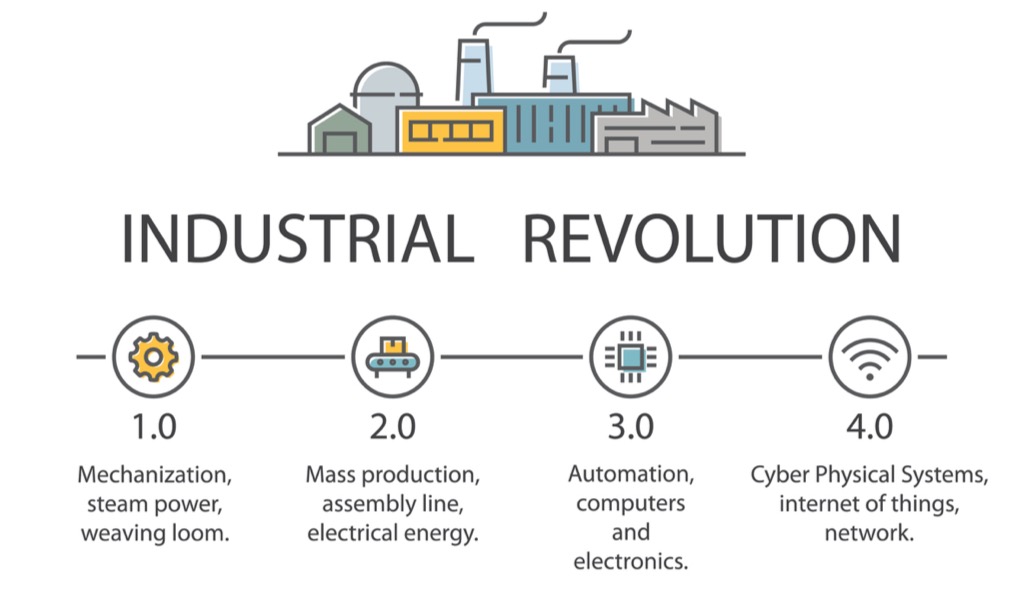
From an early case of industrial espionage, to a 1920s robot visionary, through to Machine Health… We chart the fascinating history of manufacturing and the lessons we learn from its successive revolutions.
Industry 1.0: Taking Manual Out Of Labor
The first industrial revolution allowed goods to be made by machines instead of manual labor. Also referred to as ‘Industry 1.0’, it’s often described as originating in England around 1760 and being largely coal-powered. However, if we excavate further, we actually find older stories – ones perhaps more relevant for our present challenges.
Beacons of Sustainability and Collaboration
For instance, the plucky Dutch in their battle against the sea had been using windmills since the 1400s to create land from bog. One game-changer arrived in 1593 when Cornelis Corneliszoon van Uitgeest patented a crankshaft that converted the horizontal power of wind into a vertical sawing motion. As a result, his saw mill could now convert logs into planks 30 times faster than previously. By the 1600s, the Netherlands had over 10,000 windmills, many of which had diversified to embrace a whole range of mechanized chores – from grinding flours and pigments, to making paper and fibers.
Over time, business flourished particularly along just 11 kilometers of the river Zaan near Amsterdam, where by the 18th century over 900 windmills were pumping out a whole rainbow of different products. Now Zaanse Schaans is recognized as the oldest industrial area in Western Europe, and was paramount in helping jumpstart Holland’s Golden Age.
While the early Dutch entrepreneurs were known to be fiercely independent, they were also deeply collaborative. This trait had likely evolved from having a shared enemy in the sea. Not only uniting to keep the waters at bay, they were also known to freely share mutually-beneficial innovations, as well as share risk through windmill fire insurance.
A Very Early Case Of Industrial Espionage
Meanwhile in Italy, textile innovators had ensured that water power was being used for spinning since the early 15th century. It was only in 1716, that an Englishman called John Lombe visited Piedmont and sneaked into a workshop to sketch and steal the technology to start his own mill back in Derby.
But while inspiring England with “his” invention, Lombe met a very early death. It’s said he was poisoned by a female assassin paid by Italian competitors. (Is there a moral to this story?)
Finally… The English Make Their Contribution
But yes, we must give credit where credit is due. The British did revolutionize cotton spinning and turned it into a volume industry. In 1769, Mr. Richard Arkwright patented the spinning frame for cotton and soon built the world’s first water-powered mill.
Arkwright is regarded as the “father of the modern industrial factory system”. He iterated endlessly while chasing the most efficient processes. Along the way, he built the first factory housing development to put up the extra workers he needed to scale his efforts. He also formulated the two 13-hour shift work day. And he cut corners in less elegant ways: two-thirds of his workers were children.
(There are definitely many lessons in this story.)
Letting Off Steam
Another major English power play was the invention of the first truly effective steam engine by James Watt. Patented in 1775, it soon powered ships, locomotives and machinery. Factories no longer had to be located near water or wind. With steam, they could be anywhere…
But yes, not everyone was happy. By the 1800s, the incomes of weavers were halved while the cost of living skyrocketed. When the negotiations between factory owners and a group of frustrated workers called Luddites fell apart, mechanized looms and spinning machines were destroyed. Troops were sent to crush the uprising. There were no winners.
The establishment of the telegraph and railway meant that ideas and people could scurry around much faster.
The Vroom-Vroom Of Industry 2.0: Electrifying Growth
The Second Industrial Revolution – aka the Technological Revolution – took place between 1871 and 1914. The establishment of the telegraph and railway meant that ideas and people could scurry around much faster. Electricity meant factories could embrace the modern production lines, with the automotive industry being pioneers.
In 1901, Ransom E. Olds, patented the first stationary production line – boosting his production from 425 to 2,500 cars within a year. Henry Ford went on to append this system with moving platforms and a conveyor system – so the cars came to the workers instead of the other way around. By 1926, Buick took it a further step with the Unified Assembly Line – pumping out 1,300 cars a day.
Things were booming: productivity, economies, unemployment.
Industry 3.0: Lean, Mean, Digital Machines
Also known as the Digital Revolution, the Third Industrial Revolution began in the second half of the 20th Century with the application of computer technologies. The innovation cycle accelerated as computers became more powerful – and, later, as internet speed and mobile connectivity increased. New processes had to be embraced, and endlessly fine-tuned, to deal with all these changes.
From Toyoda Looms to Toyota Cars
Leading the way was Toyota’s development of “Lean Manufacturing” (aka the Toyota Total Production System). While now largely known as an automotive company, it was originally more known for automatic textile looms. Its founder Sakichi Toyoda invented the concept of jidoka (automation with a human touch) by incorporating a device on the looms that would halt the loom whenever a thread broke – boosting quality while decreasing the need for quality control. Later, his son Kiichiro Toyoda would develop the concept of just-in-time (JIT) manufacturing to eliminate the need for excess inventory.
As the key elements of lean manufacturing, jidoka and JIT meant that by the 1970s Toyota had halved the man-hours needed to build a car. People noticed and developed their own lean approaches and applied them to other industries – from electronics to healthcare to construction.
In time to come the only work to be done by men and women will be that which requires faculties of discernment, discretion, and judgement. All other work – anything repetitive, routine, standardized – can better be done by machines.
I, Robot
Meanwhile in the endless drive to increase efficiency, automation and robotics developed in tandem. In 1926, R.J. Wensley had already invented a robot called Televox that could obey a human voice. Wensley also had a vision: “In time to come the only work to be done by men and women will be that which requires faculties of discernment, discretion, and judgement. All other work – anything repetitive, routine, standardized – can better be done by machines.”
In the 1940s, the first numerical control (NC) machine was developed by another visionary, John Parsons, by which a computer could automatically control machining tools such as drills, lathes, mills and (much later) 3D printers. Parson’s ultimate proof of concept came in 1948 when his company was awarded a military contract to make tapered wings for an aircraft. His system could not only formulate the complex 3D structure of the wings but also the required 800 manufacturing steps. However, due to the initial costs of the NC machines, Parsons was fired from his own company and only rehired when the patent royalties started rolling in. Sound familiar?
Meanwhile, progress marched on. By the 1980s General Motors tried to fully automate car factories. But despite $90 billion dollars over 10 years, the company could not be as efficient as its Japanese rivals. Critics said it was a case of too fast, too soon. And while the robots were indeed efficient, the old system on which they were grafted was not. An important lesson was learnt: know your problem before you set out to solve it.
It’s time to fully embrace the Imagination Age. Creativity is now the real driver of economic growth.
Industry 4.0: Welcome To The Future (Now)
Some argue that Industry 4.0 is just an extension of 3.0, and it certainly builds on the past just as with previous phases. But in terms of speed, scope and societal impact, the coming together of current innovations is worthy of its own revolution. And with our current challenges in terms of COVID and climate, the stakes are much higher.
Cloud computing, AI and IoT technologies are now being leveraged in a way that will enable manufacturers to fully digitally transform themselves in the short-term – maximizing production, while minimizing monetary and environmental costs.
At Augury, we believe the Information Age is behind us, and it’s time to fully embrace the Imagination Age. Creativity is now the real driver of economic growth. However, we won’t get far if we forget the lessons from the past. In short, we must follow a vision and push ourselves to respectfully collaborate and iterate on every step of the journey.
Reach out if you believe your manufacturing operation is in need of some Machine Health revolution.
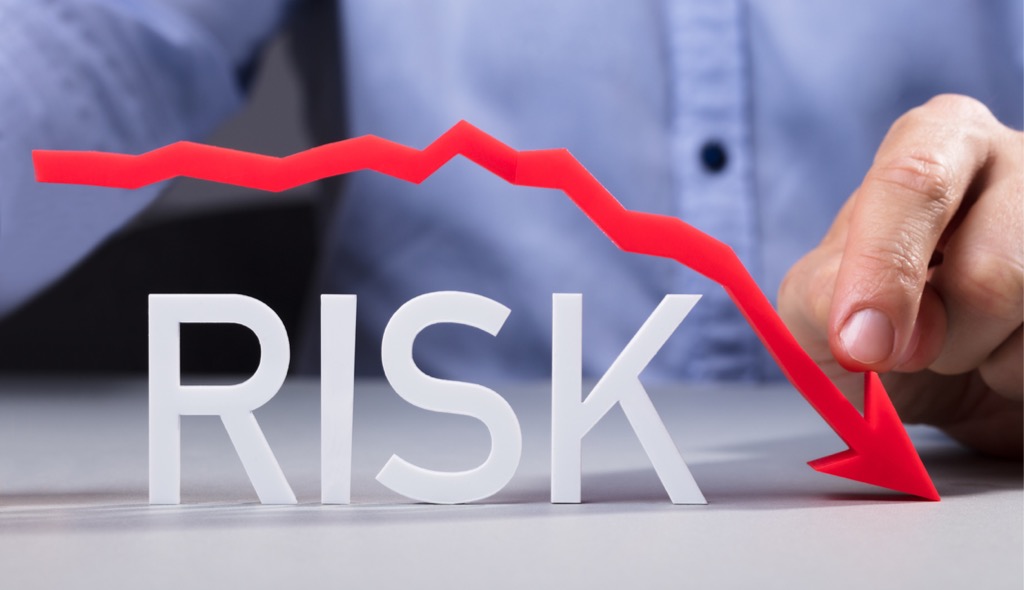
Everyone loves the idea of guarantees for reducing risk. But with every type of guarantee having its pros and cons, how do you decide which one you really need? Here, we give a rundown of the main differences between guaranteeing ROI and actual performance.
Across the AI-driven manufacturing marketplace, a clear theme is emerging: more and more people are talking about how they can reduce risk. Of course, this is where guarantees become interesting. However, there’s a whole spectrum of guarantees to choose from.
Satisfaction Guarantees Don’t Satisfy
As old as the first sales bargain, the money-back guarantee can certainly be an attractive option. In manufacturing, such guarantees are often translated into getting your money back if you don’t get your ROI within a certain timeframe. For people who don’t know what to do yet with a new technology, this concept feels very safe and could be very interesting to test the waters without losing your initial investment.
But if the goal is to actually impact business objectives, the “I can’t lose” proposition simply isn’t enough. These guarantees offer minimal risk — not reduced risk. If it does nothing, you end up with nothing. Manufacturing should be doing things that matter.
And then there’s a time frame involved. Say it’s only for a year. Will the guarantors bust their humps to make sure you get your ROI within that year, and then let you slide in the second year? And what about the conditions? Do you really know when and where that money-back guarantee applies?
With so many questions, trust becomes the deciding factor in buying into it.
If it does nothing, you end up with nothing. And that should not be our goal in manufacturing. We should be doing things that matter.
Production Guarantees Are Not Realistic
On the other end of the spectrum, you have production guarantees. It’s the ultimate statement of trustworthiness: We will pay for any losses you incur. But in general, these are unrealistic because almost no company can guarantee the production of a manufacturing facility – except perhaps the manufacturing facility itself.
A lot of people are still talking about production guarantees – it certainly represents a worthy ambition.
OEMs don’t control all the facets of your operations, including human behaviors. Likewise, technology providers can educate organizations on how and why their production lags or fails, but they can’t actually prevent production from failing. As things stand today, how would anyone ever prove who’s at fault when a production failure occurs in one of these complex and variable manufacturing facilities? And even if they could assign blame, they wouldn’t be able to get insurance for it, as the market capital required to back these types of guarantees at scale is just too far out of reach for the vast majority of organizations.
Yet, a lot of people are still talking about production guarantees – it certainly represents a worthy ambition. And at one point the world’s largest organizations, backed by a big capital base, might start offering these types of guarantees. But what can we get in the meantime?
Performance Guarantees As A Way To Share Risk
GE Aviation has an interesting OEM-backed solution with their TrueChoice™ Flight Hour program, which uses their long experience to charge you on how many hours your plane will fly – guaranteeing the flight hours. They don’t guarantee their stuff won’t break down, but you only pay when it works. That’s not the same thing as if your plane doesn’t fly, I’ll pay for all that money you lost. But it is well beyond the idea of “buy an engine, and I will monitor it for you.”
The flight hour program gives GE a real stake in the game of flight operations, since the more hours a plane flies, the more money GE makes. These “performance” guarantees are very interesting and lots of OEMs are looking at how they can be applied.
But for manufacturers even this type of guarantee is simply too limiting in many cases, as they have many older assets already in play that they own, and most OEMs aren’t going to “buy them back” at a price that makes sense. So, in reality, the extremes – the money-back versus the production guarantee – are probably either unnecessary or unrealistic. OEM backed performance guarantees come much closer, but may not work for many manufacturers.
So, what do you do instead?
The Middle Path Of Just Rightness?
At Augury, we offer the option for our customers to take advantage of our Guaranteed Diagnostics™ coverage. This means if a machine breaks down on our watch, you will be compensated for up to $100,000 per machine to repair or replace that asset – for the full life of that asset. This performance insurance coverage, backed by Munich RE, has a low premium per asset, but the value is substantial. As long as you pay your insurance premiums, you are actively mitigating risk – not just against asset failure, but actively reducing the risk of worker injury and lost production. And it doesn’t matter if it’s one year or ten years, you will stay covered.
Augury is now invested in your asset’s production, as it isn’t just the health of the asset at stake, Augury’s reputation is also on the line, both with the customer and with our insurance partner Munich RE.
By looping in a third party like Munich RE, we are also bringing in an increased sense of credibility to our services. People know that insurance companies do their research: that they are not out to lose money. This builds trust that we are indeed de-escalating your risk.
“People buy from people they trust.”
In fact, that sense of trust will still be there even if you decide not to pay the premium (although you obviously lose out on the guarantee). But you can take confidence in a provider who has the backing of an insurer who is confident enough to offer this kind of performance guarantee.
What Will Make Your Business Better?
In other words, Augury is minimizing risk by maximizing trust. And you know what they say: “People buy from people they trust.” And unlike most OEM-backed performance guarantees, our solution works on the assets you own now, so you don’t have to buy new assets to get into the program.
At the end of the day, guarantees are a measure of reducing risk. So, the question isn’t “Do I really need a guarantee?” Of course, you do. The real question is “Is this partner and their guarantee really going to help me make my business better?” Answer that, and you and your business win.
Do you want to learn more about Augury’s Guaranteed Diagnostics™ when it comes to Machine Health? Reach out!
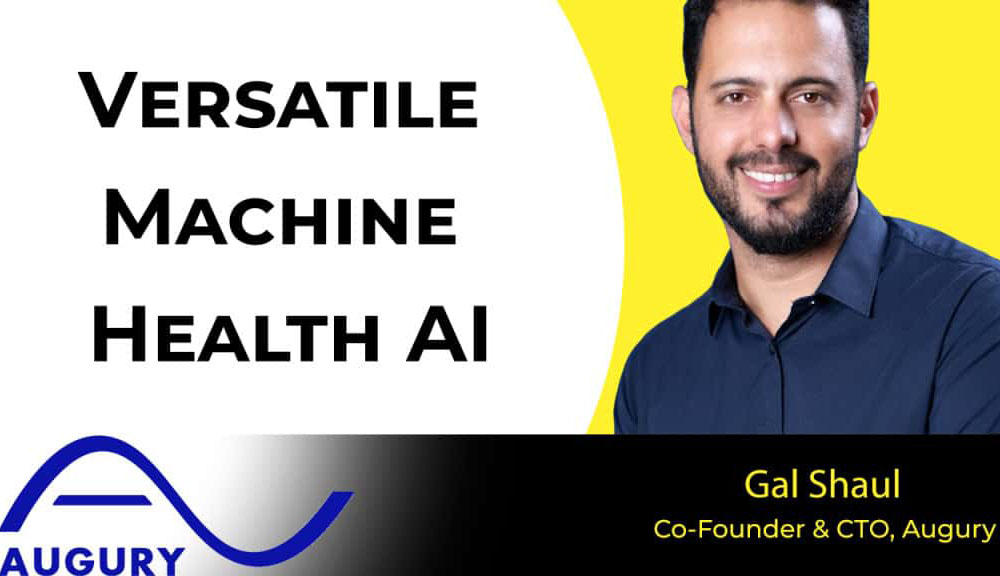
Under the title ‘Versatile Machine Health AI’, Modern CTO Podcast talks with Augury Co-Founder Gal Shaul about his tech roots, how machine health reduces unplanned downtime, and what it takes to accelerate innovation. Key takeaway: “Tech is for people by people to people.”
Keeping The Machines Running
Once upon a time, Gal Shaul was that kid taking apart his parents’ VCR to figure out how it worked – and then being unable to put it back together. While one can sympathize with his parents, these efforts did set him on a path. A few leaps later, he’s Co-Founder and Chief Technology Officer at a recently-minted unicorn as it undergoes aggressive growth.
While a youthful Gal left a trail of electronic debris behind him, his parents kept supporting him. In fact, he and CEO Saar Yoskovitz originally co-founded Augury ten years ago in a spare room of the parental house. Today, Augury’s state-of-the-art full-stack AI-driven solution can work to prevent 80% of unexpected downtime for manufacturers, while also functioning as a stepping stone for complete digital transformation.
The podcast #389 Gal Shaul, Co-Founder & CTO at Augury – ‘Versatile Machine Health AI’ features Gal and host Joel Beasley discussing COVID-19 accelerating years of innovation into the space of a few months, how to embrace new ways of thinking, and the best ways to inspire your team. The episode is currently nearing 100,000 listens. What follows are some of the essential quotes.
On The Roots Of Machine Health…
“Saar and I know each other for ages. We had been talking about startups for five years before we started Augury. Every class we took at university, we were talking about startups. We went to meetups, compared books, compared notes, and even decided on our first jobs based on what is the right path to start a company. We didn’t always agree but we always had it in mind.”
Finding That Hole In The Market…
“Saar was very interested in voice and sound in general, as well as machine learning. He felt there were missing opportunities between everything learned about image processing, and speech recognition – sound in itself wasn’t being as explored at that time. Something clicked. And a few months later, we quit everything else and started working on Augury.”
Fusing Machines With Humans…
“In the sense of our data science and AI, Augury is a very hybrid company. We use mathematical models and very modern AI. And on the other end, we bring people who are subject domain experts in machinery, coming in from predictive maintenance, who have been around these machines for years. And we try to marry these two elements. How do we tie together a very real understanding of machinery with AI?
Why Augury’s Time To ROI Is So Fast…
“If you make ‘X’ amount of product in an hour, and some of that product wasn’t produced, the direct cost is that you have less things that you can ship to market. Now with commodities, this means that someone will buy something else. People will simply buy another brand of toilet paper. The manufacturers missed their targets because they weren’t fast and efficient enough. On top of that, there are a lot of things that break. Would you prefer to tighten a bolt today, or replace an entire motor in two weeks?
How COVID-19 Accelerated Aggressive Growth
“When COVID hit, we had all our installations canceled in a day. We had to do our two-year plan in three months – to do everything completely differently. Today, this is our biggest advantage: we know what to do and how to do it fast. And we’re excited about being able to grow in three different dimensions at the same time. It’s an aggressive growth model where we grow geographically and go after new markets, while also going after new types of machines. It means we can really have this transformational impactful on manufacturing.”
The Abilities All Leaders Should Possess
“For me, leaders who can lead from behind can enable teams to flourish. And for that you need to be a good listener to actually understand what people meant and to be able to ask the right questions […] Inclusion is also very important. Sometimes leaders themselves, or the people who they like to work with, are people who are very open in conversation and would start speaking right away and feel confident. This doesn’t mean that they’re the smartest or it’s the right solution. It’s just the one that caught the mic first. And I think being able to get everyone in the room to a comfortable position where they can share and think together is really important.”
The Importance Of Nurturing Chaos For Creativity
“We don’t want to lose those water fountain moments when people from different teams are talking and something clicks. Those are the moments we care about. And those are the reasons startups exist. It’s this chaos that creates innovation that can go missing in larger organizations. And you want to keep that and not only worry about effectiveness, efficiency or any of the other metrics that are generally measured.”
For People, By People, To People…
“I think that sometimes as CTOs, or tech people in general, we sometimes fall in love with technology speaking to other technologies, and keeping humans out of the loop. I want to remind all of us that all these transformations are for people, by people, to people. It’s very important to Include people. This can’t be overstated.”
Listen to the full Modern CTO podcast #389 Gal Shaul, Co-Founder & CTO at Augury – ‘Versatile Machine Health AI’.
Captain Kirk lectures Prince William on space manufacturing … First space factory about to blast off … Can your IoT sensors hear you scream in outer space? … Here’s a round-up of some of the manufacturing-related press from the last month that caught Augury’s collective eye – and why it mattered.
With the world continuing to battle supply chain and climate issues, we decided to direct our eyes skywards in search of manufacturing-related news. It proved rich pickings.
To The Stars
Just as Augury made headlines as it became one of the first Industry 4.0’s unicorns by being valued at over $1 billion dollars, Tesla tried to steal our thunder by being valued at over $1 trillion dollars. It’s okay Elon, we won’t take it personally.
In fact, our eyes were more attracted to other Musk-related headlines, such as ‘Elon Musk Wants Tesla To Build Cars On Another Planet Before He’s Dead’ and ‘How SpaceX Will Blast The First Space Factory Into Orbit’.
According to the latter article: “A space research company called Varda Space wants to become the first to build a manufacturing facility in space […] According to TechCrunch, this kind of in-space facility could, for example, manufacture bio-printed organs or specialist semiconductors.”
Unfortunately, no mention is made on how they plan to return any products to Earth – which suggests a huge kink in the supply chain.
To Boldly Go Where No Man(ufacturing) Has Gone Before
‘William Shatner Says Prince William Is “Missing The Point” Of Space Tourism’.
“He’s a lovely, gentle, educated man, but he’s got the wrong idea,” said Shatner who played Captain Kirk in the original Star Trek series. The 90-year-old actor had just returned from his 10-minute rocket ride as a guest of Amazon founder Jeff Bezos.
Shatner was responding to the prince’s observation: “We need some of the world’s greatest brains and minds fixed on trying to repair this planet, not trying to find the next place to go and live.”
“The idea here is not to go, ‘Yeah, look at me. I’m in space’,” Shatner added, before claiming that such trips are a “baby step” towards “relocating polluting industries to space”.
Later during an interview with CNN, Shatner seemed to contradict himself: “From our point of view, space is filled with mystery … but in that moment, it is blackness and death. In this moment down here, as we look down, [Earth] is life and nurturing. That’s what everybody needs to know.”
Industry 4.0 Meets Space 4.0
Shatner has not gone completely space loopy, however. Manufacturing in space has been an area of experimentation ever since Russian cosmonauts did the first welding tests during the Soyuz 6 mission in 1969, according to Wikipedia.
In fact, the US Space Studies Institute has been hosting a Space Manufacturing Conference since 1977. And in March 2022, ESA and NASA are collaborating to host a major international conference on Advanced Manufacturing – bringing together Industry 4.0 with Space 4.0.
“Today, smart and advanced manufacturing technologies including 3D printing, virtual testing, big data-driven and quality control processes are altering the manufacturing supply chain, progressively increasing customer value and supply chain efficiency.”
And it’s thought these technologies can be nicely applied to outer space.
“In recent years, manufacturing in space has gone from sci-fi to reality. The microgravity conditions and near perfect vacuum in space have made it possible to produce materials and components whose properties simply cannot be replicated on Earth,” according to ‘Manufacturing In Space: A Giant Leap For Robots’.
“Not only is it becoming easier to undertake experiments in space, thanks to the increasing use of robotics in space and more satellite launches, but there is also an increased demand for repair and maintenance services.”
Cosmic Supply Chains
Meanwhile, Europe is out to explore “the development of a sustainable manufacturing chain in space,” according to ‘European Space Agency To Test Incus Metal 3D Printing Tech In Micro-Gravity Environment’.
“Since long-term missions need to be self-sufficient, there is great interest in the potential of 3D printing to supply research materials and spare parts on board and on demand to reduce costs and the volume of cargo missions from Earth. LMM is said to be able to produce spare parts from recycled material waste.”
Back Down To Earth
As for Augury’s own space ambitions, we’re always open to stellar opportunities. But for now, we’ll stick to our current mission: supporting the machines that matter most. And right now, these machines are still all Earth-bound.
Read ‘Manufacturing – The News // Is This The Manufacturing Metaverse’s Big Bang Moment?’
Tune in next month more ‘Manufacturing – The News, On Climate Chains and Supply Change.
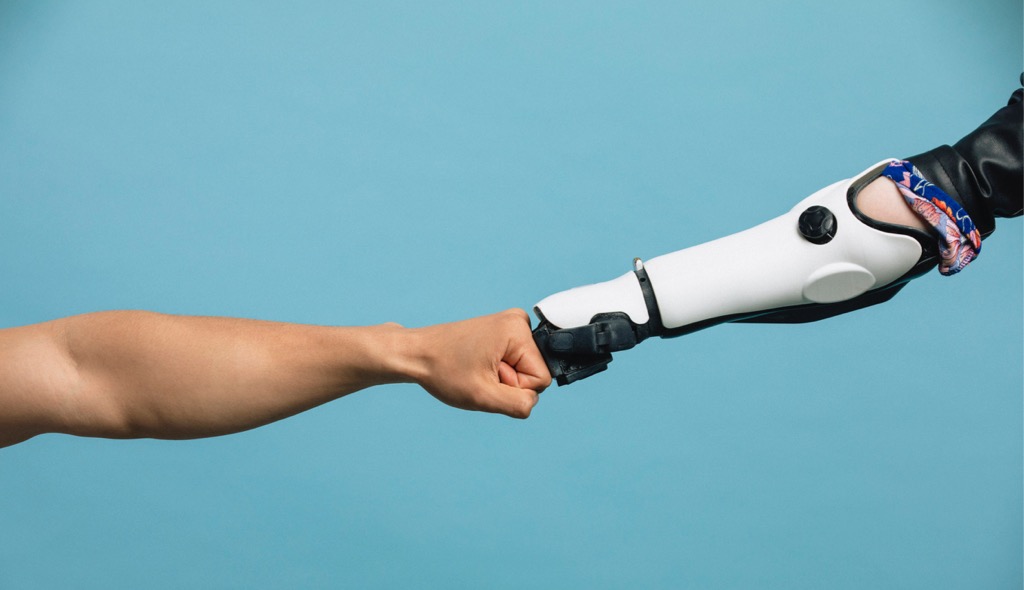
AI has made its dramatic entrance into the manufacturing environment, and the introduction of new automation and technology has exposed some clear skills gaps — particularly in how AI can inform accurate and efficient decision-making. For the future of manufacturing to incorporate skilled workers and AI-enabled tools, manufacturers must address these gaps now.
What New Skills Does AI in Manufacturing Demand?
AI holds great potential for the manufacturing industry. Along with easing processes in the flow of supply chains, inventory management, and record-keeping, it can also help analyze machine data to diagnose issues and offer predictive insights about the future health of machines.
Learn more about Augury’s AI platform.
The real value of AI in manufacturing is that it frees up technicians’ and managers’ time to focus on higher-value, strategic tasks. To realize that potential, however, human workers must understand how to work with AI. End users must collaborate with AI tools and developers to create use cases that aid real decision-making processes.
Sometimes, teaching AI will be easy and won’t require advanced manufacturing skills. For example, if you need to train AI to tell the difference between a box and a bag, any human can verify the correct distinction. In such simple instances, manufacturers don’t need to develop special skills to help improve AI.
The real value of AI in manufacturing is that it frees up technicians’ and managers’ time to focus on higher-value, strategic tasks.
However, AI also has the potential for more complex use cases and opportunities to enhance productivity. In manufacturing, for example, machine health sensors can derive vibration analysis data from machines. AI algorithms can then analyze that data to uncover potential issues with the machine’s health, but only if someone with the right expertise tells it how.
A vibration analyst would need to take a deeper look at the data and verify the results from AI. Iterating this process trains AI to recognize more complicated use cases and draw correct insights from the vibration analysis data.
Learn more about AI-driven vibration analysis.
Teaching AI is one of the most important skills manufacturers will need to develop to reach AI’s full potential. Technicians must understand that repeatedly performing, verifying, and documenting actions in the correct ways helps improve AI tools. The process isn’t just good for record-keeping — it teaches AI to create more accurate diagnostic results and predictive insights.
Advanced Manufacturing Skills Lead to Overall Transformation
The future of manufacturing involves both human innovation and machine learning. While AI is getting up to speed with the needs of the manufacturing industry, human manufacturing experts need to take responsibility for training it and predicting how it will be most useful in the future.
The job profile is now based on the desire to evolve and do more sophisticated knowledge work.
With the introduction of AI into the manufacturing environment, the scope and nature of work have become more diverse and advanced. The pool of people manufacturing companies can attract to work for them becomes a lot wider. The job profile is now based on the desire to evolve and do more sophisticated knowledge work.
It’s no longer a static industry. By equipping teams with the right skills to help AI reach its fullest potential, you can create opportunities for more dynamic roles that will rapidly transform your organization and help it stay relevant and thriving well into the future of manufacturing.
To learn more about how Augury’s machine health solutions can boost your business, get in touch today.

To celebrate World Manufacturing Day 2021 on 1 October, Augury reached out to market research analyst Dan Miklovic to give a state-of-the-industry review. While many people use the word innovation loosely, Dan has been a cheerleader for transformation in manufacturing for over half a century. So, what do we need to focus on in-the-now to build a more resilient and future-proof industry?
“It’s true, my birthday is the first of October: World Manufacturing Day. I wish I could say it wasn’t a coincidence but it is,” chuckles Dan Miklovic.
As Dan looks back at 50 years of vast and varied experience, both hands-on and as an analyst, he maintains a passion for the industry. He has certainly seen it all: from the birth of automation, to maintaining nuclear weapons while in the military (“those weapons really have their own unique maintenance challenges because you can’t really test drive them”), to the drive to digitization, to the volatility of the last 18 months…
As the founder of Lean Manufacturing Research, a VP at Gartner, a TV co-host for World Business Review, or as member of Augury’s Advisory Board, he consistently pushes for the deployment of technology to drive the maintenance and operational excellence of production assets. As Dan often says: “We can’t neglect this. We need to get this right.”
How do you describe your job as a market research analyst to your grandchildren or a clueless journalist?
Basically, my job is to provide a rational sanity check on how players in the industrial and manufacturing sectors can use technology to improve their business. I’m not a consultant – I don’t come in and dive deep or whatever. Rather I serve as a sounding board for questions like “Hey, does this make sense?” or “Should I be considering this?” or “Is there something I am missing here?” It’s more an insurance policy for knowledge around applying technology to solve business problems.
It’s more about questioning if you are drinking too much of your own Kool-Aid.
I serve a similar sanity-checking role for suppliers in those sectors. But then it’s more about questioning if you are drinking too much of your own Kool-Aid. Are you putting out marketing messages that are way overhyped? Or won’t play well with the audience? Or don’t match what the market is looking for right now? So again, I’m not there to say ‘do this’ or ‘don’t do that’. I’m more there to stop you from making really stupid mistakes.
And what do you see as the single stupidest mistake the industry is generally making as a whole?
I’m really disappointed in how the manufacturing sector has not caught up with the consumer sector in the way it applies technology – and that’s one of the reasons why I think Augury is different. Ten years ago, if you wanted to automate your house, you had to be an electrical engineer or a real technical geek – you had to do it all yourself from scratch. Today, I can buy a smart-everything and it’s all plug-and-play and I have multiple choices from Amazon, Google, Apple or whoever. Just the other day I just put a simple system in my garage: Amazon can now open it, put in a package and close it. Simple.
Meanwhile, manufacturers need to hire in a whole army of specialists to use technology that’s already proven to work! It boggles my mind that if a manufacturer wants to get an AI system, they need data scientists to program it, electronic technicians to wire it all up, reliability engineers to figure out what all the data scientists should be looking for, and then someone with at least an associate’s degree to maintain it! Meanwhile I don’t need any kind of university degree to download Maps to my phone…
So let me summarize the situation: THIS! IS! INSANE!
Is this lack of plug-and-play smart tech for manufacturing the reason why the industry is failing us now?
Yes, that’s a big part. And Covid just highlighted how disastrous this whole approach of relying too much on people being hands-on, instead of applying smart technology to help. And certainly, with the labor shortage, we simply can’t continue down this path.
What surprised you most in the last 50 years? What did you not see coming?
How recently the steady state model broke so quickly and the industry became so volatile. Traditional automated manufacturing has always been a very steady state business that always operated around the idea: if it ain’t broke, don’t fix it. And you know the whole Pareto principle 80% of your problems come from 20% of your issues. In other words, once you get something moving in a steady state, it tends to run really well. And it’s easy to keep optimum production. It’s only when you start and stop things, whether it’s planned or unplanned, you end up with issues around quality, volume, costs, energy consumption and everything.
And so now the skill you need is agility, which is really different. And it’s not something manufacturers in general have been very good at…
And what I didn’t really expect to see was the volatility that we’ve seen in the last two or three years. I mean, it’s the combination of COVID and the rapid rise of China as a leader on the technology side – an area that has always been more Western-based. And now the switch has been flipped from something where steady state was desirable, to having to deal with rapid fluctuation.
In the past, the key to success was always your ability to keep things running smoothly. Even today, it’s a nice idea but an unreal expectation. So now the skill you need is agility, which is really different. And it’s not something manufacturers in general have been very good at…
Okay we see this volatility with the shortage in semiconductors – and all those acres of unsold parked cars waiting for their chips. But can you give another example of this shift to where agility matters?
Look at cybersecurity. In the beginning, the easy way to achieve cybersecurity was just to keep things isolated. But then we realized we can’t get the information. So, we started integrating everything. And everyone assumed no one would attack these systems because they are so unique and esoteric. Wrong! Ransomware entered the picture and people should have been prepared but they weren’t. Now instead of threatening to blow up a factory, you can just shut it down and hold it hostage until you get paid: it’s so much easier. So, it’s that rapid shift that people didn’t expect and weren’t prepared for.
To be agile, you need to prepare yourself by answering some basic ‘What if?’ questions… What if people get into our computer systems? What should we do if there’s a shortage of chips?
What would you like to see happen over the next year, as people consolidate on their COVID learnings and adaptations?
Well, they have to recognize that they need to partner with their vendors, and they need to build an ecosystem of vendors, not just a biosphere of vendors. Traditionally, people have gone out and settled on two or three big vendors, and they try to do everything through them. This is what I call a biosphere – it’s small, contained and does not reflect reality.
Look at how that Biosphere 2 experiment in Arizona failed: a few little things changed externally and everything went wrong internally. You need to create a true ecosystem: like how Amazon has Echo and all these things that can plug into Alexa and how these can all coexist with the stuff from Apple or Google. People need to think about creating an environment where they can bring things into their ecosystem and take them out easily. We need to learn to live in a more changeable environment – to recognize that changes are inevitable.
Now, the second thing is how manufacturers should hold the vendor community more accountable in the sense of security and cybersecurity. Yes, some of the systems are secure and it’s people’s own stupidity, like plugging in USB drives, that causes things to go wrong. But in general, the vendor needs to understand that people are not stupid, they just do stupid things – like sleep at the wheel of their self-driving cars even when a big sign says they shouldn’t. So, you need technology to detect if the driver is actually paying attention otherwise you shut down the system. And industrial technology needs to do the same. If you’re going to rely on people to be part of the equation, you have to make sure that those people are engaged with the system. And that needs to be the vendor’s obligation.
And how about over the next 5 or 10 years? What do you see happening that will help make manufacturing more future-proof?
Additive manufacturing – or 3D printing if you want to call it that – is going to change a lot of things as we embrace increased flexibility. The last 18 months has proven that the economy of scale doesn’t always work. Flexibility and diversity are the ways to go and additive manufacturing fits with that. And it won’t only change the way we manufacture, but also the way we maintain and operate our manufacturing facilities. Why order a gasket for $100 off the OEM to keep as a spare part, when you can print it for a couple of bucks when you actually need it?
The last 18 months has proven that the economy of scale doesn’t always work. Flexibility and diversity are the ways to go
And again: we are going to have to move to smart systems – and not only for increased reliability. We are simply not graduating enough data scientists and engineers to fill the demand if we follow the old model. We need the smart techie people to work to create the systems for the Googles, the Microsofts and the Augurys, and not for the actual manufacturing companies.
What ultimate message would you like to part with?
I think the message on the whole is how manufacturing is vital and essential to the way we live today. So, we just got to figure out how to do it efficiently, sustainably and with low energy. We’ve got to get to work and get it right.
Thanks, and Happy Manufacturing Day, Dan!
Want to learn more? Just reach out and contact us!

In a recently published editorial in Top Business Tech, Augury CEO Saar Yoskovitz argues that policymakers and insurance companies can help accelerate the adoption of AI-driven innovation. They can do this by giving businesses the reassurance they need to take the plunge.
Driving Innovation Through Insurance
“The pandemic has accelerated the adoption of technology for many companies. Governments are developing strategies to encourage further adoption. However, many businesses are still wary of AI and require additional reassurance to go ahead, particularly in industries where implementation is slow. AI insurance is the solution to speed up adoption,” according to Augury Co-Founder and CEO Saar Yoskovitz in the recently published Top Business Tech article ‘It’s Time For AI Insurance’.
He speaks from experience. Augury rates as the first AI-based machine health diagnostics company that comes guaranteed by an insurance company.
More recently a CB Insights report ‘IoT Technology For Risk Management And Claims: P&C Insurance’ rated Augury as a market leader in this arena. “The strength of Augury’s product offering, its blue-chip industrial clients, and investment from leading insurance venture capital groups establish it as a leader in commercial IoT solutions.”
Un-stalling AI Acceleration
In the article, Saar explains how the Covid-19 pandemic has accelerated the adoption of AI solutions. The manufacturing industry has been particularly busy, with now over 93% of companies having integrated functioning AI into their business.
However, many business leaders remain cautious. “Some say that AI adoption is actually moving too fast. To achieve improved confidence and, ultimately, efficiency in using AI, businesses need reassurance that risks can be mitigated before rolling out the technology on a global scale.”
How Policymakers Can Help
Governments can certainly step up to develop more AI strategies. They can work to protect personal privacy and ensure the tech is only used for the benefit of society.
“However, more efforts will be needed for businesses using AI in commercial settings before they feel fully comfortable implementing large-scale rollouts. Like humans, AI systems sometimes make mistakes that result in real-world losses. So potential customers need reassurance to spur adoption. The benchmark for the successful scaling of AI has risen, as systems are now required to add value during difficult business conditions (such as the current pandemic) and during normal working times.”
How Insurance Companies Can Help
Insurance companies can also be more proactive: quantifying and mitigating the arising risk factors. After all, this is what they’ve been doing for centuries. They can also help in evaluating the most trustworthy AI solutions, validating the existing ones, and scaling those of proven value.
“Insurance can help mitigate the risks to enterprises of deploying AI at scale and improve business trust in the technology. This will help businesses concentrate on maximizing the benefits provided by the technology.”