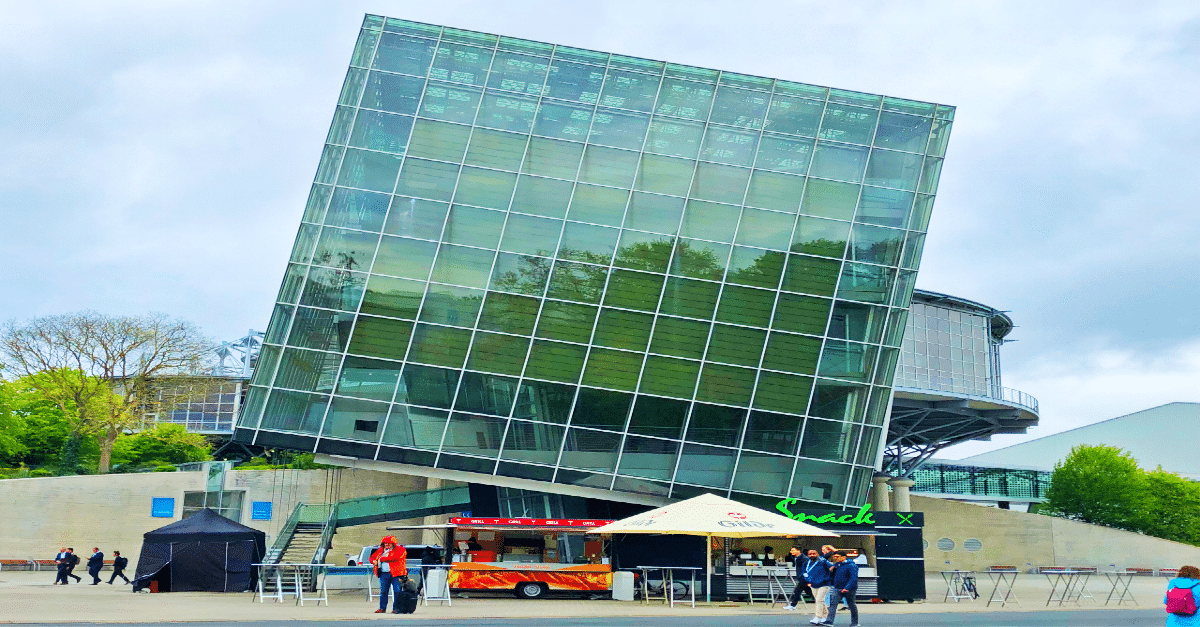
With a partnership here and a collaboration there – not to mention all the aspirations around open and unified ecosystems – Hannover Messe 2024 often came across less as the world’s largest manufacturing trade show and more like Burning Man. Especially if you factor in all the solar tractors, soccer-playing robots, and buzzing bionic bees…
Shared Vision: Tech Nerds Unite
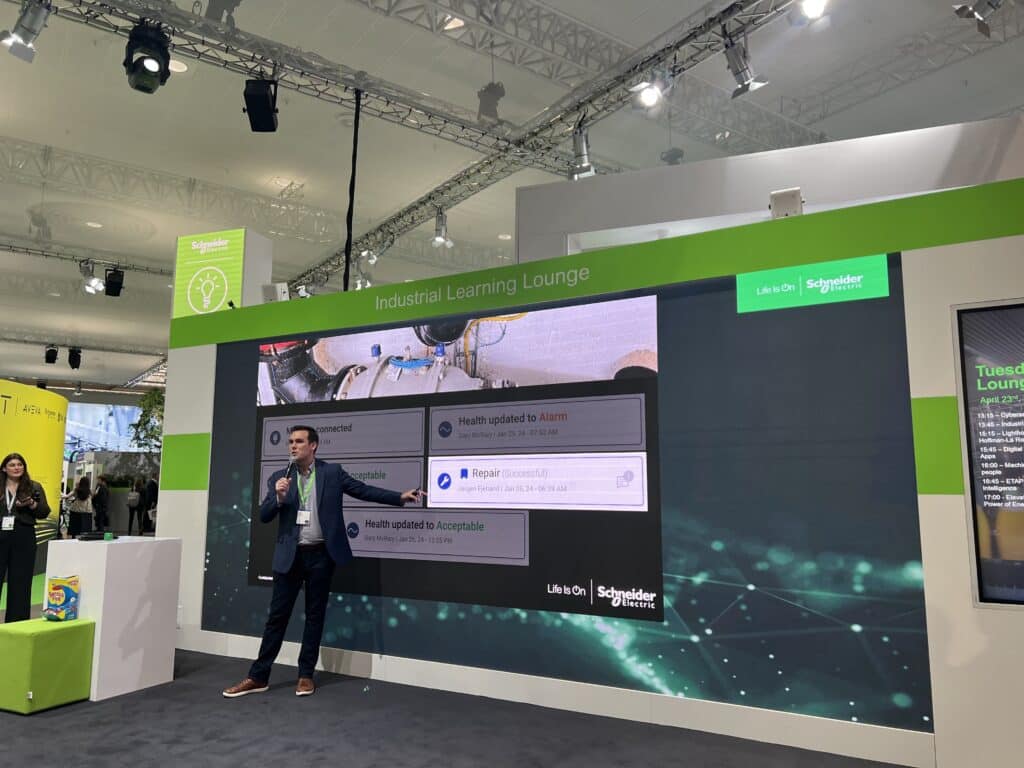
“We live in exciting times for manufacturing!” many said as they opened talks and presentations during Hannover Messe 2024 – the unimaginably large manufacturing trade show that attracts 140,000 visitors and 4,000 exhibitors from 150 countries.
Like any trade show, exhibitors try to present the right balance between being feet-on-the-ground pragmatic and being pie-in-sky futuristic.
Certainly, manufacturers are facing a myriad of real-world challenges: not enough talent, crushingly competitive markets, slippery customer demand, even slipperier geopolitics, the eternal drive to boost production while cutting emissions… Etcetera.
Many exhibitors offer AI-powered real-world solutions to deal with these problems. While in recent years, there was much talk about Industry 5.0, now people are focused on getting a more pressing job done, Industry 4.0, which also happened to be this year’s overriding theme.
So, while pragmatism was in the air, visitors still had to be careful not to trip over small soccer-playing robots or get their hair parted by Festo’s nifty new BionicBee.
There was also a much stronger sense of community. It seems people are recognizing that no one can face down these challenges alone. While innovation has always been driven by partnerships and collaborations, this approach is only becoming more apparent.
So, while pragmatism was in the air, visitors still had to be careful not to trip over small soccer-playing robots or get their hair parted by Festo’s nifty new BionicBee.
In short, tech nerds unite!
Welcome to Hydrogen Europe
Visitors were also made very aware they were in Europe – beyond the offering of beer and sausage as an acceptable breakfast option. For instance, the rest of the regulation-lagging world was offered a peek into the future. The European Green Deal sets out that greenhouse gas emissions have to be cut at least 55 percent below 1990 levels by 2030, and the continent has to be climate-neutral by 2050. And for the very short-term, larger companies have to start reporting their Scope 3 emissions from 2025 – meaning they are becoming responsible for their full supply chain. So yes, that’s quite the deadline…
Hence, sustainability is not just part of the agenda; it is the agenda. For instance, over 500 exhibitors were dedicated to the hydrogen and fuel cell sector alone.
It does make sense, however. Who can’t love a technology that can provide a viable alternative to fossil fuels for energy-intensive industries – with the only byproduct being water?
But yes, there’s still work to be done.
Is AI Hysteria Sobering Up?
Also, all-things-AI were generally presented in more down-to-earth ways than in recent years.
While last year, many were improvising visions around the relatively fresh potential of Large Language Models and claiming ChatGPT as a cure-all, this year saw everyone rally more around the idea of use cases – knowing what problem you want to solve before deciding on the best tech to solve that problem.
And if anyone was talking about generative AI, it was usually focused on its strengths as a savvy assistant – one that applies RAG to minimize any hallucinations.
In general, the salespeople have finally done some proper research. Big ideas are still out there but tempered with “it’s still a work-in-progress”.
Better Together With Margo
People looked up and listened to the announcement about Margo, the new open standard initiative for interoperability at the edge of industrial automation. Margo’s founding members included heavy hitters such as The Linux Foundation, ABB, Capgemini, Microsoft, Rockwell Automation, Schneider Electric, and Siemens.
On the face of it, Margo is what Industry 4.0 is all about: “One agnostic, scalable, secure edge application ecosystem.” Future customers will be able to pick and choose the best automation software apps that work best for their unique operations – without being locked into a single hardware platform.
Of course, interoperability has been a long and cherished dream. But the fact they have so many owner-operators on board – and a shared realization that everyone can win in such a scenario – the industry might be able to make a move from closed proprietary systems to open flexible systems.
It’s a great idea. So why fight it? But again: there’s still a lot of work to be done.
Next Level Better Together with Manufacturing-X
In other news around the dizzyingly ambitious, there was a lot of talk and action around Manufacturing-X – with the X standing for the exchange of data. Basically, it’s a move to digitize supply chains for all manufacturers.
For now, the ambitions are for Europe, but already, there was a Hannover Messe panel Making Manufacturing-X International featuring heavy hitters from across business, government, and academia.
Again, it’s a great idea. Better together! Share the data for better outcomes! Optimize how we work across supply chains and networks! No more silos!
Sorry, I love getting data into my system, but I hate giving it away. Won’t it affect my market share?
It’s also not a new idea. And one that was never before achievable due to technical challenges and eternal questions such as:
1) “Who pays? And in particular, who pays for the smaller and middle-sized companies?”
2) “Sorry, I love getting data into my system, but I hate giving it away. Won’t it affect my market share?”
But it was easy to get swept up in the optimism. Everyone involved is painfully aware of the challenges – yet still seems determined. And, again, this initiative involves not only tech companies but also the big owner-operators who can help push the agenda. And with sustainability so high on the agenda, how else will we be able to monitor compliance but with a unified system?
These are exciting times – involving a lot of work. So, tune in next year for Hannover 2025 to see how it’s all playing out.
Want to learn more? Just reach out and contact us!

In the article ‘AI Disrupts the Workforce – But Not How You Think’ for Manufacturing.net, Augury’s VP of Strategy Artem Kroupenev argues, “Workers should come to terms with anxieties surrounding AI because it’s not going anywhere.”
This article was originally published on Manufacturing.Net on February 4, 2024.
“As companies everywhere implement AI into their tech stacks, the fear of becoming obsolete (FOBO) is a growing concern for U.S. workers. According to a new Gallup report, nearly 1 in 4 U.S. workers worry technology will make their jobs obsolete. However, for industries with an aging workforce, like manufacturing, AI helps major players maintain decades of experience and institutional knowledge,” according to ‘AI Disrupts the Workforce – But Not How You Think’.
Meanwhile: “The opportunity to work alongside tech also attracts the next generation of workers who see the industry in a new light – innovative, safe, more sustainable, and critical. The future of how we leverage technology in the workplace is bright, but only if we’re all working towards the same goal.”
The article then details that despite AI being the understandable cause of workplace anxieties, it is in fact our friend.
Good For Business, Good For Workers
“It’s essential that workers in manufacturing and beyond come to terms with their anxieties surrounding AI because it’s not going anywhere. According to Augury’s recent State of Production Health 2023 report, 63 percent of manufacturing leaders plan to increase their AI budgets within the next year. This should come as good news to leaders in manufacturing currently grappling with widespread labor shortages. AI can augment their workers’ abilities and fill gaps. For workers interacting with the technology on factory floors, this brings endless opportunities for advancement.”
In the end: “The FOBO is not a fear that will disappear overnight, but while the public’s worries around AI continue to grow as technology advances, technology leaders must take action to remove these feelings of unease. This pioneering technology can up-level all industries in a way we never imagined. As we continue to see increased advancements and innovation, it’s an exciting time for the workforce. The time is now to learn, embrace, and let technology do its job: making yours more manageable.”

During Black History Month, many articles extol African Americans’ profound contributions to the manufacturing industry. However, more sobering reports paint a bigger picture wherein disparities still exist. Will AI technologies make it even less fair? Or is there another path? Read all about it in our regular round-up of manufacturing-related news.
From Super Soaker To Silicon Godfather
Most of us know the story of George Washington Carver – the renowned inventor who discovered 300 uses for peanuts (but, sadly, he did not invent peanut butter as the popular myth goes). He often tops those listicles published during Black History Month, highlighting African American innovators.
But there are so many others… Indeed, more people should know about NASA engineer and inventor of the Super Soaker®, Lonnie Johnson – who is now a climate tech entrepreneur.
And why isn’t Roy Clay Sr., the ‘Godfather of Black Silicon Valley’, more of a household name?
Not to mention these eight inspiring stories: ‘Celebrating the Pivotal Black Women Who Propelled the Manufacturing Industry Forward’.
Happily, many organizations – including AfroTech, People Of Colour In Tech, and Black in AI – are supporting the next generations of STEM dreamers. They are all working to make the future fairer – and, therefore, brighter.
Disparity Built On Disparity
In terms of manufacturing, the African American community was hit the hardest by the offshoring of manufacturing jobs that began in the 1970s. A famous 2017 report from the Alliance for American Manufacturing (AAM) laid it bare.
“The report, ‘Unmade in America: Industrial Flight and the Decline of Black Communities’, goes beyond current statistics that show national black youth jobless rates at 27 percent—nearly double that of white youths. The report examines the multi-generational impact of plant closings, outsourcing and housing discrimination in trapping black communities in concentrated poverty. While high joblessness is the obvious outcome of deindustrialization, other casualties include crime, educational inequity and fractured neighborhoods.”
“The spiral down in the 1970s continued into the 21st Century. More than 63,000 factories have closed since 2001. Over a 15-year period alone (between 1998 and 2013), an estimated 5.7 million manufacturing jobs were lost.”
But there’s hope, according to AAM President Scott Paul. “The key is getting policy right. We must invest in workforce development and America’s crumbling infrastructure programs, and vigorously fight against unfair trade practices if we’re to stop industrial flight and build up our middle-class. Now is the time for our lawmakers to invest, invest, invest.”
An AI-Inclusive Society For All
“For African Americans, the rise of this technology has benefits and drawbacks. The goal is to determine how to balance this reality and utilize technology to create an egalitarian and inclusive society,” according to ‘African Americans And The Revolutionary Potential of AI’.
“By addressing issues like discriminatory algorithms, lack of inclusion, and privacy concerns, AI-driven innovations can lead to significant improvements in healthcare, education, and community safety, narrowing societal disparities and fostering a more equitable society. With the dedication of pioneers and increased representation, coupled with ethical AI governance, the future holds promise for leveraging technology to create positive change and build a more inclusive society for all.”
Leaving No One Behind
Reinforcing this idea, a new in-depth McKinsey report can help boost the conversation around establishing an equitable future – especially in this era of reshoring.
“Generative AI has the potential to widen the racial economic gap in the United States by $43 billion each year. But deployed thoughtfully, it could actually remove barriers to Black economic mobility,” according to ‘The Impact Of Generative AI on Black Communities’.
The report breaks down what needs to be done to start deploying generative AI through an equity lens – from being vigilant and responsible in implementation (reskilling!) to ensuring democratic access.
“Gen AI could fundamentally change how most work is done and most services are provided. Early in gen AI’s trajectory, leaders have an opportunity to build equity and fairness into their developing gen AI strategies and associated applications, and to accelerate the closing of the racial gap. The aim: to have all people and communities – including Black communities, previously left behind by seismic shifts in tech – benefit from this amazing technology transformation. The time to act is now, using the foresight of past transformations as a guide.”
Let’s get to work.
Read ‘From Raw Material to Finished Product: A Life In Manufacturing‘ or reach out!
As Augury’s VP of AI and Physics, Assaf Barak is obviously tech-minded. But he’s also known for sharing his insights in a modest, straightforward and down-to-earth manner. We decided it was time for a chat. “Whoever joins us on our journey now will be able to influence the journey – and enjoy the bias our algorithms will have in solving their specific problems.”
How would you describe your job to your grandmother?

My team is developing advanced algorithms that can imitate human experts and are trained to identify machine failures before they happen. And since I am talking to my grandmother, I’d probably want to show off a bit and sound all smart and sophisticated. So, I’d also add our algorithms are state-of-the-art and did not exist until a few years ago. And by building these algorithms, we can now monitor machines 100 times more efficiently than humans.
Your grandmother must be proud. How did you end up at Augury?
I was looking for a change. I wanted to find a new startup that has a dynamic way of working with an evolving product. I wanted to work in an industry where the physical world collides and coexists with the theoretical and computerized world. In other words, I wanted what we are doing on our computers to have an impact on the physical world – on people and the way they work. I wanted to work in a place where this impact could be quantified.
And then, from that huge server, the outputs from these algorithms are aimed back to the customer with their fancy tools to help them fix what needs to be fixed. I can very much connect with this idea: making the circle round.
So, you were in search of something useful and hands-on…
I prefer a product that you can touch, feel and involves many disciplines. And at Augury, we are dealing with things we can touch and feel in the real world: machines made of metal, vibrating, and taken care of by people with cool hand tools ranging from hammers and screwdrivers right up to advanced laser systems for machine alignment. Then, in a way, these machines end up fusing with sophisticated algorithms that run somewhere in the Cloud. And then, from that huge server, the outputs from these algorithms are aimed back to the customer with their fancy tools to help them fix what needs to be fixed. I can very much connect with this idea: making the circle round.
And what gives you the most job satisfaction on an average day?
Working with a diverse team to solve very tough problems – problems that seem impossible to solve. I love seeing a single thing finally succeed – after months of it seeming unachievable. It makes me believe everything is achievable. I’m not saying this happens every day. but when it does, there’s no better feeling.
Why do you think Augury is able to lead in terms of bringing value to customers using accurate, prescriptive AI?
We are putting continuous effort to correct the problem that needs to be solved: to allow professional maintenance teams to run their machines at peak efficiency. And we never assume that we solved it. We are always only solving a part of the problem. And we remain aware that the problem is super difficult and dynamic. Therefore, we’re always thinking about what our customers need. What are they asking from us? What will our future customers ask from us? And the answers to these questions evolve and change all the time. And at this point, Augury is the first to have the right amount of data and experience to react quickly to these changes and build something that answers exactly what we have learned up to this point.
We are putting continuous effort to correct the problem that needs to be solved: to allow professional maintenance teams to run their machines at peak efficiency.
Another aspect is creativity: we have the innovation mindset. Whenever we encounter new problems, challenges or customers, we can apply out-of-the-box thinking to find a quick solution. And meanwhile we work in a domain that’s not always full of innovative ways of working. But after 10 years of experience, we now know how to negotiate that. So, this makes us interesting…
You mentioned AI now being 100 more times effective than humans in monitoring assets. How do you see AI’s potential unfold further in the future?
I see Augury being on a journey. Already, we are at a place that goes beyond what’s in the textbooks. We collect high-quality data with our sensors. We then use amazing algorithms that are able to extract patterns and signatures from assets that can give very early warnings for different types of faults.
It comes down to this: if you have the right amount of high-quality data, you can start learning things that no one has known before.
But we haven’t arrived at our end destination. But we’re confident we’ll get there – and that we will be the first. And actually, we might already be very close. It comes down to this: if you have the right amount of high-quality data, you can start learning things that no one has known before. You can start recognizing signatures of machine failures that were previously undetectable. You will be able to predict how a particular machine behaves in the future. And if you are doing this for a fleet of assets, you’ll be able to correlate all the data to best plan your maintenance procedures and your spare parts inventory – all based on the algorithms.
And the amazing thing is that we are not just learning about a single type of machine. We can apply these learnings to other machines. Our algorithms have already become so strong, they can learn relationships between different types of machines and translate that to new types of machines. We no longer have to invest time in learning whenever we are confronted with a new machine.
That’s amazing – especially for scaling. Can AI also help in making scaling easier in other ways?
Well just the fact that the algorithms are 100 times stronger than a human means you only need a very small staff to support scaling. And you can have centralized visibility on the entire assets of a global company. And with it being so centralized and needing only a few humans to support it, the costs of scaling will fall further below linear with the more facilities and assets you add. And since it is centralized, what is learnt in one factory can more easily be shared with another factory.
The tools we are developing are only just beginning to evolve. Yet, they already bring competitive advantage to manufacturers – and this advantage will only grow.
What’s the big message you’d like to share most with people – particularly those working in manufacturing?
Well, this may sound boring… I’m someone who is not easily convinced. But I’m convinced that this problem is solvable. We can do this. But I think we are still at the beginning of a marathon and the tools we are developing are only just beginning to evolve. Yet, they already bring competitive advantage to manufacturers – and this advantage will only grow.
In this development process, we will continue to listen and collaborate closely with our customers. We will continue to learn what’s important for them and train our AI models to support what’s important for them. So, whoever joins us on our journey now will be able to influence the journey – and enjoy the bias our algorithms will have in solving their specific problems. Naturally, we assume that we’re solving a general problem, but we are building this solution based on who we are working with now. They’ll be the first to enjoy the enhanced efficiency and productivity – and perhaps more so since our algorithms are perfect for their needs. So, this is an opportunity…

Augury Co-Founder and CEO Saar Yoskovitz travelled to Davos 2023 to explore how manufacturing can become the “lighthouse by which it can help solve the world’s greatest challenges.” In this post, he shares his biggest takeaways.
For five intense – and inspiring – days at World Economic Forum’s (WEF) Annual Meeting in Davos, I was able to listen to and connect with an engaged array of world leaders in government, business and social institutions. What struck me most was how the mood has shifted since the previous WEF Annual Meeting last May.
At the time, things were looking bleak: the world was facing an uncertain recession, the Russia-Ukraine war had just broken out, supply chains were in shambles and “de-globalization” was the most recurrent buzzword. Under these circumstances, any conversation about the environment and investing in sustainability felt like lip-service.
Eight months later, the world seems much more stable: Ukraine is holding up, the energy crisis has been largely averted, global inflation seems under control, and supply chains are building capacity. This brightening scenario enabled much more constructive conversations on how we tackle the world’s biggest challenges. And in this process, I picked up a few insights…
 1) In It Together
 1) In It Together
I found it amazing that the challenges of our growing company are very similar to those of the world’s largest and most prestigious companies. We’re all looking for any signs of clarity on the economic climate ahead. All of us are trying to balance a desire for growth with smart decisions on resources. And we are all taking seriously the global challenges around sustainability, workforce transformation and the efficiency and effectiveness of a global industrial and manufacturing base.
And, most importantly perhaps, we all realize progress still comes down to the basics: smart people getting together to sweat out the details, agree on directions, and really put in the effort to make change happen.
2) Tech Is Coming Of Age
With each annual meeting comes a flurry of reports, such as how circular transformation of industries is unlocking new value, how over a hundred ‘Lighthouse Factories’ are showing the way forward to a more sustainable future, and how AI is being applied to both fight climate change and spur growth. And what’s refreshing about these reports is how they are becoming less about what should be done, and more about what is actually happening.
The next phase of this journey is taking our lighthouses – unique examples of success that shine bright – and scaling them throughout the industry. And I am proud to say this all resonates nicely with Augury’s mission: creating a world where the combined work of people and machines makes life better in every way.
3) New Trends: Glocalization and Friendshoring
Last year’s big buzzword de-globalization is off the table. It has been replaced with another one: glocalization. This means we are globally interconnected, but have more localized supply chains. While this is linked to creating more resilience, it’s also related to the fact that alternative energy sources are more local by nature and are harder to transport. For instance, solar energy is generated during the day and wind energy when it’s windy – and currently we have no means of mass storage or transmission. This situation will naturally lead to more decentralization of industry. Factories will go to where the cheapest and greenest energy is available (something we’ve seen play out with data centers in the past).
Another emerging term: friendshoring replacing offshoring. Namely, how do we embrace countries that share our values and limit single-source dependencies as we had in the semiconductor industry? The US/EU IRA and CHIPS bills are a huge step in these directions.
4) Sustainable and Circular Supply Chains Have (Finally) Become A Priority
Spurred by upcoming regulation around carbon reporting, larger companies are prioritizing sustainable and circular supply chains. Scope 3 emission tracking – that takes into account the total footprint of a product by also including the upstream and downstream impacts of its supply chain – is being described as “a nightmare” by some.
It’s certainly tricky. Everyone is scrambling to track it properly but are lacking proper frameworks or tools. Scope 3 is also highly relative between products. For a cement manufacturer, Scope 3 is only 6% of their emissions, but for a food or automotive company it can be 80%. Hence, we must come together as an industry to have the much needed impact.
5) Talent, Talent, Talent
Access to talent remains a huge talking point – but now with a twist. Company investments in new geographies are moving from looking at Labor Cost Arbitrage to Skills Arbitrage. In other words, people are asking: Where can I find talent that can leverage digital tools and automation to be more productive?
Let’s get to work
In short, I left Davos with a deep sense of optimism. We have much better clarity on the challenges ahead and what is required from the industry to overcome them. It won’t be easy, and it will require governments and industries working together, but we have a path forward.
We can do this.
Read ‘Destination Davos: Augury At World Economic Forum’s Annual Meeting’. Or reach out if you want to learn more about our mission.
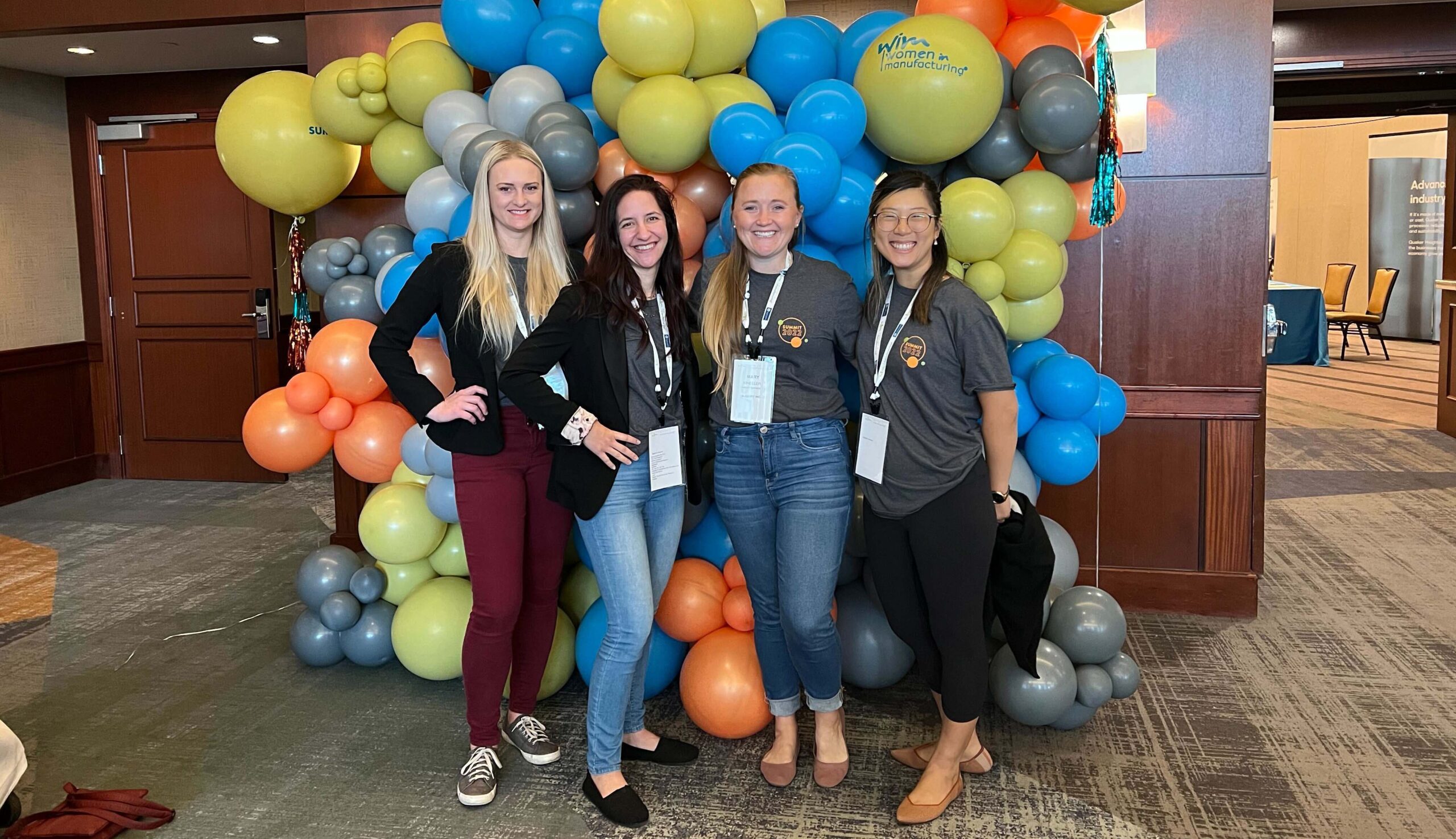
Augury was in full force at the recent Women in Manufacturing Summit in Atlanta. Account Executive Courtney Levin returned with a fistful of new contacts, friends and more. “The experience was inspiring and convinced me further: the more diverse your team is, the better it is for everyone.”
As proud members of Women in Manufacturing (WIM), a group of Augurians were on hand for the 12th annual WIM Summit last month in Atlanta. The three-day networking and educational event attracted over 1,000 manufacturing professionals from around the world. It was rated as WIM’s largest event to date.
“I went there thinking I was representing all the women working at Augury,” says Courtney Levin, an Enterprise Sales Executive at Augury. “I assumed I would learn things from the keynotes and discussions and then share this with the rest of Augury,” says Courtney, “Yes, that happened. But there was also a lot more going on. It really felt like everyone there was part of the same team.”
The Power Of Mentorship
Courtney sort of fell into manufacturing. “Six or seven years ago, I was working at a tech company in their software division and a random recruiter reached out to me and asked if I wanted to move into manufacturing. I bit. And I never looked back.”
It helped having a strong role model. “My first manager KCat was just a badass – for lack of a better word. There are so few women in manufacturing and she really paved the way at our company for women in leadership roles. Our team had a lot of women – and this showed me the potential.”
Courtney is now a mentor herself and sees WIM as an organization that can broaden and amplify the benefits of mentorship. “It’s just so valuable to get support from people who are higher up in an organization – and they don’t have to belong to the same minority group, or be from the same department or even the same company.”
Learning Moments
Another aspect of the summit that stood out for Courtney was the quality of all the keynotes. “Usually when you go to a conference, you don’t come out of every session inspired. But here were all these powerful, intelligent and innovative women sharing their experiences and positive messages.” One talk stood out particularly: ‘Amplify Your Impact: Effective Everyday Advocacy’ by Kathryn Bardi, a renowned expert in Applied Neuroscience and DEI (Diversity, Equity and Inclusion).
“She really gave me a lightbulb moment. She talked about that feeling you get when you as a female enter a meeting with only men – which happens a lot in our field. She explained what was happening in your brain and it helped validate experiences we’ve had numerous times as women.
Womanhood In The House
One of the things that surprised Courtney most about the summit was how easy it was to talk to everyone. “I was there to learn but then lead-gen came naturally since everyone was interested in helping one another ,” she says.
On one level this was because it was an industry event. “Everyone there knows the importance of avoiding downtime. They understand the implications of a solution that can warn you before something happens: a solution that tells you what the issue is and how to fix it. They understand what that means in terms of efficiency, costs and safety.”
But on another level, there was an ingrained sense of camaraderie. “I would be talking with someone about Augury and they would stop me to say ‘Hey, let me grab my VP here because they really need to hear this’. One person even said, ‘Shut up and take my money’. Everybody was really out to help everybody.”
“A casual conversation during breakfast would lead to people giving me their card – and then chasing me down when I didn’t email them quickly enough. This level of immediate interest doesn’t happen normally! Not to point fingers at a particular gender, but usually VPs run away when they see me coming,” laughs Courtney.
More Diversity Please!
It’s a fact that when teams are more diverse, they are more successful. And now is certainly a time when manufacturing needs more success stories. “Our industry must work harder to embrace diversity. We’re all going to be better for it. I know this is such an obvious thing, but it’s still not very pervasive at the moment,” says Courtney.
“The main theme across all discussions during the summit – not just during keynotes but also breakouts – was that the number one issue facing manufacturing is people. And the answer is diversity: not just women, but being inclusive for everybody.”
“We’ll definitely be back next year and meanwhile trying to attend as many regional events as possible. And I’ll be trying to drag every woman working at Augury with us.“
Further related reading:
‘Women In STEM: Operations Manager Amanda Reineck and Maintenance Engineer Shelby Gagliardi From GAF’
‘Women In STEM: Corinne Nielsen, Reliability Success Manager at Augury’
‘Women In STEM: Elise Morse, Vibration Analyst at Augury’
“Innovation is exciting – and inspiring. Join us in solving your very specific manufacturing problems,” says Augury’s Product Marketing Managers. In this ongoing series ‘What is Production Health?’, we talk with various key players about the potential in unifying Machine Health with Process Health – and making Maintenance & Operations teams unite in the process.
As Product Marketing Managers at Augury, Kristen Hoppe and Amy Marchesi are interpreters of sorts. They help link Augury’s customers and market with Augury’s product team to define and share how Augury’s innovative products and solutions help solve manufacturing’s biggest challenges. With Amy responsible for Machine Health and Kristen tasked with Process Health, they are the perfect combo to discuss Augury’s quest to combine the two into an all-encompassing Production Health solution.
Read: ‘Roadmap To The Future:
Machine Health + Process Health = Production Health’
Car Vs Cookie: The Ultimate Showdown
It’s still early days, but how are you describing this transition Augury is making towards Production Health?

Kristen: We’re still definitely in the process of more clearly defining our ambitions. But if you’re looking at it from a holistic perspective, it’s about bringing more insights about your production line to operators as well as the decision-makers – to really help everyone involved to better understand the different pieces of what’s going on. As a result, you can prevent loss: may it be by avoiding machine failure, or by minimizing waste or energy use.
Amy: I’ve been trying to find a fitting analogy. And I’m not there yet. But I have a car analogy – because when all else fails, cars always work [laughter]. So, let’s say you have a car that always gets flat tires. The first thing you might think about is the quality of the tires. So, you get better ones. But then you still keep getting flat tires. Then you start to think maybe it’s your driving. So, you start driving more carefully – but you still get flat tires. So, maybe you just need to change these tires more regularly. But this comes with so much cost and inconvenience…
But what you really need is something that checks all the variables – not only the tires and the driver, but also the weather, the state of the roads, etcetera – that could be impacting why you are getting flat tires. And then it turns out to be your route to work: you go by a construction site with lots of debris. So, then you just change your route and you drive happily ever after…
Kristen: I also like the cookie analogy that the Process Health Team uses: that Process Health is about taking in all the factors so you can create that perfect cookie every time. And by looping in Machine Health, we’re also making sure that the things you need to make this perfect cookie are never going down – so you can just continue making those perfect cookies non-stop.
Finally: The Dream Of Industry 4.0 Is Waking Up
Besides when talking about cars or delicious cookies, are there other specific times when people’s eyes light up when you are talking about Production Health?

Amy: I think our customers understand what it’s about: Production Health is the original promise of Industry 4.0 – one that began all shiny but then got further and further out of reach. And now we finally have the concrete steps for actually getting there – to finally fulfill that dream.
Kristen: People seem to get excited when they realize it also offers concrete steps on the sustainability side. It’s not that people are necessarily caring more about sustainability but their companies are now really pushing for it with goals and KPIs that need to be met. They seem especially interested in reducing loss and/or waste and where you can share the monetary value with management.
And how about personally: Did you have your own a-ha moments? A moment where you said to yourself: “Oh wow, we’re really onto something here!”
Kristen: I’m fairly numbers-driven. So, when I see the actual numbers in terms of what we’ve been able to provide in terms of Process Health and Machine Health, this is a great foundation as we move forward in shaping and defining Production Health and the impact it will have on industry.
Amy: For me, it was when the Seebo team first explained in person what their Process Health platform really does: taking into account all these different variables. It really came to life for me: especially how it can fit with Machine Health. It made me better understand the symbiotic nature of our merger and how it offers a view on the full operations: how Process Health insights can improve Machine Health insights and vice versa. Together, we can give an overall picture.
And Now For Something Completely Practical
It’s indeed somewhat eerie how two separate solutions seem so built for each other. But what do you see as the main challenges in making this happen on a practical level?
Kristen: Well first, there’s an actual physical product bump: we are obviously still in the process of finding the optimal integration strategy for what were two distinct companies. On top of that, what we are creating is an entirely new category in Production Health, and that means really understanding the value our customers need to find and building those entirely new insights to deliver them. So, we need the single dashboard before we get production insights. And before that, we have to figure out how Process Health can best ingest data from Machine Health.
Amy: Yes, just from a visual standpoint, we need to have an integrated Production Health platform that includes both Process Health and Machine Health. And yes, there’s a lot of work still in how we can stitch the data sets together so we can start producing these deeper insights. But this will set the groundwork for that bigger – and very fascinating – beast of integrating other data sources into the Process Health world.
What do you think is the most important thing that Augury and Seebo customers should know right now?
Amy: Our customers are already seeing extremely concrete value for using our current solutions. And now as we go into this new frontier of Production Health, they can be actively involved in solving the use cases that are most particular to them – by starting to work with us. Just look at Colgate-Palmolive and their company and culture and see what they have done. As an early adopter of both Machine Health and process optimization, they are now so far ahead in their digitization journey – just by being brave and engaged in their endeavor. Innovation is exciting – and you get to solve the problems that are most important to you and have a big voice in the game.
Kirsten: I want them to understand, this is only the beginning and we are working towards something that will take away a lot of their day-to-day operational troubles – because we’re not chasing symptoms but going after root causes. We want them to have their best day every day. And as a result, they can just really focus on their jobs: the business side of things.
Learn more about Augury’s vision of Production Health here.
Or reach out and talk with us directly.
Over at Manufacturing.net, Augury’s VP of Strategy Artem Kroupenev discusses four ways to attract and retain team members. In short: “The breakthroughs of today are what the future industry will be built upon. Invite job seekers to be a part of it.”
This article first appeared on Manufacturing.net on Aug 3, 2022
No one needs to tell you that there’s a significant labor shortage in manufacturing. You need only look to your open positions to find proof of that. With the Great Resignation, job openings in manufacturing are at record highs: 800,000 each month.
Although great efforts are being made to bring manufacturing back to the U.S. and recruit the next generation of talent, manufacturing labor shortages are quite the hurdle to surmount. All is not lost, however. One study found that perceptions are changing around manufacturing, largely due to the industry’s response to the pandemic. But more work needs to be done to attract and retain top talent.
Money is often a good start, as are time-off benefits and greater schedule flexibilities, but companies need to think more about rewriting the cultural narrative of what manufacturing is to better reflect its current state. Technology in manufacturing has been reshaping the industry, but our recruiting tactics don’t reflect that. We show how working for a manufacturer is an attractive proposition for talent with the skills and background to succeed in the industry.
How to Attract Manufacturing Employees and Retain Team Members
With such a labor shortage, it may be tempting to focus on training and recruiting the next generation of people to work in the manufacturing industry. But that’s not enough. We can’t just wait for a whole generation to grow up and enter the workforce. Instead, turn your attention toward getting the right systems in place to make the proposition of job opportunities more appealing to talent of all ages. The following are often the best places to start:
- Create Higher Value With Manufacturing Positions
- Increase Diversity Through Company Culture
- Change the Perception of Manufacturing
- Institute Reskilling Efforts
Read more about these four approaches in the full article on Manufacturing.net.
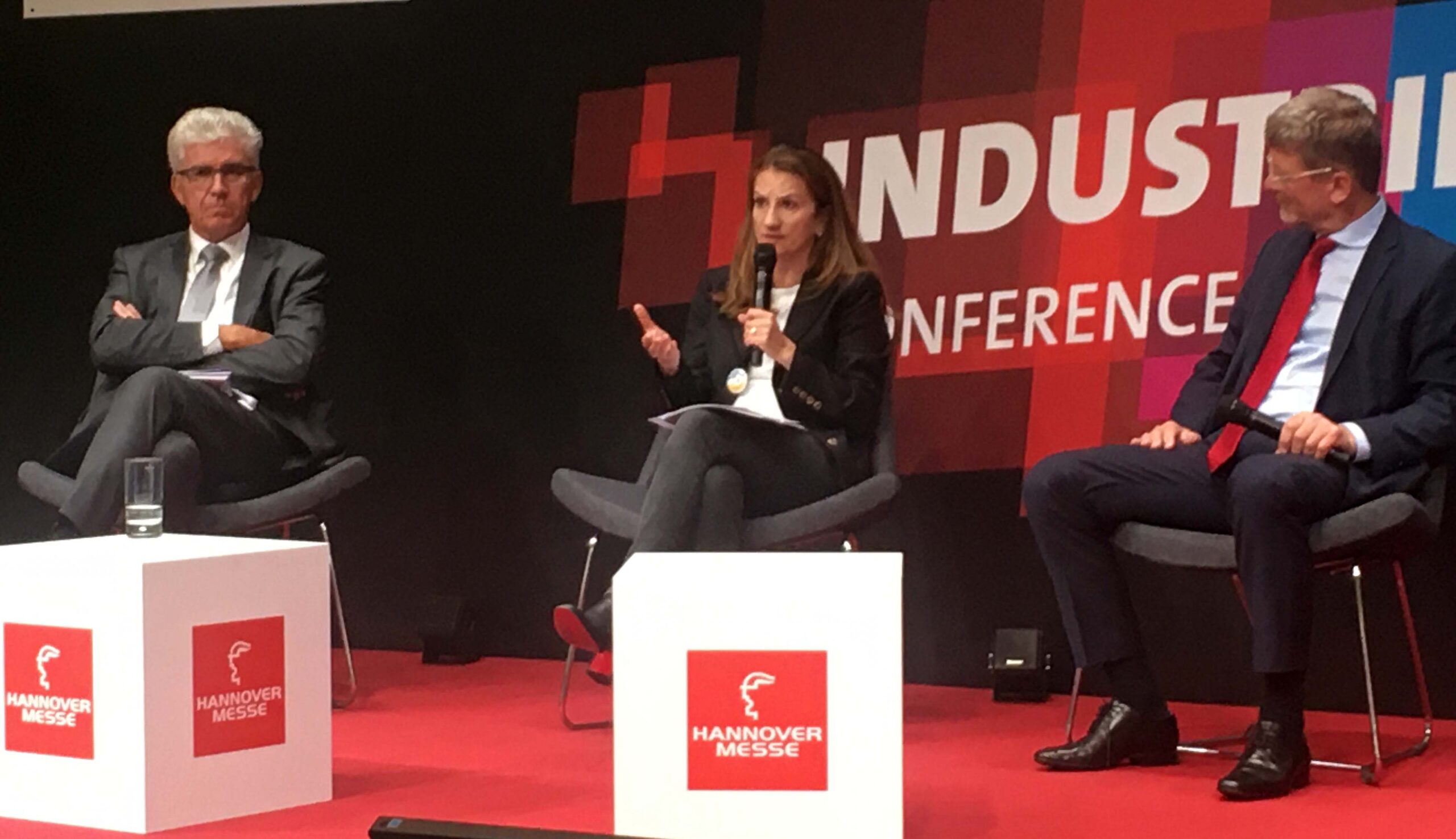
At a panel discussion during Hannover Messe 2022, representatives from academia, business and government gathered for a constructive look at how manufacturing can not only be transformed to increase productivity, but also become a driver of a human-centered, sustainable and resilient society. “Only by bringing the ingenuity of individuals to the forefront can Industry 4.0 technologies fulfill its promise.”
One Goal, Three Perspectives
Bringing together the wildly contrasting worlds of academia, business and policymaking – the triple helix model of innovation – has long been standard for applying AI and data science to human healthcare. Basically, you need to align all three if you want to take on the technical, ethical, social and legal whirlwind involved in bringing a medical innovation to market. And when it works, the pay-offs can be huge – as we recently witnessed with the speedy development of a rainbow of Covid-19 treatments.
The panel discussion ‘Looking Beyond 4.0 – Industry As A Driver Of A Human-Centered, Sustainable And Resilient Society’ at Hannover Messe 2022 showed why the triple helix model should be more commonly deployed in helping accelerate change in the increasingly complex world of manufacturing – especially now when the industry must achieve both production goals and societal ones.
“Industry 5.0 provides a strategic orientation to make companies use Industry 4.0 technologies fully, while maximizing industry’s contribution to a sustainable and prosperous society,” noted the panel’s moderator Liviu Stirbat, the Head of Unit Industry 5.0 at the European Commission.
The View from Academia: First, The Bad News…
As senior research scientist at TNO Innovation for Life, Professor Steven Dhondt is the main coordinator for the EU-funded ‘Beyond 4.0’ research project. He opened the panel by presenting the bad news: wages, employment and productivity all remain too low. “The expected fruits of industry 4.0 are just not there. Yes, there are the 2% of companies that excel in everything, but the 90% who are the followers are really lagging.”
Even companies that are doing well and “speak to our imaginations” such as ASML in the Netherlands or FANUC in Japan are “struggling to make industry 4.0 a great success”, according to Professor Dhondt. “So, industry 5.0 is a new context for companies to think within,” he said. “Companies need to engage their employees to participate in thinking about what’s needed for companies to reach a higher level of productivity.”
The expected fruits of industry 4.0 are just not there.
Meanwhile, according to Professor Dhondt’s research, of those already working in manufacturing jobs related to robotics, AI and big data, only 18% feel they are being listened to by their employers.
So there’s work to be done…
Good Business: Motivating, Capturing and Fostering Workforce Creativity
Doctor Barbara Frei is Executive Vice President of Industrial Automation at Schneider Electric, a leader in digital automation and energy management (and Augury investor and partner). Doctor Frei very much represents the real-world aspects of a company that employs 140,000 people with 300 manufacturing sites worldwide. Happily, she offered good news.
“Involving people very early is key for having a successful implementation of Industry 4.0,” says Doctor Frei. “Sustainability has always been at the core of what we are doing. Already in 2005, we launched our first sustainability program. But it’s not only about the CO2 emissions, it’s very much also how we engage our employees and treat people. It’s really about people-centricity.”
Around 20 years ago, Schneider Electric started deploying short interval management in its manufacturing sites. This involves the site team meeting daily or twice a week to look at KPIs such as quality and output, and discussing methods for improvement – with everyone being encouraged to participate.
The approach worked, but only really took off in 2019 when the process was digitized and became much easier to track. Now 34,000 ideas later, about 45% of these have been implemented. “And that’s so motivating for our employees,” said Doctor Frei. “They can look anytime in one of the PC terminals on the shop floor to see Hey, where is my idea? Has my idea been reviewed or implemented? What was the KPI in the end? How did we perform?’”
We came from a people-centric approach, and then built the industry 4.0 implementation on top of this.
From 2017, Schneider Electric began setting up their Smart Factory Program, which also actively involves those working on the floor and in support functions. They’re the ones who decide what’s best to implement – based on their knowledge of their particular site’s capabilities – in terms of digitalization, automation and making more data-based decisions.
Besides being inspiring for the team, the approach also works to impress customers visiting the site. “The employees themselves present to the customer saying, Look, this is what we have implemented. This is working well… And this is working less well… This gives us a strong credibility in how we’re implementing industry 4.0,” said Doctor Frei. “It shows clients we eat our own food.”
“So, I would say we did it a bit the other way around: we came from a people-centric approach, and then built the industry 4.0 implementation on top of this.”
Policymaking: Supporting the Innovators
Peter Dröll is Director for Research and Innovation at the European Commission. As an EU leader, he represents the political side of the spectrum. He believes fervently in looping in workforce creativity and insight to reinvigorate industry. With manufacturing representing one job out of five, he sees any decline in manufacturing as a direct threat to European cohesion and democracy – citing ‘The Revenge of the Places That Don’t Matter’ as one potential outcome.
“Industry, which in Latin means ‘hard work’, is about going from the individual to the collective, and from the small to the scale. But currently, industry is also not only part of the solution, it is also part of the problem – in terms of emissions and resources. We need to transform,” says Director Dröll. “This is what’s behind 5.0: to bring the ingenuity of the individual, as we heard from Schneider Electric, more to the forefront.”
“So how are we going to do it?” he asked. Basically besides sponsoring research, the EU is putting money where its mouth is, for instance via the ‘ERA industrial technology roadmap for low-carbon technologies in energy-intensive industries’ and more grassroots initiatives such as the first Industry 5.0 Award. “And look out for more Industry 5.0 projects in the future investment package.”
Let’s Get Concrete: Sharing The Success Stories
The second part of the panel discussion addressed what further concrete steps were needed to push through the Industry 5.0 agenda.
Professor Dhondt noted that research should now focus more on the actual workers – “We still need to learn more from them.” He also believes companies should be more actively pushed to invest in themselves and the future.
We need leaders who take risks, who show that it’s possible – that industry can be competitive, clean, and provide a regenerative nature of production.
Doctor Frei named upskilling and leadership. “Upskilling is really key. But we also need leaders who can explain to the team: Why are we doing this? What’s the picture we’re going towards?”
Director Dröll agreed. “We need leaders who take risks, who show that it’s possible – that industry can be competitive, clean, and provide a regenerative nature of production – giving back the human and natural capital. And we need to showcase these success stories of trendsetters over trend followers.”
“As well as success stories about those who upskilled successfully,” added Professor Dhondt.
And to prove the power of stories, the panel ended with Doctor Frei sharing a personal experience. “Together with 300 employees – all of them skilled people – I lost my job once because of a consolidation of factories. We all found a job within the shortest time. I’m happy that this happened, because I would never have the career path that I do right now. So, I believe even if there is a restructuring, there is usually a better opportunity just looking for you.”
Participants of Hannover 2022 can watch the full panel discussion here.
To learn more about how Augury is taking Industry 4.0 to the next level, read ‘The Trillion-Dollar Challenge: Closing The Gap With Production Health’.
Looking for a happy ending? Cheerful news around manufacturing seems hard to find these days. But it’s there if you dig deeper! Read all about it in our monthly round-up of manufacturing-related news.
Impending Gas Catastrophe May Spark Post-Winter Party
It’s not looking good, according to ‘Europe’s Winter of Discontent’.
“If you have spent the past few days being sizzled alive on a Mediterranean beach or slow-roasted on the streets of Berlin, London or Rome amid a heatwave, cold weather may be the last thing on your mind. But make no mistake, winter is coming, and it promises to be brutal and divisive because of an energy crisis that is rapidly worsening as Vladimir Putin strangles supplies of Russian gas.”
“Industrial users such as chemicals and glassmaking firms are in trouble, as well as a broad list of businesses, including many German champions.”
It’s time for the European Union to show unity. It’s time for a plan. Sacrifices will need to be made. But it may be a blessing in disguise: “The prize for Europe is not just getting through the coming months. Europe will forever free itself from Russian energy intimidation. It will also have created a coherent continent-wide energy-security mechanism that will help accelerate the shift to cleaner energy. Europe has a habit of coming together during crises. It is time to do so again. If you are reading this in Paris or Madrid with the air-conditioning on, turn it down a notch.”
Once Again: A Perfect Storm of Perfect Storms
“War, raising the specter of nuclear conflict. Climate change, threatening famine, flood, and fire. Inflation, forcing central banks to crush consumer demand. The pandemic, closing factories and overloading hospitals. Each crisis is hard enough to parse by itself; the interconnected mess of them is infinitely more so,” according to ‘A Crisis Historian Has Some Bad News For Us’.
“America and the world are living through what Adam Tooze, the internet’s foremost historian of money and disaster, describes as a ‘polycrisis’. As he sips a beer at a bar near Columbia University, where he is the director of the European Institute, Tooze talks through a long list of challenges.”
The once obscure academic is now an economic influencer. And while he drowns us in bad news, he remains strangely chirpy. “In person, he comes off as intellectual, sure, but also self-deprecating, voluble, funny. While we chat polycrisis, he riffs on his love of cities (‘You cannot feel depressed!’); his sense of alienation, being so few degrees from so many important people (‘a weird club’); and his experience in therapy (‘Being present is the hardest thing on Earth’).”
Meanwhile: “He is offering no reassurance about where that might head – only the hope that perhaps this polycrisis might be knowable to us.”
Here’s to turning knowledge into power.
ESG Is Not Experiencing Its Happiest Hour
“Every industry can be part of the solution — or part of the ongoing problem”, according to ‘Corporate Greenwashing Is Getting Harder To Spot – Here’s How To Do It’. “Greenwashing obscures the level of change that needs to happen,” says one activist. “It’s a giant societal placebo that makes you think we’re moving in the right direction when that’s not true.”
Meanwhile, much ire is saved for ESG – since its vagueness-in-vastness can easily be exploited. “The methods used to evaluate companies’ Environmental, Social, and Governance credentials are often misleading and downplay climate impacts.”
In another article, it’s argued ‘ESG Should Be Boiled Down To One Simple Measure: Emissions’. “Although ESG is often well-meaning it is deeply flawed. It risks setting conflicting goals for firms, fleecing savers and distracting from the vital task of tackling climate change. It is an unholy mess that needs to be ruthlessly streamlined.”
And indeed, it’s good to focus. “Investors and regulators are already pushing to make disclosure by firms of their emissions more uniform and universal. The more standardized they are, the easier it will be to assess which companies are large carbon culprits—and which are doing most to reduce emissions. Fund managers and banks should be better able to track the carbon footprints of their portfolios and whether they shrink over time.”
“Make no mistake, though: tougher government action is essential now.”
Turning Plastic into Innovation
Speaking of tougher government action: ‘California Requires Plastics Makers to Foot the Bill for Recycling’. “The landmark legislation also restricts single-use plastics. And because California’s economy is so big, experts say, the law could have far-reaching effects.”
It’s estimated the law will eliminate 23 million tons of plastic over the next decade.
Now, this may sound like bad news for plastic packaging manufacturers. However: “Those tracking the bill were buoyed by the comparative buy-in from industry groups, which have historically resisted producer responsibility laws. In a statement, the American Chemistry Council described the law as ‘not perfect’ but said it would work to eliminate plastic waste.”
“Recycling advocates said that they hoped the law would lead to potential innovations such as refill stations for products like detergents or beverages.”
Opportunity knocks.
This Can’t End Well. Or Can It?
“Operators are forced to defer maintenance as aging fleet is ‘run harder than it’s ever been run’,” according to ‘“Things Are Going to Break”: Texas Power Plants Are Running Nonstop’.
Power generating stations are being pushed to their limits as Texas faces a growing population, a surge in energy-hungry crypto mining, and severe weather conditions, which demands cranking either the air conditioner or the heater.
“It’s kind of like humans – we need to rest and recover. If we run full speed for a long time, we can collapse.” So, where’s the happy ending here? Well, not to toot our own horn… But haven’t they heard of Augury?
Read ‘Manufacturing – The News: Stay Positive, But Not Too Positive’.
To learn more about the good news Augury’s full-stack solutions offer manufacturers, get in touch today.