Industrial AI is artificial intelligence trained on machine, process, and plant data to help manufacturing teams understand what is happening into production and what to do next. It diagnoses problems earlier, explains the cause, and points to the next step. Your team remains in charge of which AI recommendations are implemented into production.
Your plant produces a steady stream of data from machines, processes, and the people who run them. Industrial AI turns your data into clear answers: it reads your machine, process, and plant data, using a context graph to interrelate different data sources to ultimately explain what’s changing and why, and points your team to the next step.
This guide covers what makes AI suited for Industry, how it differs from general-purpose AI, how it works, and examples of how manufacturers are using it today. You’ll also see how your teams can use industrial AI in their daily work.
What qualifies AI as “industrial”?
To be considered “industrial” AI, the model must be able to interpret machine, process, and plant data within the context of your plant’s operating conditions. The AI should read each change of real-time machine and process data against the correct equipment, process, and history for each asset. The goal is to give your team a clear diagnosis and a next step to act on.
So, what should you look for in an AI to make sure it’s useful within a factory setting? Artificial Intelligence that is built to handle, work with, and provide answers for industrial environments should:
- Learn from machine and process data and read each change in the context of the equipment and site around it.
- Continuously ingest, structure, and share real-time data from your existing equipment, systems, and records. The AI should be designed to understand your historical data and what it means in the context of the wider manufacturing ecosystem.
- Explain both what is wrong and why it’s wrong. Getting the “why” is a critical attribute of industrial AI because teams need to be able to trust the AI’s responses.
- Provide recommendations for next steps, but ultimately leave the decision about what to do with your human team. Your team can set up approved recommendations to be carried out automatically by agents, but AI agents should not carry out any unapproved actions without your team signing off on them.
- Scale from one line to every site.
Another way to understand what makes AI suitable for complex manufacturing environments is to think about the kind of tasks you assign to general-purpose AI (e.g., ChatGPT and Claude). These LLMs are useful in handling a broad range of general-knowledge tasks or providing a wide breadth of information on nearly any subject. But they’re not designed to understand, explain, or provide insights on the things your plant team deals with on a daily basis.
This is why you need to make sure the industrial AI you bring into your plants are designed to handle plant-specific questions.
How does industrial AI differ from general-purpose AI?
The biggest difference between industrial AI and general-purpose AI is how the model is built, optimized, and how it learns. General-purpose AI learns from text, images, and public data, which is why it handles broad tasks well. Industrial AI learns from your machine and process data, making it ideally suited to answer questions around what’s happening on the plant floor and why.
| General-purpose AI | Industrial AI | |
|---|---|---|
| Learns from | Text, images, code, and public web data | Machine, process, and plant data |
| Answers | Broad questions across many topics | Specific questions about plant assets, processes, and production |
| Context | Whatever the prompt supplies | Equipment, process, and site history |
| Output | Text, images, or code | Diagnoses, root causes, and recommended next steps |
| Where it runs | Anywhere | Alongside the systems a plant already uses |
Context is a vital differentiator between general-purpose and industrial AI because the context an AI reasons over is, essentially, how it generates outputs. Without the right context, your team can’t get the sort of actionable insights and troubleshooting guidance they need in order to make the most of AI within their daily work.
You’ll want to use an AI on the plant floor that considers the context of your equipment, processes, and site history when giving your team answers because the same reading can mean different things on different equipment, processes, and sites.
Both general-purpose AI and industrial AI are useful; one is not better than the other in terms of intelligence or capabilities. However, they serve two very different jobs. If you’re in manufacturing, you’ll want an AI that answers questions relevant to your specific plant, not generic advice.
What data does industrial AI learn from?
Industrial AI learns from three layers: machine data from many sites, your plant’s own systems, and your team’s expertise. Both cross-site and cross-machine data help the AI learn what healthy and failing equipment look like so it can spot early issues from real-time condition data. Combining these data with your plant’s systems and team’s knowledge teaches the AI what normal looks like within the context of your operations.
Some examples of these data types include:
- Cross-site and multi-machine data: vibration, temperature, flow, pressure, and process readings from many plants and machine types. With this data, the AI can understand how different types of machines behave and fail, including the patterns that tend to come before a failure.
- Your plant’s systems: historians, CMMS, LIMS, MES, ERP, and OEM manuals. Basically, anything that tracks or records what happens within your facilities and is documented somewhere. This data helps industrial AI understand how your assets, processes, and records relate to one another. For example, this gives the AI a sense of how a machine’s or process’s behavior lines up with your production schedule, batch records, and maintenance history.
- Your team’s expertise: maintenance notes, operator logs, work orders, voice recordings and on-the-job knowledge gleaned by your technicians over the years. This kind of data is immensely rich and is important to ensure that the AI is working best for your lines, processes, and operations. Without this data, the AI may give less relevant answers as it relates to your specific scenarios.
These three data layers come together into an industrial context graph: a connected map of how your plant’s systems and assets relate to each other. The map links a machine to its maintenance history, its place in the production process, and any relevant notes or documented knowledge from your team. Using a context graph built for your operations, the AI can answer highly specific and nuanced questions about a machine or asset within the context of your plant’s operations, rather than just what a generic manual or guide would tell you.
Let’s say that your industrial AI detects a change in vibration on a motor. Cross-site machine data helps the industrial AI recognize the anomaly. Data from your plant’s systems tell the AI what that particular motor drives, when it was last serviced, and what the OEM manual says could be happening. Your team’s notes add the most critical component: what your technicians already know about this motor, including a recurring quirk after startup, any repairs that worked well in the past, or a part that wears out quicker than expected.
The same approach works for process data. Let’s say yield on a line starts to slip after a changeover. Data from your plant’s systems (e.g., your historian, MES, and batch records) shows which recipe and settings were running previously, as well as how earlier runs behaved. Your operators’ notes provide valuable context that isn’t captured in system records, such as how a particular raw material tends to run. With all three layers connected, the AI can identify the setting most likely behind the slip. The AI recommends an adjustment, and your team decides whether to make it.
Each data set on its own can help your team answer part of the question about why something is happening. But with a context graph mapping how each system and asset relates to each other, the data points connect into one picture that informs the AI’s answer for your team. It’s what makes it possible for industrial AI to give your team plant-specific, machine-specific, and process-specific answers.
What does industrial AI do?
Industrial AI can help your team move from first signal to resolution by detecting a change in a machine or asset, diagnosing the cause, and then recommending next steps for your team.
- Detect: Spot a change in a machine or process earlier than a routine maintenance check or a manual check by your team. That earlier warning gives your people time to act, whether yield is slipping, a line is losing rate, or a process is drifting toward off-spec.
- Diagnose: Identify the issue, its cause, and its severity in relation to everything else taking place within your plant at the moment. A quality drift on one line, for example, might trace back to a process condition that shifted after a changeover. Because industrial AI works from the context of your whole operation, it can help your team find where the problem started, not just where it showed up.
- Act: Recommend the next step, such as a repair, a process adjustment (e.g., speed, temperature, or feed rate), or a change to how a line runs. Then, the recommendation can be routed to the right person on your team.
With each of these steps, the value of having industrial AI within your facility compounds. Industrial AI can alert your team with the context they need to act instead of just a notice that something changed. It also provides your team with viable resolutions based on what’s worked in the past, including maintenance history, past production runs, and OEM guidance.
Essentially, industrial AI gives your teams longer lead times to address issues and faster steps to solve them. It alerts your team and gives them actionable steps to get things fixed quickly. After validating the AI’s recommendations, your team can carry out any repairs or adjustments to get things back on track. Applied at scale over your entire facility, you can reduce unplanned downtime and maintenance costs, improve yield and quality, and cut waste and energy use.
How is industrial AI used in manufacturing?
Manufacturers use industrial AI to detect issues earlier, identify root causes faster, and act on clear next steps wherever machines and processes generate data. Common industrial AI use cases include process optimization, quality, maintenance and reliability, and energy efficiency. Teams often begin where cost or risk is highest, then expand across lines and sites.
| Industrial AI use case | What industrial AI does | Example question answered by industrial AI |
|---|---|---|
| Process optimization | Finds the root cause of yield, throughput, or energy swings | What is driving variation on this line? |
| Quality | Links process conditions to product outcomes | Which conditions come before a quality drift? |
| Maintenance and reliability | Diagnoses equipment issues early and recommends the next step | Which asset needs attention this week, and why? |
| Energy and sustainability | Shows where energy use changes with production conditions | Where can this plant reduce overall energy use? |
Let’s look at some of these industrial AI use cases in closer detail.
Process optimization
At ICL’s Súria site in Spain, a potash plant running around the clock on four shifts, the team set out to make production consistent no matter who is on shift. Using Augury’s Operations Agent, operators and engineers can ask questions about the process and run a root cause analysis in minutes, instead of routing every question through an expert.
“Once you show a guy he can do an RCA in a minute, this is priceless,” said Avraham Boublil, Process Engineering and R&D Director at ICL. “If I have a question, I ask the tool, and that’s it… We are basically making the gap disappear.”
Quality improvement
Barilla used Augury’s industrial AI to reduce scrap and improve quality on one of their baked goods lines. After analyzing interrelated set points and data tags, the AI identified several constantly shifting variables that were causing the losses.
The Barilla team used the AI-identified cause to apply the necessary fixes. As a result, they reduced waste by 37% in just a few months. The AI now helps the team prevent similar losses in their ongoing operations.
Maintenance and reliability
A leading building materials manufacturer implemented Augury’s AI-driven monitoring solutions. Combining real-time condition data with two months of historical data, the AI flagged a developing bearing fault on a Comerio calendar drive. This allowed the team to keep the machine running, but they watched it closely for any changes. In the meantime, a second alert on a cooling fan led them to replace its bearings during a planned outage day, saving over $200,000 in downtime and repair costs.
When vibration data indicated the situation was worsening, an inspection confirmed the drive was close to failure. The early alert gave the team time to order the spare part and reserve the specialist’s time before the drive failed. By avoiding catastrophic failure, the bottom-line savings equaled nearly $6.5 million from avoided downtime, maintenance costs, and lost production.
Energy and sustainability
Industrial AI can also help your team see where energy use increases or decreases with changing production conditions. In a Forrester Total Economic Impact™ study commissioned by Augury, a composite organization using Augury’s process optimization AI cut natural gas consumption by 5% a year, saving $870,000 over three years and reducing CO2 emissions.
What are the benefits of industrial AI in manufacturing?
Manufacturers use industrial AI to spot issues earlier and receive actionable next steps. As a result, they are able to reduce unplanned downtime and maintenance costs, increase throughput, and reduce energy use.
Forrester’s Total Economic Impact™ study of Augury’s predictive maintenance and process optimization AI measures these benefits for a composite U.S. manufacturer with $20 billion in annual revenue:
- Reliability:
- Less unplanned downtime: The composite organization avoids 95 hours of unplanned downtime per site each year, worth $16.8 million over three years.
- Lower maintenance spend: Maintenance spend drops 15% per asset, saving $1.5 million over three years.
- Process performance:
- Higher throughput: Throughput rises 5% on each line using process optimization AI, worth $7.5 million in profit over three years.
- Lower energy use: Natural gas consumption falls 5%, saving $870,000 over three years.
Together, these benefits add up to a 310% return on investment over three years, a $20.1 million net present value, and payback in under six months, as reported in the Forrester study.
Does industrial AI replace my plant teams?
No, industrial AI isn’t here to replace your team’s jobs. But it can take over low-value or complicated work from your team, which gives your team earlier warnings on issues and clearer answers on how to fix them. Everything that industrial AI provides to your team is a recommendation: your team ultimately decides if the AI’s recommendations make sense and which ones to implement.
That said, industrial AI can create shared knowledge between your newer technicians and seasoned experts, equalizing access to plant-specific context between all members of your team. AI can also speed up highly complex or time-consuming tasks (e.g., compiling root cause analysis reports or running multi-variate analyses), which gives your most experienced analysts more time to solve and address problems.
Consider how the different teams within your facilities can use industrial AI in their daily work:
- Technician: gets a faster diagnosis on an issue, which can mitigate unplanned downtime.
- Analyst: reviews the AI’s findings on a complex calculation or analysis instead of spending hours hunting down the right data and analyzing it themselves.
- Process engineer: pinpoints what’s driving yield or quality variation on a line instead of testing one variable at a time.
- Planner: receives earlier warnings on something trending in the wrong direction, allowing them to reduce replacement part lead times.
Remember: even if your teams are using AI, they have the final say in any decisions carried out on the plant floor.
How Augury approaches industrial AI
Rather than adapting a general-purpose model to your plant, Augury trains its industrial AI on 1.1 billion hours of machine data from more than 800 manufacturing sites. All this combined knowledge is applied to the context of your unique plant data. Using Augury’s AI for diagnosis and next steps, your team spends less time investigating and more time acting.
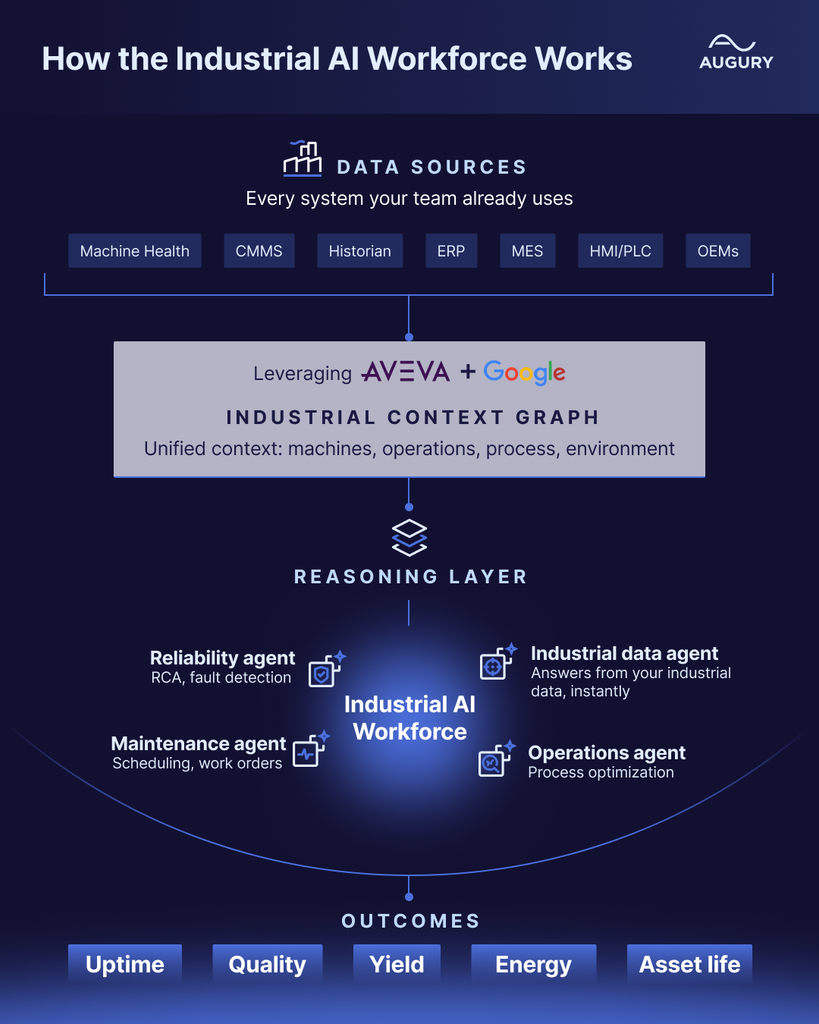
Want to see how it could help your teams? Learn more about our Industrial AI Workforce.
Frequently asked questions
Industrial AI is used in manufacturing and process industries such as food and beverage, building materials, oil and gas, pulp and paper, and pharmaceuticals. Essentially, wherever machines and processes generate data, industrial AI can help teams spot process and machine issues earlier, then take the necessary actions to resolve them.
To get started with industrial AI, your plant needs three things: machine and process data (e.g., flow, pressure, and vibration readings); plant context (e.g., maintenance records and work orders); and your team’s documented intrinsic knowledge about how things work. The AI combines and learns from these three data sets to give your team recommendations. Your team makes the final decision about what goes live.
Most plants already have much of what they need in separate systems, including historians, MES, and CMMS, so the first big step is connecting these sources. ISA-95, the international standard for enterprise-control system integration, offers a shared model for how these systems exchange information. Find a gap in your machine data streams? Industrial IoT sensors can fill in what you’re missing.
Traditional alarms fire when a single reading crosses a fixed limit, but industrial AI can read every change that takes place on your plant floor in the context of the equipment, process, and history around it. This enables industrial AI to give you a likely cause about what is changing and why, as well as recommended next steps, making industrial AI more actional than threshold-based alerts that only notify your team about a change.