



In the Loop with Anoop is a monthly series where Anoop Mohan, Chief Product & Technology Officer at Augury, shares his perspective on Industrial AI, the future of manufacturing work, and what it actually takes to build technology that serves the people on the plant floor. Subscribe on LinkedIn to get each new post delivered directly to you.
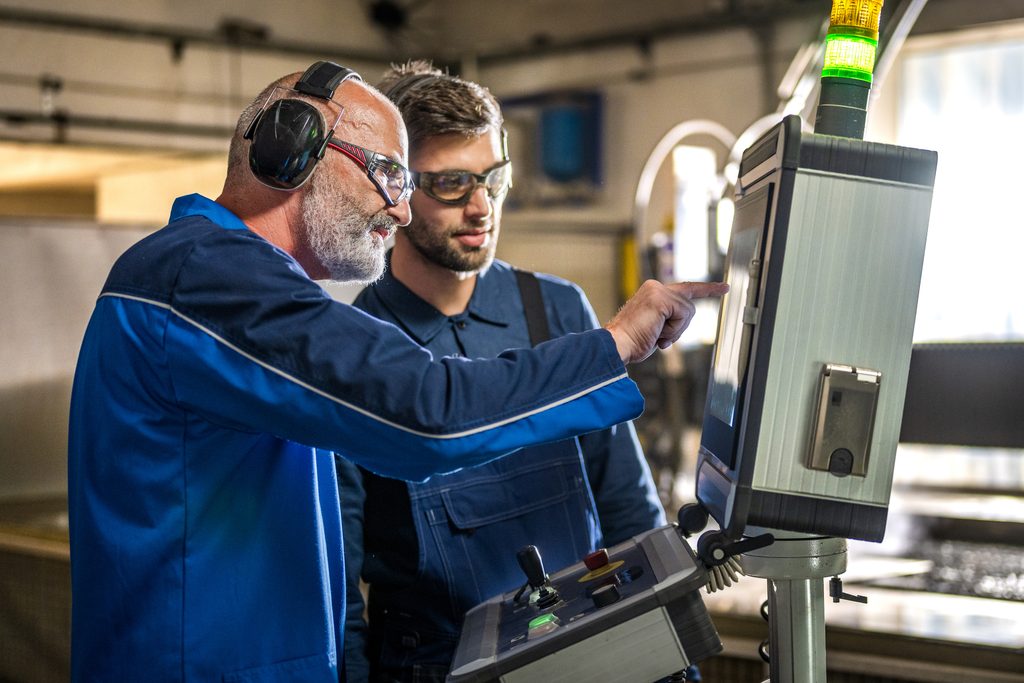
A customer’s senior process engineer, let’s call him “Bill,” is 66 and ready to retire. He knows the plant better than anyone alive, and without him, nobody else could tell you why one fix works and another doesn’t.
“I wish we could capture everything in his head,” the customer told me. There was real truth in that. Here’s the good news: we don’t need to replicate Bill’s thirty years of judgment from scratch. What his plant actually needed was a way to share all his hard-earned experience with whoever will fill his shoes next.
I’ve heard a version of that story at many plants I’ve visited. At one large consumer goods site, the team nicknamed a process engineer “the encyclopedia.” When I asked her whether she’d written down any of her extensive knowledge, she laughed. She told me trying to capture it would take longer than just doing the job.
The gap is closing
We often hear that 1.9 million jobs may be unfilled by 2033 if nothing changes. But when I sit with customers, they don’t worry about that number. They worry about a name. The name of the person whose retirement is already on the calendar, and who knows which reading means trouble before anyone else in the room does.
This is a version of the Agency Gap I’ve written about before. Different systems, different silos, and in the middle, one person holding the picture together in their head because nobody built a way to get it out of there.
Why the old tools never had a chance
Historically, knowledge transfer has been tough because every tool built to capture it didn’t track the way people actually think. Enterprise software runs on forms, fields, and mandatory rows. Ask someone to talk about a problem, and they’ll give you five hundred words, including which valve to check and the reading that told them something was wrong. Ask them to type it into a required field and it becomes ten words, just enough to get past the form.
That was never a willingness problem. It was a modality problem. Nobody had built an interface that matched how an expert actually explains what they know. Until now.
What changes when the interface is a conversation
Conversational, multimodal AI agents finally match how people share what they know. They listen the way a colleague listens, follow a thought as it wanders, and hold onto the parts a form would never capture.
Let’s go back to our friend, “the encyclopedia.” Since she was the most experienced engineer at the plant, we gave her a recording app. All she needed to do was push a button and talk. We asked her to use it on the drive home, ten minutes a day, for thirty days. That’s three hundred minutes, most of a working day, of knowledge that had never existed anywhere except in her head. At another site, we recorded a technician over the course of two days. Within 24 hours, we’d built an agent that was fielding questions the way he would have answered them.
None of that knowledge had ever been written down, because it had never had anywhere to go. Now it does.
Structure, then scale
Capturing the conversation is one problem. Making sure what’s captured is consistent and trustworthy, not just raw audio or video sitting in a folder, is another. That’s the piece our OKF Industrial Profile solves: an open-source standard we built with Google Cloud this year to structure what an expert says into something an agent can actually reason from, instead of re-consuming hours of recordings every time someone asks it a question. We open-sourced it because industrial AI shouldn’t be locked inside proprietary walled gardens. Common ground is the point.
It’s also why this doesn’t stop at one recording. I’ve written before about building context with a design partner over a ninety-day window: interviewing people, integrating data sources, getting an agent to roughly 70 percent of an expert’s judgment before it keeps learning on its own. That’s the same window we use here. Context and knowledge capture aren’t two separate efforts. They’re the same one.
Bill’s knowledge, Bill’s legacy
Bill spent thirty years becoming irreplaceable. Now he doesn’t have to be. His experience won’t retire when he does. Whoever replaces him inherits it on day one: the reading that means something’s off, the valve nobody remembered to check, the instinct that took Bill decades to earn.
So here’s my question for you: who’s the Bill on your team, and what happens when they retire? I’d like to hear it.
Explore the Industrial AI Workforce and see how knowledge never has to retire.


