
In manufacturing, machine learning (ML) is a category of AI in which algorithms learn from historical equipment and process data to recognize patterns, predict failures, and surface inefficiencies. Unlike traditional monitoring systems, which only trigger alerts when a value crosses a set threshold, ML models improve over time as they’re exposed to more data, making them better suited to the complexity and variability of real industrial environments. This guide covers the highest-impact use cases within a variety of manufacturing verticals, how ML and AI work together at the system level, and what it takes to put ML to work in your facilities.
It’s a perpetual goal in manufacturing: produce more, higher-quality products at minimum cost.
Machine learning (ML) is the technology that makes this goal achievable at scale. It’s also what helps manufacturers extend the life of their assets, improve yield while reducing waste, and lower maintenance costs.
This article covers how ML works in manufacturing, the use cases that deliver the most value, and how ML works together with (and differs from) AI. After reading this article, you’ll be able to clearly evaluate different ML technology capabilities, identify the right pilot use case for your facility, and understand how to put it to work within your operations.
What are the benefits of machine learning in manufacturing?
Machine learning in manufacturing delivers measurable value across three areas: reliability, process improvements, and more efficient operations. Manufacturing companies running advanced ML programs use findings from all three areas to improve their bottom line, including:
- Reliability benefits: less downtime and longer asset life
- Predictive Maintenance (PdM) means performing maintenance only when it’s needed. This reduces labor costs, maximizes uptime, and minimizes waste.
- Accurate Remaining Useful Life (RUL) predictions can mean fewer “unpleasant surprises” and unplanned downtime. Plus, learning the behavior of every machine helps you to operate within optimal conditions that simultaneously improve performance while maintaining Machine Health.
- Process benefits: yield and quality improvement, or waste reduction
- Optimizing production reduces the most common process-driven losses in manufacturing (yield, waste, quality, and throughput) while increasing capacity.
- As you streamline production processes, you can grow or expand product lines at scale.
- Getting actionable, ML-identified insights helps teams continuously improve quality.
- Process improvements help you respond to consumer trends quickly and confidently as market demands evolve.
- Operational benefits: lower maintenance costs and better workforce efficiency
- A well-monitored and synchronized production flow drives overall efficiency and effective inventory management.
- When humans and robots collaborate, human working conditions often improve and become safer.
How do these benefits come together? Machine learning models can identify asset failure signals before breakdowns occur by continuously analyzing sensor data coming from the plant floor, process records, and patterns from past runs. Surfacing the hidden causes of yield and quality losses helps teams implement timely changes to optimize throughput during production, not after a run is complete.
The difference between AI and machine learning in manufacturing
Artificial Intelligence (AI) is a broader category of machine learning. AI refers to any system that enables machines to perform tasks that typically require human judgment. Machine learning is a specific method within AI. Instead of being programmed with explicit rules, an ML system learns from data, detects patterns without being explicitly programmed to find them, and improves its performance over time.
| Machine learning (ML) | Artificial Intelligence (AI) | |
| What it does | Continuously analyzes industrial data to detect patterns, anomalies, and developing faults early, before they cause failures | Takes ML-detected signals and combines them with operational context (e.g., maintenance records, production schedules, and asset history) to determine what to do next |
| How it thinks | Finds patterns in historical and real-time data without being explicitly programmed to look for them. The more data it processes, the more accurate it becomes. | Reasons across multiple data sources simultaneously. It can correlate an ML signal with shift schedules, downstream production impact, and past repair outcomes to form a recommendation about what to do. |
| What it takes in | Sensor readings, vibration signatures, temperature data, process parameters, and historical production records | ML outputs plus operational context, including: CMMS records, production targets, parts availability, maintenance history, and shift schedules |
| What plant teams get from it | Early warning of developing faults and process anomalies. This gives teams time to act before an unplanned stop or quality loss occurs. | Specific, prioritized recommendations on what to do, when to do it, and who should act. This means teams spend less time diagnosing and more time executing fixes. |
| Where it’s used in manufacturing | Predictive maintenance; Remaining Useful Life (RUL) estimation; anomaly detection; yield and quality loss identification. | Prescriptive maintenance recommendations; work order orchestration; root cause investigation; production schedule optimization. |
| Manufacturing example | ML detects an abnormal vibration pattern in a motor weeks before failure. It flags this abnormality for the maintenance team to investigate before it causes an unplanned stop. | AI can correlate a motor fault with upcoming production targets, parts availability, and maintenance history. From here, it recommends the optimal intervention window to minimize production impact. |
What AI looks like in manufacturing: An AI reasoning layer takes in an ML-detected anomaly. It cross-references the real-time data with the asset’s historical data, maintenance records, and operational context (for example, what was being produced when the anomaly happened). After analyzing cause and effect, the AI shows your reliability engineer which machine component is likely degrading, why, and what to do.
What ML looks like in manufacturing: An ML system learns from thousands of historical data points from across your plant floor. From these learnings, it can understand which temperature patterns precede failures for a specific asset. Because it can analyze and cross-reference so many variables, some of the patterns the ML discovers will likely fall outside the scope of what a human engineer would have thought to code, or what a human has the biological capacity to analyze alone.
Truthfully, most of what gets called “AI” in manufacturing is actually machine learning: algorithms trained on sensor readings, process data, and historical records to recognize patterns and make predictions. If you’re vetting agentic manufacturing vendors and they’re making broad claims about a tool or system being AI, make sure you get specific details about how the tools actually work before taking those claims at face value.
Emerging technologies within manufacturing, including agentic AI, extend beyond traditional machine learning algorithms. We’ll get into these later in this article.
How AI and machine learning work together in manufacturing
Machine learning is the “detection” layer in manufacturing, responsible for identifying patterns and signals in your industrial data. AI systems, particularly agentic AI, are the “action” layer. AI takes the ML’s signals and combines them with operational context, historical records, and expert knowledge to understand what they mean. This is how AI can determine what to do next before passing these instructions on to your plant team to execute.
In manufacturing, blending ML and AI is how you close the gap between a diagnostic insight and a production decision. Even though an ML model might flag an anomaly in process data, you need AI to correlate the anomaly with Machine Health data, production targets, and shift schedules in order for it to recommend the specific resolution steps.
Augury’s Operations Agent is an excellent example of how ML and AI can be combined in practice for optimizing yield and throughput across high-variability production lines. First, ML models surface process drift or anomalies from real-time data coming in from the plant floor. The AI agent correlates variables against yield outcomes by combining ML signals with production data, historical patterns, and the right operational context to help teams understand what’s happening and determine next steps.
Bringing AI and ML together enables your teams to move from traditional machine health practices, such as simply detecting issues, to fully orchestrating and executing immediate fixes as issues arise. Ultimately, this is how industrial teams can finally operationalize the data they’ve always had but couldn’t act upon fast enough (if at all).
What are common machine learning use cases in manufacturing?
Two of the highest-impact use cases for machine learning in manufacturing are predictive maintenance and predictive quality and yield. Predictive maintenance uses ML algorithms to anticipate equipment failure so teams can schedule ad hoc repairs. Predictive quality and yield applies multivariate ML analysis to production process data to find the hidden causes of losses in quality, throughput, and efficiency.
Let’s take a look at these two benefits in greater detail.
How manufacturers use machine learning for predictive maintenance
Predictive Maintenance (PdM) means your plant floor team uses algorithms to predict the next failure of a component, machine, or system. Personnel can be alerted to perform focused maintenance procedures to prevent the failure, but not so early as to waste downtime. The advantages of PdM are numerous and can significantly reduce costs while eliminating the need for unplanned downtime in many cases.
Predictive Maintenance is a well-known concept within industry because maintenance issues drive up high costs, and the trickle-down effect of poor maintenance can gut your margins and uptime. And yet, according to a report published by Plant Services, 74% of manufacturers surveyed said they still rely on manual preventive maintenance strategies.
Traditional manual and semi-manual maintenance approaches rely on teams to perform maintenance according to a predetermined schedule. Some manufacturers may use SCADA systems set up with human-coded thresholds, alert rules, and configurations to monitor equipment status against manually set safety or performance thresholds.
But the problem with traditional maintenance programs is that they don’t take into account the more complex dynamic behavioral patterns of the machinery. They also don’t make use of contextual data relative to the manufacturing process at large. For example, a sensor on a production machine may pick up a sudden temperature spike. A static, rule-based system wouldn’t know that the machine is undergoing sterilization and would likely trigger a false-positive alert.
Machine learning algorithms can preemptively identify failures, helping systems continue functioning without unnecessary interruptions. When maintenance is needed, it’s very focused: technicians are informed of the specific components to inspect, repair, or replace; the tools they need to use; and the right methods to follow.
As an added benefit, predictive maintenance can result in a longer Remaining Useful Life (RUL) for equipment because PdM minimizes secondary damage. A robust PdM program also requires smaller labor forces to perform maintenance procedures, as teams are used more efficiently and only do work when it’s necessary.
How machine learning identifies the hidden causes of yield and quality losses
Predictive Quality and Yield (sometimes referred to as just “Predictive Quality”) uses machine learning algorithms uniquely trained to understand individual production processes. This enables the algorithms to automatically identify the root causes of process-driven production losses using continuous, multivariate analysis.
Automated recommendations and alerts can then be generated to inform production teams and process engineers of an imminent problem and seamlessly share important knowledge on how to prevent the losses before they happen. This is how Predictive Quality reveals the hidden causes behind many perennial process-based production losses, such as quality, yield, waste, throughput, energy efficiency, or emissions.
Reducing these types of losses has always been a struggle for manufacturers. But this mission is more important than ever.
For starters, consumers’ expectations are sky-high, with global consumer habits gradually “westernizing” even as the population boom continues. According to a 2024 United Nations report, the global population is projected to reach 9.8 billion by 2050, which equates to more than 225,000 additional mouths to feed every day.
Consider, too, that consumers can choose from so many alternatives for almost every product imaginable. A 2026 survey of 1,000 U.S. consumers found that 82% would “try out a competitor” if their favorite product isn’t on the shelf, which may result in permanent brand switching. Brand switching is particularly challenging for food and grocery manufacturers (53% of consumers would switch when facing a stockout) as well as beauty and personal care manufacturers (22% of consumers).
Against such demands, you can no longer afford to absorb process inefficiencies and their associated losses. Every loss in terms of waste, yield, quality, or throughput chips away at your bottom line and hands another win to your competitors.
But without the right technologies, many manufacturers have hit the limits of their process optimization efforts. Some inefficiencies don’t have any obvious cause, either, leaving process experts at a loss to explain them.
Core machine learning applications, including predictive maintenance and predictive quality analysis, help you address these challenges head-on in ways that traditional threshold-based monitoring systems and calendar-driven maintenance programs fall short.
What are examples of machine learning in manufacturing?
Real-world examples of machine learning in manufacturing include:
- Predictive maintenance on rotating equipment: ML models trained on vibration and temperature data detect developing faults in motors, pumps, compressors, and gearboxes days to weeks before failure, so teams can intervene before breakdowns occur.
- Predictive quality and yield analysis: multivariate ML models identify which process variables drive losses in throughput, product quality, and efficiency, surfacing root causes that manual inspection can’t consistently find.
- Automated root cause analysis: ML cross-references machine health data, production records, and historical fault patterns to compress time-to-diagnosis from hours to minutes.
- Anomaly detection on production lines: unsupervised ML algorithms establish a normal operating baseline for each asset, then flag deviations before they escalate. This reduces the false positives often generated by threshold-based systems.
- Remaining Useful Life (RUL) prediction: supervised regression models estimate how many cycles or days remain before a component fails, enabling maintenance teams to plan interventions at the lowest-cost window.
- Predictive quality inspection: ML models trained on sensor and process data identify which production conditions correlate with defects or out-of-spec product before the batch is complete.
| Industry | Example ML use case | Real world outcome |
| Food and beverage | Predictive maintenance on production lines | Zero unexpected breakdowns across four plants (PepsiCo/Frito-Lay) |
| Consumer packaged goods (CPG) | ML-powered anomaly detection on rotating equipment | Prevented 500,000 lbs. of scrapped product (Hill’s Pet Nutrition) |
| Pharmaceuticals | Continuous monitoring on batch-processing equipment | 2.1 million doses saved; $1.8M annual savings |
| Building materials | 24/7 anomaly detection on shingle production lines | 16 machine saves, 98% alert response rate (GAF) |
Machine learning in Food and Beverage manufacturing example
PepsiCo’s innovation arm, PepsiCo Labs, partnered with Augury to deploy its Machine Health Solutions across Frito-Lay snack food production facilities. The company’s goal was straightforward: reduce unplanned downtime as part of a broader operational excellence initiative. But even with a clear business target to hit, teams had no reliable way to see machine failures in advance.
PepsiCo Labs ran a rigorous, objective side-by-side evaluation of multiple solutions before selecting Augury as its Machine Health solution. Augury’s ML-powered anomaly detection continuously monitors the acoustic and vibration signatures of production equipment on the Frito-Lay lines. The system flags developing faults in motors, blowers, and other rotating assets before they escalate into unplanned stops.
“We scouted the world for different solutions, big companies and small companies, and we objectively tested them side by side. Augury was the solution that came on top,” said Anna Farberov, General Manager of PepsiCo Labs.
The results from the initial one-year pilot across four Frito-Lay plants were decisive. The team recorded zero unexpected machine breakdowns, avoiding over 4,500 hours of downtime and saving more than one million pounds of food from being wasted due to sudden stops.
“After a year, the Frito-Lay [pilot plants] had zero breakdowns, interruptions, or incremental costs,” said Clark Michael, Supply Chain Director at PepsiCo.
Following the pilot, PepsiCo scaled Augury’s predictive maintenance solutions across nearly all of Frito-Lay’s U.S. plants.
Machine learning in Consumer Packaged Goods (CPG) manufacturing example
One of Colgate-Palmolive’s leading brands, Hill’s Pet Nutrition, uses Augury’s Machine Health Solutions to optimize its maintenance program. Their goal was to use Augury’s ML and AI solutions to improve machine performance and reduce downtime.
Before using Augury, the company relied on preventative maintenance methods to schedule and manage asset health. Manual inspections and calendar-based maintenance schedules made it nearly impossible to identify critical faults before issues or shutdowns arose.
The team brought in Augury’s solutions to help them adopt a predictive maintenance approach. By deploying ML-powered anomaly detection on rotating equipment across the entire plant, Hill’s Pet Nutrition could catch developing faults weeks earlier, even if the issue wasn’t audible to the human ear.
“Now that we have data that tells us what’s going on with our equipment, we can make exact plans and understand what we need to do, to work on, to make our equipment run the way it’s designed,” said Adam Kilgore, Maintenance & Reliability Leader at Hill’s Pet Nutrition.
The results were immediate. In one instance, Augury’s ML system flagged a developing blower fault and predicted failure before it occurred, saving the company from scrapping nearly 500,000 pounds of product. The financial impact was undeniable, too.
“Within the first six weeks, we had two Machine Health events that basically paid for the entire fit-out of [the] plant for the entire year,” said Warren Pruitt, Vice President of Global Engineering Services at Colgate-Palmolive Company.
According to Pruitt, Colgate-Palmolive has expanded Augury to all its North American plants, in addition to many of its European, Latin American, and Asian plants.
Machine learning in Pharmaceutical manufacturing example
Pharmaceutical manufacturing requires zero tolerance for product quality. A single equipment failure during batch pharma processing can cause unplanned downtime and destroy an entire product run. The trickle-down impact of waste, regulatory risk, and delays in delivering critical medications can wreak havoc on a pharmaceutical manufacturer.
For one of Augury’s global pharmaceutical manufacturing clients, this reality was too much to continue managing with manual monitoring and calendar-based maintenance schedules. By deploying Augury’s ML-powered anomaly detection on batch-processing equipment, the team gained continuous visibility into the mechanical health of their production assets. Now, they can intervene early, before faults can contaminate or result in a scrapped batch.
Augury’s ML-driven Machine Health monitoring has helped one generic and biosimilar manufacturer save 2.1 million doses of product. Another global pharmaceutical manufacturer saw an annual savings of $1.8 million by giving plant floor teams the Machine Health data (and answers) they needed before it was too late. And, most importantly, before low-quality products made their way to the people who need it.
“Our customers at the end of the day are patients,” said an engineering maintenance technician at a global supplier of human and animal health products. “Augury helps me make sure our machines are healthy so we can make sure we deliver the products our customers need.”
Machine learning in Building Materials manufacturing example
GAF, North America’s largest roofing materials manufacturer, deployed Augury’s Machine Health Solutions across its production facilities as part of its shift from time-based preventive maintenance to ML-powered predictive maintenance on rotating equipment.
Before adopting Augury, the GAF team in Michigan City, IN, faced an all-too-common set of maintenance challenges. They had difficulty accessing equipment and capturing asset data, which resulted in missed early detection of mechanical issues. Without continuous data from the plant floor, the team had no reliable way to see problems coming. Sometimes, when machine failures occurred, essential parts weren’t readily available and caused undue stress and high costs.
With the capability of producing enough material to roof approximately 30 homes per hour, the stakes were unbearably high for the Michigan City team.
“If you’re down for 40 hours, that’s 1,200 homes not getting roofed,” said Davis Popp, Maintenance & Reliability Engineer at GAF’s Michigan City site.
By deploying Augury’s anomaly detection across their shingle production lines, the GAF teams gained 24/7 visibility into the health of their rotating assets. The team could now catch developing faults before they escalated into unplanned stops.
“Augury prevents us from going down, especially unexpectedly,” said Popp.
The results earned GAF’s Michigan City and Ennis sites Augury’s 2024 Beam of Excellence award for Maintenance & Reliability. This recognition is given to the top 5% of facilities across Augury’s entire customer base. GAF’s Michigan City plant logged 16 machine saves and improvements with a 98% average alert response rate in 2024. GAF’s Ennis site, which also runs Augury’s Machine Health Solutions, recorded 31 machine saves and improvements with a 97% average site serviceability.
Two categories of machine learning in industrial manufacturing: supervised and unsupervised
Machine learning for manufacturing applications falls into two primary approaches: supervised learning (where the algorithm trains on labeled data with known outputs) and unsupervised learning (where the algorithm finds patterns in data without predefined categories).
Practically speaking, most industrial ML applications blend both approaches because they fit different demands on the floor. Predictive maintenance models often use supervised regression to estimate remaining useful life because there’s a clear, continuous output (i.e., time or cycles until failure) that the algorithm can be trained toward. Anomaly detection is typically unsupervised because its primary role is surfacing unusual process behavior before it results in losses.
Supervised machine learning in manufacturing
Supervised machine learning is the most commonly used technique in manufacturing because it leads to a predefined target. You have the input data and the output data. You want to map the function that connects the two variables. That’s where ML comes in.
Supervised machine learning demands a high level of involvement: data input, data training, defining and choosing algorithms, data visualizations, and so on. The goal is to construct a mapping function with a level of accuracy that allows you to predict outputs each time new data enters the system.
The ML algorithm is fed and trained on an initial training dataset. By working through further iterations, the ML continues improving its performance, with the ultimate goal of reaching your defined output. The learning process is considered complete once the algorithm reaches an acceptable level of accuracy.
In manufacturing, the two most common supervised learning approaches are regression and classification. Both of these approaches share the same goal: to map a relationship between the input data (from your manufacturing process) and the output data (your known possible results, such as quality or waste losses, part failure, overheating, etc.).
Let’s take a look at how to conduct both of these ML supervised learning approaches.
Regression
Regression should be used when data exists within a range. This is often the case when analyzing sensor data, like temperature or weight.
For regression, the most commonly used machine learning algorithm is Linear Regression. It’s fairly quick and simple to implement, and its output is easy to interpret.
In manufacturing, regression can calculate an asset’s estimated Remaining Useful Life (RUL). This is a prediction of how many days or cycles you have before the next component, machine, or system failure.
An example of linear regression in manufacturing would be an ML system that predicts a machine’s temperature. This is because temperature is a continuous value with an estimate that would be simple to train an ML algorithm on. Once trained, the model can forecast temperature spikes so operators can schedule maintenance before the equipment overheats. It can also flag any temperature deviations that fall outside the asset’s expected range. This can indicate potential problems, enabling maintenance teams to check things out before failure.
Classification
When data exists in discrete, well-defined categories, use classification. Machine status is a good example of discrete sensor data: operational, idle, and faulty are all distinct and easy to categorize.
Logistic Regression (for binary outcomes like pass/fail) or Random Forests (for multi-category outcomes) are both commonly used machine learning algorithms. These algorithms are great at handling complex sensor patterns efficiently while providing teams with clear probabilities for each category decision.
Classification can be used in manufacturing to perform automated Quality Assurance (QA) or fault detection. It enables you to predict which category a part or machine state falls into, which makes it easier to identify whether a part is working correctly or possibly defective.
Learn more: 10 Common Machine Fault Types Detected
An example of classification in manufacturing would be an ML system that predicts a machine’s operational health state using vibration sensor data. First, an ML algorithm would be trained to understand and recognize health statuses (e.g., Normal, Warning, Critical).
Once trained, the model can automatically categorize real-time vibration sensor streams. It immediately alerts your maintenance team to the exact type of failure taking place, helping them intervene quickly and efficiently before a breakdown.
Unsupervised machine learning in manufacturing
Unsupervised learning is best for cases where you don’t yet know the outcome, but you have a lot of raw, unlabeled data. For example, you might have thousands of machine sensor data points, but you don’t fully understand which data indicates a “good” or “bad” machine status.
There are two primary unsupervised ML approaches used in manufacturing: clustering and Artificial Neural Networks (ANNs).
Clustering
Clustering involves creating clusters of input data points that share certain attributes so an ML algorithm can discover underlying, hard-to-find patterns in the data set. This is useful when you don’t know the outcome of the data or any information describing the data (e.g., no data labels).
Clustering can also be used to reduce noise (e.g., irrelevant parameters within the data) when you’re dealing with a ton of data variation.
Artificial Neural Networks (ANNs)
Artificial Neural Networks (ANNs) are proving to be an extremely effective unsupervised learning tool within industrial manufacturing. ANNs are used for a variety of applications within manufacturing, including production process simulation and Predictive Quality Analytics.
The basic structure of an ANN is loosely based upon how the human brain processes information using its network of ~100 billion neurons to solve extremely complex and versatile problems. In practice, an ANN passes data forward through a series of connected layers. Each node in a layer receives inputs, applies a mathematical weight to them, and passes its output to every node in the next layer.
The network adjusts the weights during its training until its predictions match known outcomes. This process is called backpropagation. The final result is an ML system that can recognize patterns that are far too subtle or complex for rule-based programming to capture accurately.
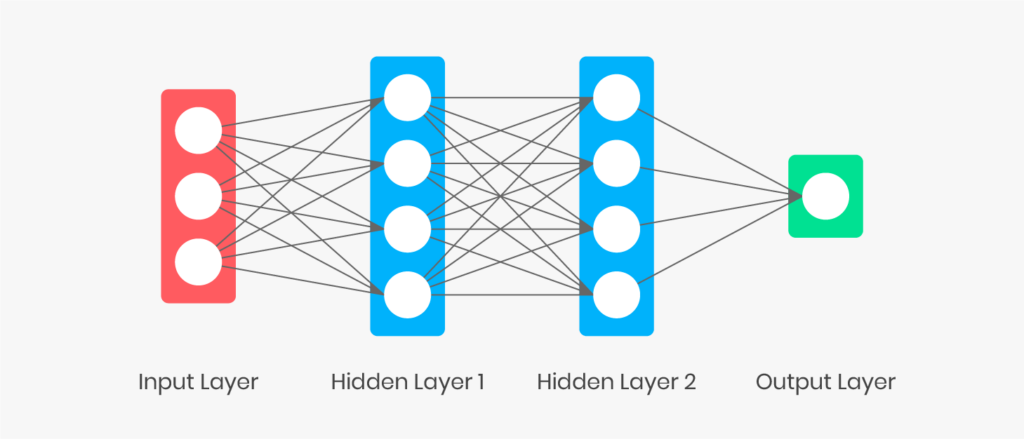
The ability to process a large number of parameters through multiple layers makes Artificial Neural Networks excellent at recognizing nonlinear patterns within variable-rich and constantly changing manufacturing processes. Moreover, once properly trained, an ANN can demonstrate a high level of accuracy when creating predictions around the mechanical properties of processed products. This can help you, for example, reduce the cost of raw materials.
Get machine learning right from the start: focus on data preparation and use case fit
Getting machine learning right comes down to two equally important things: starting with the right question and building your ML models on clean data from a variety of sources. Manufacturers who define a specific, answerable problem before selecting a specific ML vendor consistently outperform those who start with a platform and work backward.
Data preparation for training manufacturing machine learning algorithms
Starting with the right question, not the algorithm, is the discipline that separates successful ML programs from stalled ones. You’ll need to get specific in the question you’re asking, too. Broad goals, like “improve quality,” aren’t clearly defined enough for an ML to work through and problem-solve. Instead, make your question super granular, like, “What process variables predict yield losses on Line 3?”
Once you have the question you want to answer, it’s time to bring in as many relevant sources as possible. You’ll get the most accurate ML models by collecting historical process and machine data from as many sources as possible. Sensors, quality records, maintenance logs, batch data, and environmental factors…any of these could make the difference in sharpening the model’s overall accuracy.
You can’t just throw any data into the mix, either. Like any “learning” technology, machine learning is only as good as the data it trains on. Your data must be clean and validated as correct: training a model on poor or inaccurate data will give you a poor and inaccurate model.
How to select the right manufacturing use case for ML
Not every problem within your production process will benefit from ML. Yes, predictive maintenance and predictive quality are solid high-fit choices for ML. But some problems can’t be solved well using ML.
Some examples of manufacturing use cases that aren’t right for ML include:
- Any process, challenge, asset, or operational condition that lacks historical data.
- Highly unstable processes, such as a new production line or product launch that’s still in ramp-up, where settings and recipes change too often to establish a reliable baseline.
- Any scenario where there’s no clear “output” variable to train the model towards. If the model doesn’t have a clear sense of what it’s trying to achieve, it will have a hard time building something useful and accurate for your team.
The reality is that there are numerous potential applications for AI and machine learning in industrial manufacturing. Each use case requires a unique approach.
We developed a simple, effective formula to select the right industrial AI solution to address your specific manufacturing challenges and goals using ML and AI. We call this methodology the Industrial AI Quadrant:
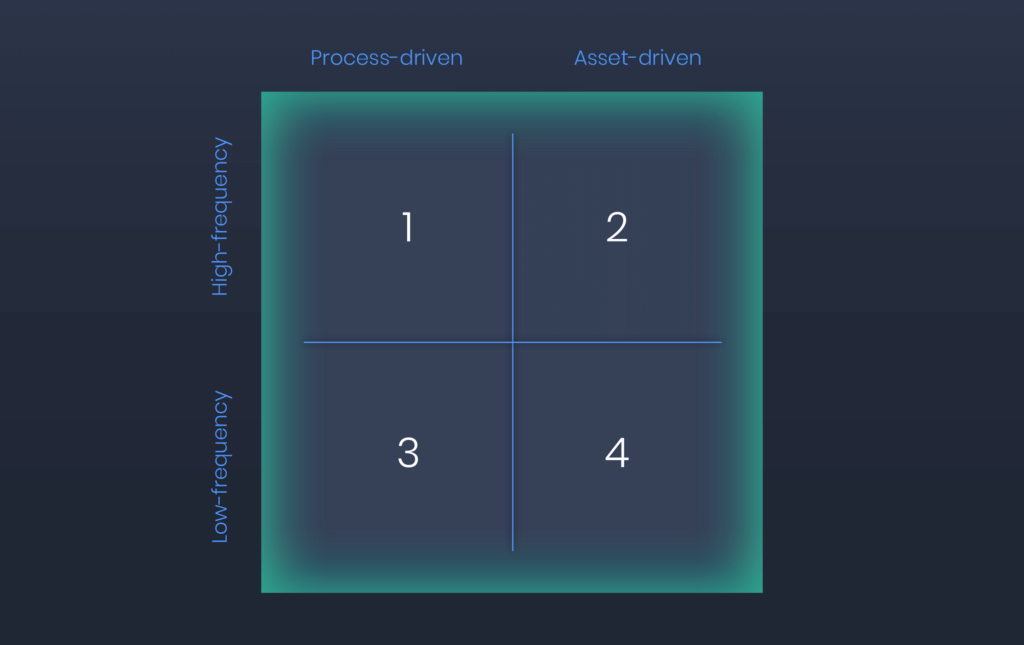
The Industrial AI Quadrant helps you map a given production challenge to the right ML approach using two parameters: the underlying cause of the problem (does it originate within the process, or from an asset?) and how frequently the problem occurs (often or rarely).
Here is how each quadrant matches up with different manufacturing use case categories, including how ML can help:
| Quadrant | Focus and Frequency | Manufacturing use case example | ML approach |
| 1 | Process-driven / High-frequency | Optimizing product quality and yield | Supervised ML (learning from extensive, labeled historical data). |
| 2 | Asset-driven / High-frequency | Repeatedly failing or misaligned machinery parts | Hybrid models (using process data as a proxy to find the root stressor). |
| 3 | Process-driven / Low-frequency | Complex, multi-variable process anomalies | Multivariate, unsupervised ML (tracking subtle data deviations from a perfect baseline). |
| 4 | Asset-driven / Low-frequency | Sudden, catastrophic mechanical breakdowns | Unsupervised ML (relying on continuous vibration or acoustic feeds). |
From machine learning to the Industrial AI Workforce
Machine learning doesn’t change what manufacturers are trying to achieve, but it can change what’s possible as you pursue your goals.
The most successful manufacturing teams start with a specific problem, build on clean data, and match the right ML approach to the right use case. Going into their ML program with the right approach is the difference between a few successful use cases, like reducing downtime or increasing yields, and a solid operational foundation that prepares your company for agentic AI to be actionable when you’re ready for it.
Curious about how ML and AI could help you tackle your biggest bottlenecks? Reach out to our team to learn more.
FAQs
-
How is machine learning used in manufacturing?
Machine learning is used in manufacturing to analyze continuous data from machines, sensors, and production processes to identify patterns that human teams can’t consistently detect at scale. The most common applications are predictive maintenance (where ML models alert teams to developing equipment faults before failure) and predictive quality and yield analysis (where ML surfaces the process variables causing losses in throughput, product quality, and efficiency).
Beyond these two core use cases, machine learning also supports visual quality inspection, demand forecasting, and supply chain optimization.c
-
What are examples of machine learning in manufacturing?
Examples of ML in manufacturing include:
- ML models trained on vibration monitoring and temperature data to predict bearing or motor failures before they cause downtime
- Multivariate process analysis that identifies which production variables are driving yield losses on a specific line
- Computer vision systems that inspect products for defects faster and more consistently than manual methods
- Demand forecasting models that synchronize inventory and production schedules to reduce waste.
In each of these use cases, ML learns from historical data rather than following manually programmed rules. This is why ML is more adaptive and accurate than traditional machine health methodologies and helps teams solve long-standing problems that evade rule-based and time-based approaches.
-
What’s the difference between AI and machine learning in manufacturing?
Artificial Intelligence (AI) is the broader discipline and applies to any system that enables machines to perform tasks requiring judgment or reasoning. Machine learning (ML) is a specific technique within AI, in which algorithms learn from data rather than being explicitly programmed to follow prescribed decision logic.
In manufacturing, most practical “AI” applications are actually powered by machine learning. Most of these tools are just algorithms trained on equipment or process data to recognize patterns and make predictions. While this is still highly valuable, the distinction between what’s ML and what’s true AI matters when evaluating industrial manufacturing AI and ML vendors.
If you’re on a demo call and the company makes broad AI claims without specifying the exact method used, it’s worth asking more detailed questions about how it all comes together.
-
How can manufacturers start using machine learning?
The most reliable starting point is a specific problem with an existing data record: a recurring equipment failure, a quality issue that appears on a particular line, or a yield loss with no obvious cause. Make sure you define the question you want answered before you select a technology or vendor.
Once you’ve chosen your question, assess whether you have the historical data needed to train a model. Ideally, you’ll have at least 12 months of relevant data with enough examples of the outcome you’re trying to predict.
By starting with a well-scoped pilot on a high-impact problem, you’ll drastically improve your chances of building an ML model and use case that builds organizational trust in the tech.
-
What data does machine learning need to work in manufacturing?
Machine learning in manufacturing performs best when trained on data from multiple sources simultaneously, such as:
- machine sensor data (vibration, temperature, pressure)
- process data (parameters, set points, batch records)
- quality and lab data
- maintenance records
- production logs
The more sources you can bring into the model, the more complete the picture of what’s actually happening on the line. That’s vital when getting an ML model to correlate causes and effects within your plant.
Keep in mind that data quality matters at least as much as volume. You’ll need clean, consistently labeled historical data with plenty of examples of the outcome being predicted. This is more valuable than a large dataset with inconsistent labeling or significant gaps, as well-structured historical data gives the model something viable to point toward.