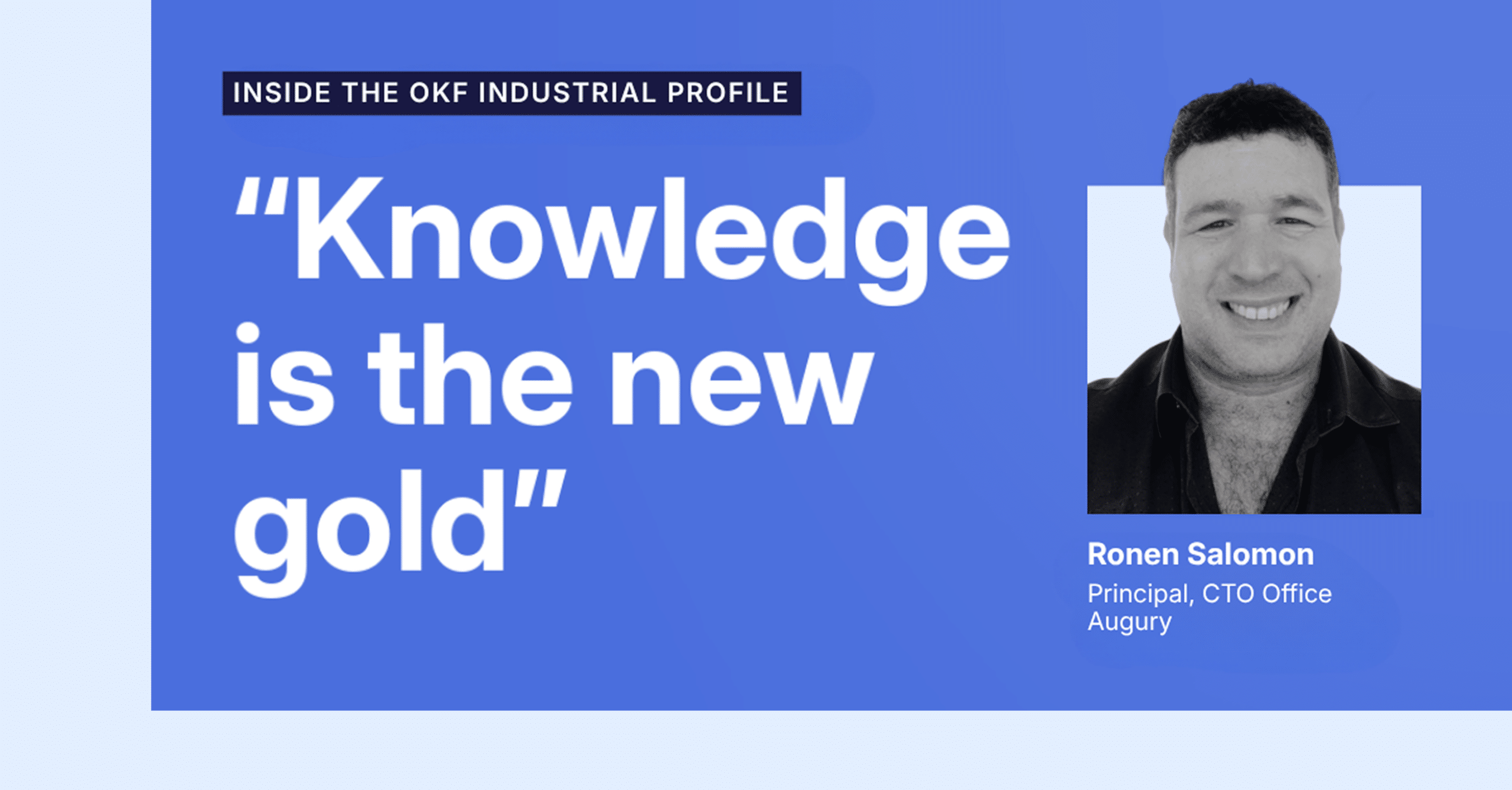
When an experienced operator retires, decades of judgment about how the machines behave goes with them. The OKF Industrial Profile, Augury’s open-source profile of Google Cloud’s Open Knowledge Format, gives that knowledge a structure: plain files a reliability engineer can review and any AI agent can use. Ronen Salomon, Principal, CTO Office, on how it came together.
You lead hardware and ecosystem work at Augury. How did you end up building a knowledge format?
I’ve been at Augury for seven years, building sensors and systems. In that time, we built sensors, gateways, the lab, test guidelines, and the team around all of it. There was no cookbook for any of that. We wrote it as we went.
It’s the same kind of problem here. The knowledge that makes production make sense, from one machine to the whole process, is spread across documents, systems, and the people who know it best, and very little of it travels. The OKF Industrial Profile is a way to write that context down, in files anyone can read, so it stays with the plant and reaches everyone who runs it. If a person can read the file and understand it, AI can too.
Why now?
Google Cloud introduced the Open Knowledge Format this past June. That opened up room for an industrial profile, and being early to that conversation matters.
Think about USB. Everybody knows USB. If something is going to become the shared way of doing this, you want to be inside it, not running a variation off to the side.
Everyone knows the AI buzzwords by now. What isn’t settled is how an AI agent actually consumes industrial data: what a tag means, how fresh a signal has to be before you trust it, how one machine’s behavior connects to the process around it. That’s still taking shape, and we want to help shape it.
Every plant has two or three people who just know things nobody wrote down, and some of them are retiring. How does this help a site solve that problem?
Every site has people who can walk past a machine and tell you what’s happening with it. That’s 25 years of pattern recognition, and it’s some of the most valuable knowledge a plant has. They’re glad to share it. It comes out in their own words, in the moment, which is exactly why it’s worth capturing in a form the whole team can use.
And this matters more every year. Younger people entering the workforce want to work with tech. The sites still need to run, and they run on nuance. So we catch the facts while the people who know them are still on the line.
Plant teams trust recommendations they can trace. What does traceability actually change for an operator on the floor?
Nobody shuts down a line because the software said so. They shut it down because they can see something and explain why.
Trust comes from accuracy and evidence. When a recommendation traces back to its source, the team can weigh it against what they already know and decide for themselves. That’s the rule: show the source, and let the people who know the machine make the call.
The wording matters too. If the reasoning comes back sounding like a process manager with 25 years on the line, that lands differently than a system talking at them. It’s the same thing you do with any AI assistant when you tell it to drop the jargon and give you the facts in plain language.
The goal is to give the team a better foundation for the calls only they can make..
The profile captures not just what a machine is, but which of its sensor readings to trust. From the hardware side, what does that unlock?
Before predictive maintenance, people put their hands on a machine and said it was rotating too much. They weren’t there 24/7, but when they said something was wrong, they were usually right. Bad mounting, a loose bracket, something off with the speed. Predictive maintenance made that continuous and gave those people their time back.
What’s different now is scale. An industrial site has far more data and sensors, and it’s more than any person can keep in their head. So it gets written down, and writing it down settles a lot of arguments before they start.
You contributed this to Google Cloud’s open ecosystem rather than publishing something proprietary to Augury. Why does that matter for adoption?
If you want an ecosystem, you have to be in one. Google Cloud publishing the Open Knowledge Format gives the industry a shared foundation. Common ground is the point.
If this works the way you want, what’s different for plant teams in a few years?
Time is money, and nobody wants to reverse-engineer twice. When machine history is lost, predictive maintenance gets much harder than it needs to be. If a reliability engineer can get an answer in minutes because the site’s knowledge was captured during onboarding, that’s a better day for everyone on the call.
Here’s how I’d put it: knowledge is the new gold. Everybody is going to have agents. What separates them is context: real data from a real plant. If you get that right, AI gets more reliable and more useful for the site, and we get closer to answering the questions that decide how well a plant runs.
For someone who finds the profile on GitHub tomorrow, where do they start?
Start with the problem you want to solve, not the format. Then look at what data you already have, including the parts that only exist in people’s heads, and find the simplest way to get it out: writing, recording, or someone sitting down to talk it through.
The OKF Industrial Profile is open source and available on GitHub.