
A few incredible days at the North American Manufacturing Excellence Summit made one thing clear: the manufacturers pulling ahead aren’t waiting to see how others use AI. They’re preparing to use AI agents to empower every employee.
The knowledge crisis hiding in plain sight
I’ve been attending conferences focused on digital transformation for years. NAMES 2026 felt different. Every session I attended circled back to the same structural challenge: the generation of engineers and technicians who built and ran modern manufacturing is retiring, and they’re taking decades of hard-won expertise with them. The kind of reliability knowledge that lives in pattern recognition, in intuition built from thousands of hours on the floor, in knowing which machine sounds slightly off before any alarm triggers.
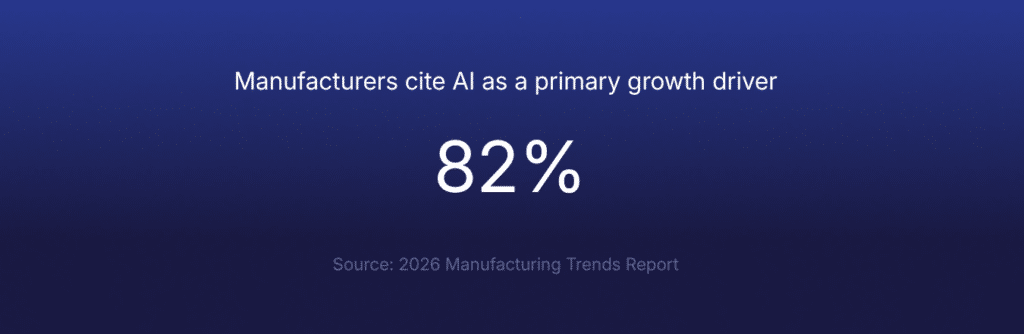
As experienced workers retire and operational complexity increases, manufacturers are increasingly turning to AI to preserve and scale institutional knowledge. A 2026 industry report found that 82% of manufacturing executives now see AI as a core growth driver, while other 2026 manufacturing research highlights workforce readiness, data continuity, and operational expertise as critical barriers to scaling modern operations.
The World Economic Forum has emphasized that AI and automation should be used to augment (not replace) the industrial workforce. In its 2025 and 2026 workforce research, WEF highlighted that manufacturers are facing widening skills gaps as AI, robotics, and digital technologies reshape operations, making continuous upskilling, digital training, and human-machine collaboration essential to future competitiveness. This isn’t about doing more with less. It’s about helping experienced employees scale their expertise and giving newer workers faster paths to proficiency than previous generations ever had.
Agentic AI: the difference between a tool and a teammate
Much of the NAMES conversation distinguished between two generations of industrial AI. The first was reactive: dashboards, alerts, reports that give teams better information. That value is real, but it still relies entirely on an experienced person knowing what to do with the signal. The gap between insight and action still runs through your most senior experts.
The manufacturers and industry leaders best positioned for the years ahead are those willing to rethink how humans and intelligent systems work together…strengthening resilience, accelerating learning, and unlocking new sources of optimization.
Agentic AI closes that gap. An agent doesn’t wait to be consulted. It perceives, reasons, and acts within defined boundaries, escalating to a human when judgment is required, and handling the rest autonomously. More importantly, it carries with it the logic and pattern recognition of the best practitioners in the field. A newer technician working alongside an agent isn’t starting from scratch; they’re working alongside a system that embodies the expertise of the most experienced engineers in the industry.
That’s a fundamentally different proposition than any training program or knowledge management system I have experienced before. It’s not about transferring knowledge to people over time. It’s about making that knowledge available to every person, on every shift, in real-time.
Building the team your operation deserves
Manufacturing has a lot of machine whisperers out there. But that workforce is aging, and I need tools that our people can use to help guide their jobs.
What Jason Stevenson described at NAMES is something reliability and operations leaders across manufacturing recognize immediately: the data is there, the talent is there, but connecting them in real time across every shift, every asset, every process variable is where the gap lives.
That gap is exactly what the Industrial AI Workforce is built to close.
Think of it less as software and more as the addition of deeply experienced team members who never clock out. Each one brings a specific kind of expertise to your operation, and each one is built on a foundation that no general-purpose AI tool can replicate: over 15 years of continuous machine data, more than a billion operating hours, and the collective pattern recognition of the reliability engineers and plant operators who define what excellent industrial operations actually look like.
The Reliability Agent puts the pattern recognition of a 30-year reliability veteran at every technician’s fingertips, continuously monitoring assets, applying predictive maintenance analytics to contextualize anomalies, and guiding the right action before failures occur.
The Operations Agent empowers operators and engineers to see process deviations the way your most experienced team members do, connecting equipment behavior, process conditions, and production outcomes into real-time production intelligence.
The Data Exploration Agent gives every engineer, from day one to year twenty, instant access to answers buried in your industrial data, without needing to be a data scientist to ask the right questions.
Anoop Mohan, Augury’s Chief Product and Technology Officer, put it plainly on the NAMES stage: the goal is 30% productivity improvement for every person in industrial operations, driven not by working harder, but by making every decision better informed and faster.
The next generation deserves better than starting from zero
Here’s what struck me most across all the NAMES conversations: the engineers and technicians entering the workforce today are talented, motivated, and tech-native. What they’ve historically lacked isn’t capability, it’s context. The kind of contextual knowledge that only came from standing next to someone who’d seen a thousand failures, who could tell you not just what the data said but what it meant.
Agentic AI changes that inheritance. A technician starting their career today at a plant running Augury’s Industrial AI Workforce isn’t starting from zero. They’re starting from the accumulated knowledge of every expert who came before them, encoded in a system that’s always present, always watching, and always ready to guide the next best action.
That’s not a marginal improvement in productivity. That’s a structural shift in what a manufacturing team is capable of, and the data is beginning to show it.
What comes next
NAMES 2026 confirmed that the inflection point is here. The manufacturers I spoke with who are furthest along aren’t treating agentic AI as a pilot. They’re treating it as infrastructure, as fundamental to their operations as their CMMS or their ERP. And the ones who are moving fastest share a common belief: that the goal was never to get more out of fewer people, but to get more out of every person by making their expertise go further.
The knowledge your best people carry shouldn’t be locked inside their tenure. The Industrial AI Workforce is how you make it available to everyone and how you ensure the next generation of industrial professionals inherits not just a plant, but the wisdom to run it well.
Let’s not do AI for AI’s sake. We’re trying to solve a business problem here, and for us it’s uptime and satisfying the customer. If this is a tool that we can use, great.