




Asset condition monitoring gives your team a continuous view of how equipment is running. Vibration, temperature, and magnetic flux readings change as a fault develops. When you catch those changes early, a potential breakdown becomes a repair you can schedule around production.
An inspection round only catches problems on the day someone walks by. A condition monitoring program compares each asset against its own healthy baseline and flags changes as soon as they start. This guide covers how asset condition monitoring works, which assets it covers, how the data is analyzed, and how to build and manage a program that grows with your plant.
Key highlights:
- Asset condition monitoring is the continuous measurement of indicators such as vibration, temperature, and magnetic flux to detect developing faults and plan maintenance before failures occur.
- Condition monitoring applies to rotating, electrical, structural, and fluid systems, and each has its own condition indicators.
- An asset condition monitoring program moves from criticality ranking to baselines, alert rules, maintenance workflows, and regular KPI reviews.
- Solutions that pair continuous sensing with Industrial AI diagnostics and optional expert review help teams extend coverage from critical machines to balance-of-plant equipment without adding to their workload.
What is asset condition monitoring and how does it work in manufacturing?
Asset condition monitoring is the ongoing collection and analysis of equipment health data. It helps your team find developing faults and act before they become failures. ISO 17359 is the international guideline for setting up condition monitoring programs. It lists parameters such as vibration, temperature, lubricant condition, flow rate, contamination, power, and speed.
In manufacturing, asset condition monitoring works in three stages:
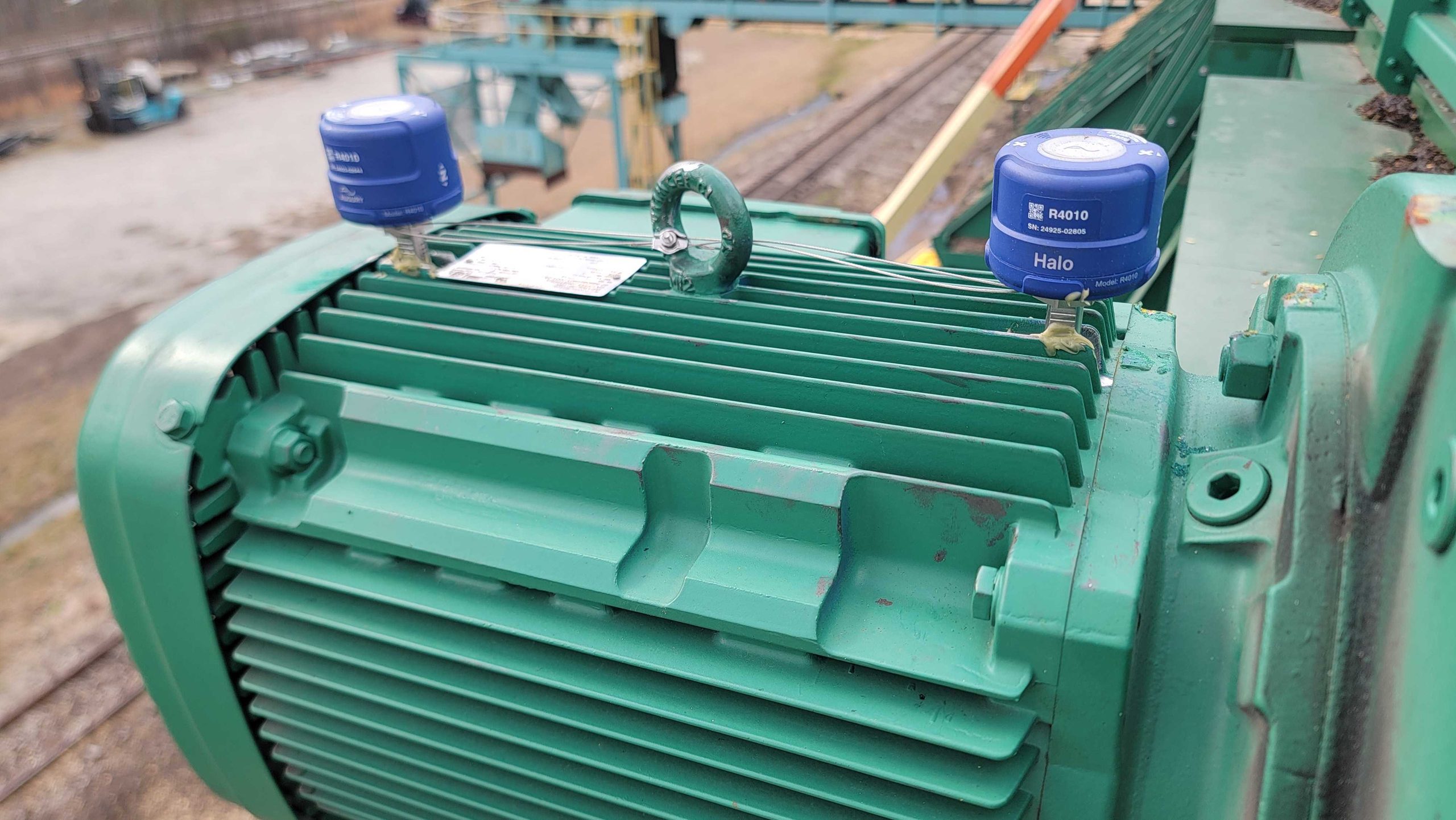
- Collect: Sensors on each asset capture condition data, continuously or at set intervals, and send it to a central platform.
- Analyze: Software compares new readings with the asset’s healthy baseline and with known fault signatures. This reveals early signs of wear, misalignment, imbalance, or electrical problems.
- Act: When a reading points to a developing fault, the maintenance team gets an alert with the likely cause and severity. They then plan the repair into the next available window.
The value comes from lead time. The earlier a fault shows up in the data, the more options your team has for parts, labor, and scheduling.
What types of assets does condition monitoring cover?
Condition monitoring covers rotating and mechanical assets, electrical assets, structural and fixed assets, and fluid and hydraulic systems. Any asset whose health changes in a measurable way before it fails is a candidate. That includes electrical equipment, structures, and fluid systems. If your focus is rotating equipment, the guide to machine condition monitoring goes deeper on motors, pumps, compressors, gearboxes, and bearings.
| Asset category | Examples | Condition indicators monitored |
| Rotating and mechanical assets | Motors, pumps, fans, compressors, gearboxes, and conveyors | Vibration, bearing temperature, ultrasound, thermography, and lubricant condition |
| Electrical assets | Motor windings, transformers, switchgear, motor control centers, and variable frequency drives | Condition monitoring for electrical assets tracks current and magnetic flux signatures, thermal hot spots, insulation resistance, partial discharge, and dissolved gas in transformer oil |
| Structural and fixed assets | Storage tanks, piping, pressure vessels, heat exchangers, and support structures | Wall thickness, corrosion, crack growth, strain, and settlement |
| Fluid and hydraulic systems | Hydraulic power units, lubrication systems, cooling water loops, and compressed air systems | Pressure, flow, fluid temperature, particle count, water content, and leaks |
Many assets have both mechanical and electrical failure modes. Motor failure surveys rank bearing faults as the most common cause of induction motor failure, with stator winding faults second. Pairing vibration data with electrical indicators such as magnetic flux gives your team visibility into both sides of the same motor.
What’s the difference between condition monitoring and predictive maintenance?
Condition monitoring tells you what state an asset is in right now. Predictive maintenance is the strategy of using that condition data to forecast when a fault will need action. Your team then schedules the repair before the fault becomes a failure. Condition monitoring and predictive maintenance work together: condition monitoring is the measurement, and predictive maintenance is the strategy built on it.
You’ll also see the term condition-based monitoring. It describes the same practice of tracking asset condition to drive decisions. That data feeds condition-based maintenance, where work starts when a reading crosses a set limit. Predictive maintenance adds one more step: trending the data forward to estimate how much time remains before intervention. That’s how predictive maintenance in manufacturing lets teams line up parts and labor before the repair window arrives. EN 13306, the European standard for maintenance terminology, reflects the same relationship: it treats predictive maintenance as a form of condition-based maintenance guided by a forecast of how the asset is degrading.
| Aspects | Condition monitoring | Predictive maintenance |
| Primary purpose | Measure and track the current health of an asset | Forecast when a developing fault will need action |
| Data use | Compares readings with baselines and limits to detect change | Trends condition data forward to estimate time to intervention |
| Maintenance trigger | A reading crosses a threshold or moves away from baseline | A forecast shows the fault reaching an actionable stage |
| Main outcome | Early awareness that an asset’s condition is changing | A repair scheduled into a planned window |
What are the benefits of condition monitoring for your assets?
The benefits of condition monitoring for your assets include earlier fault detection, less unplanned downtime, lower maintenance costs, and better maintenance planning. Machine health monitoring turns scattered inspection readings into a continuous record, and machine vibration monitoring adds fault-level detail to that record. Let’s look at each more closely.
- Earlier fault detection: Continuous data catches developing faults such as bearing wear, misalignment, and looseness in their early stages, often before anyone could see or hear them on a walk-around. The earlier a fault appears, the more room your team has to decide when and how to intervene.
- Less unplanned downtime: When a developing fault shows up in the data, your team can schedule the repair for a planned stop instead of losing production to a breakdown. Predictive maintenance runs on condition monitoring data, and in a National Institute of Standards and Technology (NIST) survey of U.S. manufacturers, those that relied more on predictive maintenance than on preventive maintenance reported 18.5% less unplanned downtime.
- Lower maintenance costs: Work based on actual condition replaces time-based tasks on equipment that doesn’t need them yet. It also reduces the emergency repairs that come with running a machine until it breaks. The U.S. Department of Energy’s O&M Best Practices Guide cites studies estimating that a working predictive maintenance program saves 8% to 12% over preventive maintenance alone.
- Better maintenance planning: Each alert comes with a likely cause and severity. Planners can use that to order parts ahead, assign the right technician, and group work into shutdowns already on the schedule.

How is asset condition data analyzed to detect faults?
Software compares each new reading with what healthy looks like for that asset. It then checks whether the difference matches a known fault. That’s how raw asset condition data becomes an actionable signal. Three methods usually work together:
- Trend analysis against healthy baselines: Each asset’s normal vibration, temperature, and magnetic flux under typical speed and load become its baseline. Analysis tracks how far and how fast new readings move away from it. A slow rise in bearing temperature or a growing peak at a specific vibration frequency then stands out before it reaches an alarm level.
- Threshold-based alerting: Fixed limits trigger an alert when a reading crosses them. Teams set these limits from manufacturer guidance, industry vibration severity standards, and site experience. Thresholds are simple to set and explain. But a single limit can’t adjust to changing operating conditions, which is a common source of false alarms and late detection.
- AI-assisted diagnostics: Machine learning models trained on large sets of labeled fault data compare each asset’s signals with patterns from similar machines. They classify the likely fault, estimate severity, and account for operating context such as speed and load. Your team gets a diagnosis instead of a raw alarm.
How to build an asset condition monitoring management program
Asset condition monitoring management is the ongoing work of deciding what to monitor, how to monitor it, and how to act on what the data shows. Treat it as a loop: what technicians find at each repair feeds back into which assets you monitor and how you set alert rules.
The steps below are adapted from the general procedure in ISO 17359, which starts with a cost-benefit analysis and an equipment audit, then moves through criticality, monitoring method, data acquisition and analysis, maintenance action, and review. Each step centers on one decision your team makes.

1. Prioritize assets by criticality
Rank equipment by what a failure would cost. Consider lost production, safety exposure, repair cost, and whether a spare or redundant unit exists. Single points of failure with a high cost of downtime go to the top. A reliability-centered maintenance (RCM) analysis gives you a structured way to connect each asset’s failure modes to the right strategy. That includes deciding which low-cost, low-impact assets you’ll deliberately run to failure.
2. Select the condition data to collect per asset
Match each indicator to the failure modes you want to catch. For asset condition monitoring for pumps, that usually means vibration and temperature at the motor and pump bearings. Add pressure or flow when performance loss or cavitation is a concern. Motors benefit from electrical indicators alongside vibration, and gearboxes from lubricant analysis.
3. Install sensors and establish healthy baselines
Mount sensors at consistent measurement points. Then collect data across normal operating conditions to define healthy for each asset. For equipment that runs at several speeds or loads, set a baseline for each operating state, since normal readings shift with speed and load. Record a new baseline after any major repair or rebuild. Otherwise, post-repair readings get compared with pre-repair wear.
4. Set alert thresholds and diagnostic rules
Start with manufacturer limits and industry severity guidance. Then tighten or relax alerts based on each asset’s baseline and history. Define what each alert level means in practice, from “watch” to “plan a repair” to “act now,” so everyone reads an alert the same way.
5. Route alerts into maintenance workflows
Connect alerts to your CMMS so each one carries the asset, likely fault, severity, and recommended action into a work order. Assign an owner to review new alerts each shift or each day.
6. Review program KPIs and refine coverage
Review results on a fixed schedule, monthly or quarterly. Track how many alerts became planned work, how many faults were confirmed on inspection, and how unplanned downtime on monitored assets is trending. Add coverage where failures still surprise you. Scale it back where an asset has proven low-risk.
How do I choose the best condition monitoring system for a plant?
To choose the best condition monitoring systems for a plant, evaluate each option against four questions. Can it detect faults early on the assets you care about? Does it tell your team what’s wrong and what to do? Does it fit the maintenance workflows you already run? Can it scale from a pilot to your full asset base?
Look at the service model closely too. Many predictive maintenance solutions bundle hardware and software with asset condition monitoring services, such as installation, program setup, and review by certified vibration analysts. Services are also sold on their own, for example when a contractor runs periodic vibration routes and delivers findings without permanent sensors or software on site. Those human layers shape how quickly your team trusts and acts on alerts. Ask each vendor which services are included and at which service level.
| Condition monitoring system evaluation criterion | What to check | Why it matters for reliability teams |
| Asset and sensor coverage | Which asset types, speeds, and environments the system supports, including classified areas through hazardous zone monitoring, and which indicators each sensor captures | Coverage needs to match your criticality list, or high-priority failure modes go unwatched |
| Diagnostic accuracy and depth | Whether alerts include a likely fault, severity, and recommended action, and how the vendor measures false alarm and missed-fault rates | Specific diagnoses let technicians act without a second investigation |
| Maintenance workflow integration | CMMS and EAM integration, work order creation, and alert routing by role | Alerts that arrive inside existing workflows move to action with fewer handoffs |
| Scalability and expert support | Installation effort per asset, multi-site management, and which expert review services are offered at each service level | Programs grow when installs are fast and your team can get a second opinion when an alert needs one |
Put every critical asset under continuous watch
Scaling a program often comes down to coverage. Your most critical machines get attention, while supporting equipment waits for the next round. When critical and supporting assets are both under continuous watch, a developing fault on any monitored machine becomes planned maintenance instead of an unexpected stop. Your team spends its hours on the repairs the data says are needed.
Reliability teams get there by extending coverage without adding to their workload. With Augury Reliability Expert, built on Augury’s Machine Health foundation, that coverage spans the rotating equipment across your plant, including equipment in hazardous areas. Your team pairs continuous sensing and Industrial AI diagnostics with the service level each asset needs, from AI-driven monitoring on balance-of-plant equipment to certified analyst review through critical equipment machine health for the machines production depends on. Explore Augury’s asset condition monitoring use cases, or book a demo to walk through coverage for your own asset list.
Frequently asked questions
-
How do I calculate machine condition monitoring cost per asset?
To calculate machine condition monitoring cost per asset, add up the full cost of the program over a set period, usually a year. Then divide it by the number of assets covered. Include:
- Sensors or route-based data collection equipment
- Installation and connectivity, such as gateways
- Software or subscription fees
- Expert services, such as analyst review
- Internal labor to review alerts and complete the resulting work
Then compare that figure with the expected cost of a failure on each asset, including the repair, lost production, and any safety or quality impact. It also helps to price the alternative: a route-based program has its own cost per asset, from technician time on each collection round to analysis, and it only captures data on the days someone takes readings. Cost per asset often varies by criticality, since your most critical machines may justify a higher service level than balance-of-plant equipment.
-
Is continuous condition monitoring worth it if we already run manual inspection rounds?
Continuous condition monitoring is worth it for teams that already run manual inspection rounds because it captures what happens between rounds. A round gives you a snapshot on the day a technician walks by, while continuous data shows the trend. It also frees your rounds for tasks that need hands and eyes, such as lubrication, belt tension, and leak checks from your preventive maintenance checklist.
On the financial side, Forrester Consulting conducted The Total Economic Impact™ Of Augury Machine And Process Health, a study commissioned by Augury (July 2025). It found a 310% ROI over three years and payback in less than six months for the composite organization it modeled.
-
Wireless versus wired condition monitoring sensors: Which is better?
Which is better, wireless or wired condition monitoring sensors, depends on the asset, the data it needs, and how practical it is to run cable to it.
- Wired systems suit large, high-speed machines that need continuous high-bandwidth data or a link to machine protection systems, where the cost of cable and conduit is justified.
- Wireless sensors install without cabling or production shutdowns, which makes them practical for covering many assets quickly, including balance-of-plant equipment and hard-to-reach locations.
The two work well together. Existing wired systems can stay on the machines that have them while wireless sensors extend coverage across the rest of the plant.
-
What KPIs measure whether an asset condition monitoring program is working?
The KPIs that measure whether an asset condition monitoring program is working show two things: whether alerts are accurate, and whether they turn into planned work.
- Alert-to-work-order conversion rate
- Confirmed-fault rate, or the share of alerts verified on inspection
- Planned maintenance percentage on monitored assets
- Unplanned downtime hours on monitored assets
- Mean time between failures (MTBF)
- Share of critical assets under monitoring
As a program matures and fewer failures occur, value shows up as steady planned work, not dramatic saves. Track avoided failures and the lead time each alert gave your team. That keeps the program’s impact visible after the obvious wins.
-
How does AI improve the accuracy of condition monitoring alerts?
AI improves the accuracy of condition monitoring alerts by comparing each asset’s data with patterns learned from large volumes of machine data. It doesn’t rely on a single fixed threshold. Models account for operating context such as speed and load, tell apart faults that look alike, and rank alerts by severity. Augury’s models, for example, draw on more than 1.1 billion hours of machine monitoring. Augury reports about 70% fewer false alarms compared with threshold-based systems.
On assets with expert review, certified analysts confirm the AI’s findings before alerts reach your team. Agentic tools such as the Reliability Agent build on those diagnostics. They put together an investigation into what’s failing, why, and what to do next, for your team to review.


