Where is manufacturing today? Nick Leeder–who has advised many companies on how to move from AI curiosity to clarity through his Nick Leeder & Company consultancy–offers his take on what the new State of Production Health report says about where the industry stands and how leaders should position themselves for growth and resiliency.
Reading Between the Production Lines
This year’s State of Production Health report from Industry Week is packed with positivity, but behind the stats lies a story that every manufacturing leader needs to hear.
I’ve been helping manufacturers make sense of technology for the better part of three decades. And if there’s one pattern that never changes, it’s this: progress often hides the problems we most need to face.
That’s the feeling I got reading the 2025 State of Production Health report, a comprehensive study of 500 manufacturing leaders across the US and Europe. On the surface, it’s a story of confidence. AI is maturing. Optimism is high. More projects are moving beyond pilot.
But peel back the layers, and a more complex picture emerges. There’s a disconnect between what leaders believe is happening and what’s actually delivering results. Between tech adoption and operational impact. Between optimism and readiness.
Let’s talk about that.
Where are we now?
The report paints a picture of a sector in motion. Despite economic volatility, rising tariffs, stubborn inflation, and ongoing supply chain headaches, 96% of manufacturing leaders say they’re optimistic about the industry’s future.
And that’s not blind faith. Adoption of AI is accelerating. In just one year, the number of manufacturers who have scaled over 50% of their AI pilots tripled, from 4% to 14%.
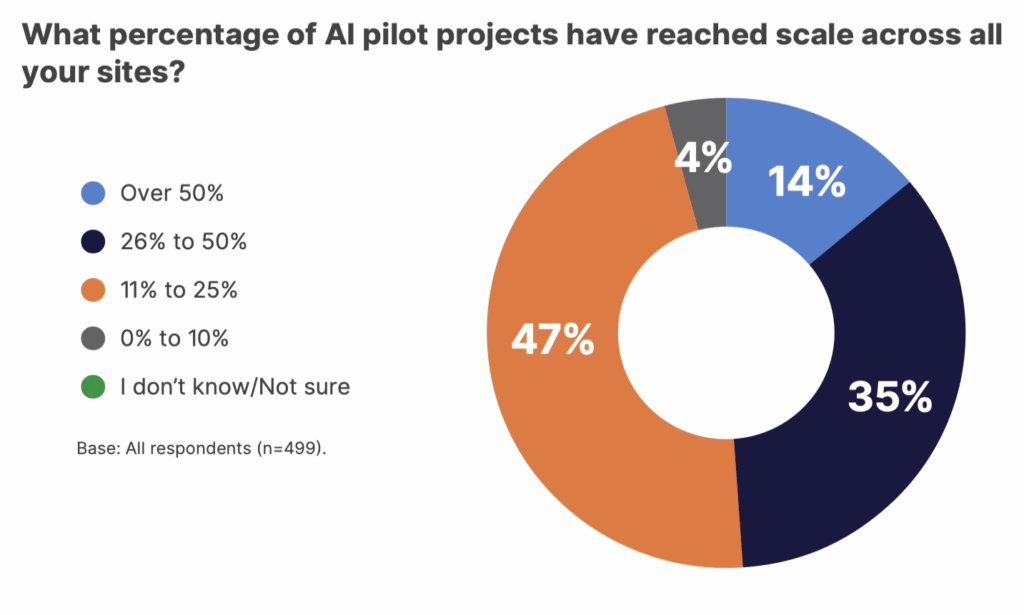
That’s a big shift. It means more organizations are treating AI as part of core operations, not just innovation theatre. And yet…
We’re still struggling to measure impact where it matters. Machine health is the top use case for AI, but only the seventh in terms of quantifiable business benefit.
It begs the question: are we chasing what’s easy to implement, rather than what delivers real value?
Five uncomfortable truths, and what to do about them
Here’s what I think are the five most revealing insights from this year’s report, with reflections for operational leaders navigating the messy middle of digital transformation.
1. We’re solving the wrong problems with AI
Machine health, energy tracking, and documentation automation are the top use cases. But production leaders still rank quality, throughput, and cost as their biggest goals.
There’s a mismatch here.
The tools are available, but they’re not always aimed at the core problems on the shop floor. And without proper targeting, AI becomes just another line item, not a competitive advantage.
What to do: Step back. Reassess. Focus AI investments on the top three drivers of OEE and yield, not what’s most convenient to deploy.
2. Change management, not tech, is the biggest barrier
For the first time, digital change management tops the list of things limiting production outcomes. It’s not the sensors or software holding you back, it’s the culture.
Disparate systems. Disconnected teams. Misaligned goals. That’s what’s breaking transformation.
And it’s not just IT’s problem. Each department sees its own biggest blocker: plant leaders cite asset connectivity, supply chain teams cite volatility, and procurement teams point to fragmented vendors.
What to do: Treat transformation as a people problem first. Start with alignment, not architecture.
3. Confidence is up, but clarity is not
83% of manufacturers rate themselves as “advanced” or “very advanced” at AI adoption.
And yet, when asked where AI is delivering ROI, the answers are vague. In some cases, the most-used AI tools are among the least understood in terms of business impact.
That’s not advancement. That’s false confidence.
What to do: Ask harder questions. If you can’t explain how AI is improving uptime, reducing waste, or boosting first-pass yield, you’re not ready to scale.
4. Upskilling has fallen off the agenda, and that’s risky
In 2023, workforce upskilling was the top reason to invest in AI. By 2025, it’s dropped to fifth place.
That’s a problem. With 2.8 million workers heading for retirement, we’re about to lose a generation of know-how. AI should be a vehicle to preserve that expertise, not a replacement for it.
What to do: Rethink AI as a co-pilot, not a shortcut. Use it to help your teams make better decisions, faster. Pair sensors with support. Data with direction.
5. Sustainability is now a priority, but we’re not set up to measure it
Sustainability has leapt to the top of the AI priority list this year. That’s encouraging.
But only 2 in 5 manufacturers can actually measure the impact of AI on those goals. If AI is going to play a real role in ESG performance, measurement needs to catch up.
What to do: Start by linking your process optimization goals to specific energy or waste metrics. Then choose AI solutions that can track those improvements over time.
“For the first time, digital change management tops the list of things limiting production outcomes. It’s not the sensors or software holding you back, it’s the culture.
What to do: Treat transformation as a people problem first. Start with alignment, not architecture.“
So what does this mean for manufacturing leaders?
The story here isn’t about failure. It’s about clarity.
The last five years have been about experimentation, pilots, proofs of concept, learning by doing. But the next five will require discipline. Structure. Courage to admit what’s not working.
Here’s what I’d recommend:
- Audit your AI landscape. Don’t just ask what’s been deployed, ask what’s delivering. Map your AI efforts against real-world production KPIs.
- Rebuild your roadmap around the people. Bring operations, IT, and procurement into the same room. Co-create goals that everyone owns.
- Invest in scalable foundations. That means vendor interoperability, role-specific training, and change management support, not just another tech pilot.
Get the 2025 State of Production Health report here for all the data and insights. For a deep dive into the findings, join me, Dan Miklovoc, and Augury’s Brian Fitzgerald at the July 29 webinar.