Facing machine breakdowns before they’re caught is a challenge every operations team knows too well. Even with careful scheduling, manual inspections often catch faults too late to avoid costly downtime.
With artificial intelligence (AI) in maintenance, that changes. By analyzing data in real time, AI can detect equipment issues early, enabling proactive, data-driven repairs instead of manual troubleshooting.
In this guide, we’ll walk through what AI in maintenance is, its applications and benefits, and practical steps for advancing your maintenance strategy, no matter where you are on your digital journey.
Key highlights:
- AI for maintenance is the use of artificial intelligence algorithms trained on industrial datasets to analyze real-time sensor data—such as vibration, temperature, and magnetic fields—to diagnose specific mechanical faults and prescribe the repairs needed to prevent unplanned machine downtime.
- Industrial teams use maintenance AI for applications such as automated fault detection and prescriptive diagnostics to eliminate guesswork in troubleshooting.
- Shifting to AI for preventive maintenance allows teams to prioritize work based on equipment condition, reducing downtime and resulting in greater asset reliability and lower operating costs.
- Augury’s AI maintenance solutions combine machine learning models with reliability expertise to provide insights backed by Guaranteed Diagnostics™.
What’s the role of AI in plant maintenance?
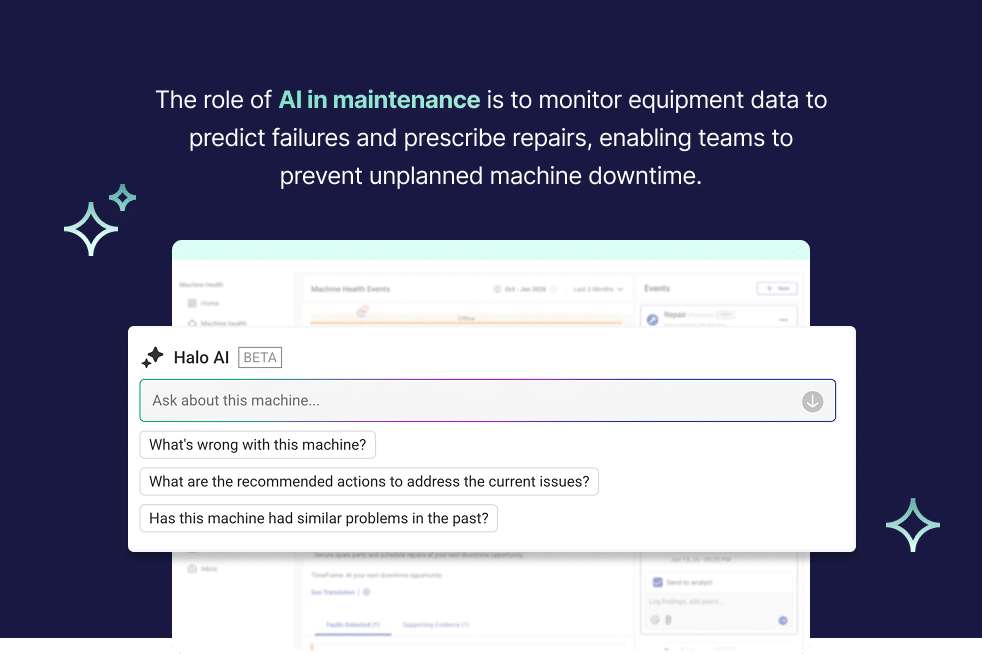
The role of AI in plant maintenance is to monitor equipment data to predict failures and prescribe repairs. Purpose-built algorithms analyze vibration, temperature, and magnetic signals to identify early indicators of mechanical wear, allowing teams to schedule fixes before issues result in unplanned downtime.
In industrial settings, if machine failures aren’t detected early, the impact can compound quickly. Unexpected breakdowns disrupt operational schedules and drive up maintenance costs. In fact, 30% of manufacturers list “unplanned production downtime” as one of their organization’s biggest challenges, according to The State of Production Health 2025 by Industry Week.

AI solutions give reliability teams earlier visibility into equipment issues, helping enterprises reduce reactive maintenance practices.
To see how reactive, preventive, and predictive maintenance compare in practice, watch our detailed breakdown:
The 6 best applications of AI for maintenance operations
Reliability experts use AI for maintenance to predict failures, optimize production yield, manage energy consumption, and more. As Deloitte highlights, AI solutions can serve as an “omnipresent maintenance employee helping the human workforce make better decisions about when and where to target operations.”
| AI maintenance applications | How this application works | How AI improves maintenance operations |
| 1. Automated fault detection | AI identifies machine faults such as bearing wear or imbalance using continuous 24/7 sensor data. | Early detection prevents minor irregularities from escalating, keeping production schedules stable. |
| 2. Prescriptive diagnostics | AI-based Machine Health software provides clear repair recommendations and remediation steps for your machine faults. | Precise instructions eliminate troubleshooting guesswork, allowing your maintenance team to complete repairs on the first attempt. |
| 3. Root cause analysis | AI-driven Machine Health isolates the root cause of a fault to ensure maintenance teams fix the underlying issue instead of just the symptoms. | Solving the root cause of machine faults reduces repeat problems and lowers your mean time to repair (MTTR). |
| 4. Energy management | AI helps you track and optimize the performance of energy-intensive assets to reduce waste and emissions. | Correcting inefficient equipment performance lowers utility costs and helps your organization meet sustainability and ESG targets. |
| 5. Spare parts forecasting | Artificial intelligence allows you to align purchasing with actual asset health to avoid overspending on urgent, last-minute orders. | Precise forecasting ensures necessary components are available when needed, reducing capital tied up in unused inventory. |
| 6. Quality defect prevention | AI detects machine malfunctions that trigger quality defects, allowing you to address the root cause of waste before scrap is produced. | Early AI detection lowers your scrap rate and improves product consistency across the factory floor. |
What are the benefits of AI for preventive maintenance?
The benefits of AI for preventive maintenance include higher asset reliability and lower operating costs. A Forrester Total Economic Impact™ study found that organizations shifting from reactive to predictive maintenance reduced repair spend by 15% per asset. These efficiencies come from data-driven, condition-based decisions that minimize emergency machine interventions and unnecessary part replacements.

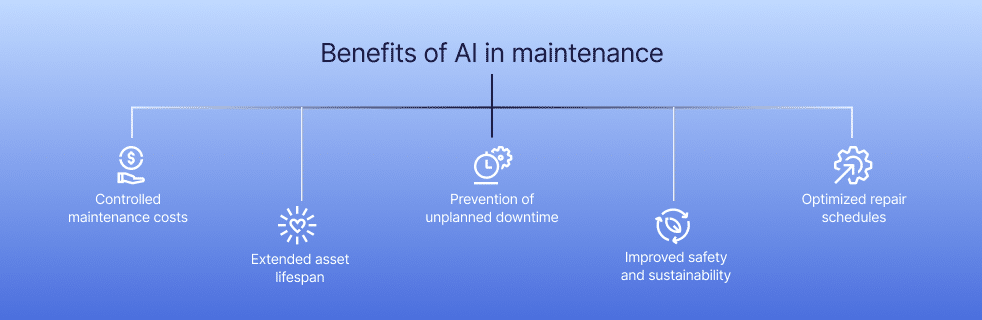
Maintenance and reliability teams leveraging AI benefit from:
- More controlled costs: Minimize unnecessary labor and component swaps by intervening only when data indicates real risk
- Optimized repair schedules: Prioritize maintenance actions based on real equipment condition rather than fixed service intervals
- Prevention of unplanned downtime: Rely on predictive maintenance systems to flag risks before breakdowns occur
- Extended asset lifespan: Use IoT sensors to detect wear early so you can address issues before they cause long-term damage
- Improved safety and sustainability in production: Detect risk conditions and excess material use with advanced data analytics
How do I overcome common barriers to the adoption of artificial intelligence in maintenance?
Building support for AI in maintenance starts with showing a clear ROI. When stakeholders can see the value—reduced downtime, lower costs, better asset performance—adoption follows.
But even after you’ve got the green light, the practical work brings its own set of challenges. Many digital transformation leaders find that hurdles like fragmented data or vague goals can still stall their momentum if they aren’t careful. You don’t have to let that happen. Here’s how you can knock down those barriers and keep your progress on track:
- Identify specific production problems: Understand recurring equipment issues, bottlenecks, or cost drivers that affect uptime, throughput, or safety. Clearly define problems to help teams apply AI tools to the areas with the highest operational impact.
- Build a strong data foundation: Consolidate asset signals, work orders, and historical data so AI maintenance solutions generate reliable insights. Inconsistent inputs and disconnected systems weaken AI model outputs, making results hard to scale.
- Start with a pilot to prove value: Apply AI to a defined asset group to measure and validate performance. Pilot results create a baseline for scaling and support continuous improvement across operations.
- Partner with experts to accelerate deployment of AI for maintenance: Work with teams that bring proven experience in industrial maintenance and reliability programs. Practical guidance helps shorten your AI setup time.
Increase production uptime with Augury’s AI maintenance solutions
Augury’s AI maintenance solutions provide the expertise to catch asset faults before they impact your production capacity. With Guaranteed Diagnostics™, we can explain what is happening within your machines and how to fix it. Clear action steps help your team prioritize work on critical equipment and reduce emergency repairs.
Leaders like Molson Coors use our AI-powered technology to optimize asset care. By switching to predictive maintenance, the Albany brewery avoided 1,000+ hours of downtime and $600K+ in costs, catching problems weeks before they threatened production. Get a demo to discover how Augury’s predictive maintenance solutions help increase uptime, reduce maintenance costs, and support more reliable operations.

Frequently asked questions
What is AI in maintenance?
AI in maintenance is the use of artificial intelligence to analyze machine data and identify potential faults. Machine Health extracts hundreds of feature sets from your equipment, from simple standard deviations to complex parameters such as motor RPM, to recognize patterns that indicate mechanical, electrical, or operational issues.
Learn more: Machine Health for Dummies
How accurate is AI for diagnosing industrial machine faults?
AI’s accuracy for diagnosing industrial machine faults depends on the depth of its training data.
Augury’s Machine Health monitoring system provides accurate predictions backed by Guaranteed Diagnostics™. Our AI leverages over 1.1B hours of machine recordings to fuel its algorithms, and human experts then validate its outputs for the highest level of technical precision.
What specific machine faults can AI in maintenance detect?
AI in maintenance can detect a wide range of machine faults, including bearing wear, shaft misalignment, and rotating asset imbalance. Because AI systems capture real-time data 24/7, they identify minor irregularities early, preventing them from escalating into bigger failures.
| Common machine faults | Machine fault description | How AI in maintenance detects this fault |
| Rotating asset imbalance | Center of mass misalignment in components like rotors | Radial vibration analysis to reveal characteristic patterns |
| Coupling wear | Weakening or looseness of a coupling component | Harmonic analysis (3x, 4x, 5x) of the vibration signature |
| Soft foot | Feet not making proper contact with the frame or baseplate | Line frequency measurements (1x and 2x) to detect anomalies |
| Shaft misalignment | Shaft axes not positioned collinearly during power transfer | Radial and axial sensors to measure vibration at 1x and 2x speed |
| Resonance | Vibration amplified by a structure’s natural frequency | Velocity change and noise floor tracking to signal amplification |
| Bearing wear | Physical degradation of bearing surfaces or rolling elements | High-frequency noise detection to trend defect amplitude |
| Belt wear | Worn belts in electric motor drive trains | Vibration signature monitoring to capture belt slip events |
| Rotating mechanical looseness | Looseness specific to rotating parts like bearings or shafts | Spectrum analysis to reveal repeating multiples of the shaft speed |
| Structural mechanical looseness | Excessive play between stationary structural components | Axis-specific vibration monitoring to pinpoint structural play |
| Cavitation | Formation and collapse of vapor bubbles inside pumps | High-frequency vibration and acoustic pattern tracking |
Dive deeper: 10 common fault types detected by Machine Health
How do AI-based maintenance solutions for manufacturing compare on predictive accuracy?
AI-based maintenance solutions vary in predictive accuracy, and the differences usually come down to how providers build and train them. Some systems rely on generic algorithms and limited datasets, helping you flag some anomalies, but they don’t explain what’s happening or what to do next.
Reliable AI systems like Augury’s Machine Health combine:
- Continuous, high-quality sensor data
- Purpose-built algorithms trained on industrial equipment
- Deep reliability expertise
This approach identifies your machine’s specific faults, explains why they occur, and guides appropriate maintenance actions. The result is fewer surprises, clearer priorities, and predictions that teams can trust enough to act on early.