
Predictive maintenance (PdM) is how high-performing manufacturers are moving from reactive firefighting to planned, first-time-right work. Recent technologies, such as AI-driven anomaly detection, can help you spot asset faults weeks in advance, leading to higher equipment reliability and cost savings from emergency repairs, overtime hours, and resource allocation.
For IT and digital transformation leaders looking to standardize reliability practices across a global footprint, a cloud-native, easy-to-deploy solution is key. Prioritizing interoperability and low-friction integration helps you build a unified data layer for predictable enterprise value.
In this guide, we cover the top predictive maintenance technologies and how they can drive measurable impact for your enterprise.
Key highlights:
- Predictive maintenance technology uses the Internet of Things (IoT) and artificial intelligence (AI) to identify specific machine faults before they impact production lines.
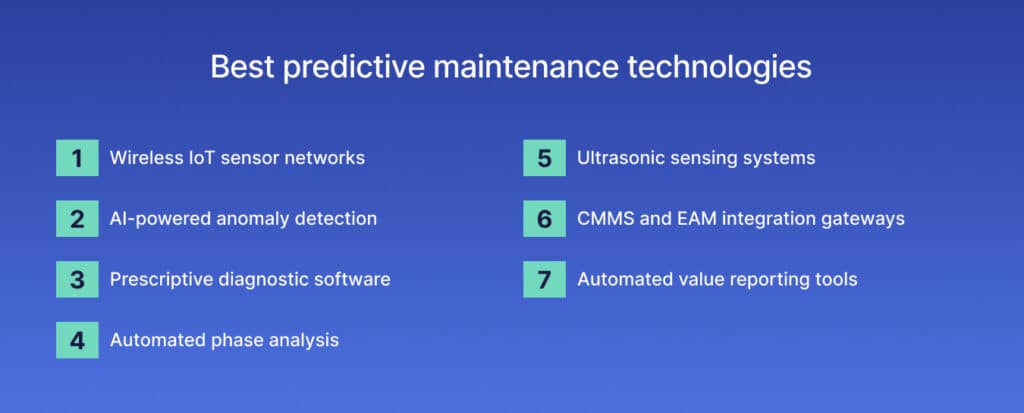
- Top technologies for predictive maintenance include wireless IoT sensors, AI-driven anomaly detection, prescriptive diagnostics, automated phase analysis, and more. These solutions work together to convert high-resolution machine data into actionable repair instructions for your plant-floor teams.
- Modern predictive maintenance solutions prioritize interoperability and scalability, allowing executive leaders to align maintenance data with broader enterprise goals.
Let’s review the 7 predictive maintenance technologies that will help you build a reliable, enterprise-wide PdM program.
1. Wireless IoT sensor networks
Internet of Things (IoT) sensors enable predictive maintenance by automating data collection from your machines. They’re the infrastructure for a connected plant floor, providing the real-time inputs needed for cloud analytics and a fully integrated operational technology (OT) layer across your enterprise.
Modern devices capture temperature, vibration, and magnetic flux signals that help verify whether your assets are operating within their healthy baseline or starting to develop specific mechanical faults. The IoT predictive maintenance sensors then send this machine health data to a database via wireless networks, and AI processes these signals to provide equipment diagnostics, allowing reliability teams to schedule maintenance on their own terms.
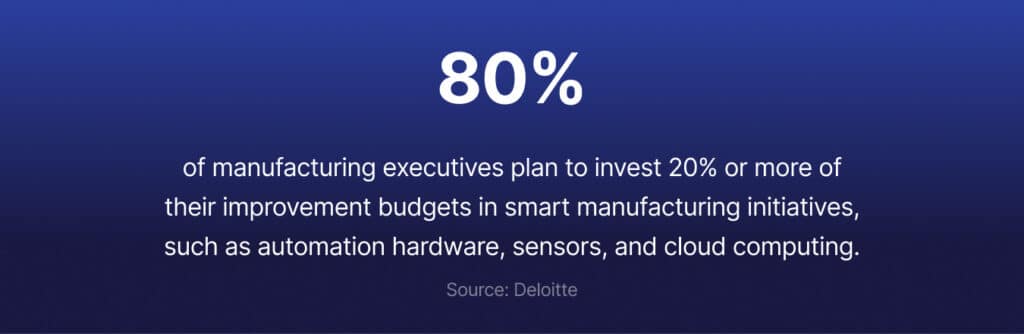
According to Deloitte, 80% of manufacturing executives plan to invest 20% or more of their improvement budgets in smart manufacturing initiatives, including automation hardware, data analytics, sensors, and cloud computing. This shift indicates that leaders are prioritizing the infrastructure needed to gain total visibility over their operations, including maintenance and reliability work, moving away from isolated data points toward a connected enterprise.
2. AI-powered anomaly detection
Artificial intelligence (AI) uses machine learning algorithms trained on large industrial datasets to learn exactly what “healthy” looks like for your specific assets and flag any anomalies that show up, ranking faults by severity.
The value of AI-powered predictive maintenance technology becomes clear when you compare it to traditional threshold-based systems. Traditional analysis only triggers an alert when a machine reaches a pre-set vibration or temperature level, creating a frustrating trade-off:
- Setting thresholds too low leads to “alarm fatigue,” where your team spends most of their time chasing false alerts that don’t actually exist
- Setting thresholds too high means the system might miss a fault entirely, leading to the very unplanned downtime you’re trying to avoid
AI reduces uncertainty by analyzing the entire vibration spectrum and distinguishing between normal operational changes and an actual developing fault, such as bearing wear or misalignment. This precision gives your enterprise a high-fidelity data stream that allows technicians to minimize “firefighting” and focus their energy on the right repairs.
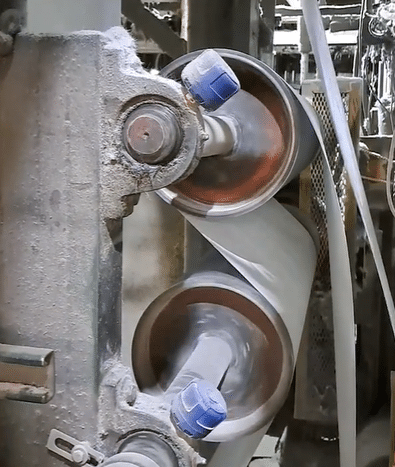
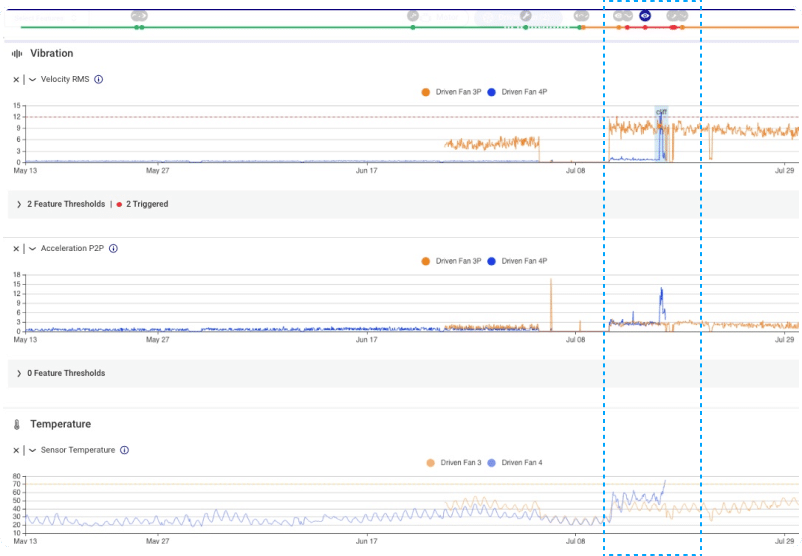
At a wood products plant, the on-site team successfully averted a disaster after receiving a real-time alert regarding a sudden, rapid spike in temperature and vibration on a belt-driven fan. By responding immediately to these predictive insights, the team discovered a fire had ignited inside the equipment. Their action limited damage to the fan and bearing, preventing the fire from spreading across the facility. See the changes in vibration velocity and acceleration, as well as temperature, at the time of the alert below.
Learn why AI works better than previous technologies for machine health maintenance.
3. Prescriptive diagnostic software
Predictive maintenance technology strengthens your reliability strategy by giving you the foresight to catch equipment issues early on. But knowing that a machine might fail is only half the battle. Prescriptive diagnostics software goes beyond flagging an anomaly by providing specific guidance on what your team needs to do next.
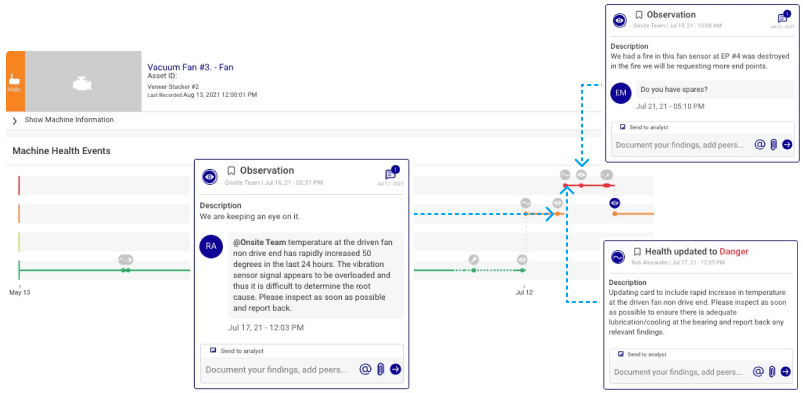
Instead of leaving technicians to figure out the “how” on their own, prescriptive solutions give them actionable instructions, such as “replace the drive-end bearing” or “realign the motor.” Hybrid approaches combine human and AI analysis, ensuring your team has a trusted partner to validate every Machine Health alert and closing the “insight-to-action” gap that stalls many digital pilots.
Here’s what that collaboration looks like in practice:
Learn more about the industry’s evolution toward prescriptive maintenance.
4. Automated phase analysis
Standard vibration analysis can show you that a motor is shaking, but is it a crooked shaft, an unbalanced rotor, or a loose base? Automated phase analysis serves as the ultimate tiebreaker. By measuring the relative timing of movement between different points on a machine, it reveals how components interact in real time.
Integrating this predictive maintenance technology into your reliability program allows you to:
- Minimize repair uncertainty: Instantly differentiate between similar mechanical faults to ensure your technicians perform the right fix the first time.
- Confirm repair quality: Use high-resolution data to verify that an imbalance or misalignment was fully corrected before you resume full production.
- Scale specialized expertise: Provide your entire organization with the depth of insight typically reserved for senior specialists, ensuring consistent results across every site in your global footprint.
Learn more from our webinar on Phase Analysis 101:
5. Ultrasonic sensing systems
The goal of an enterprise-wide rollout is to achieve visibility across the entire production floor. New predictive maintenance technology is helping reach this milestone by bringing connectivity to “difficult-to-monitor” assets such as slow-rotating equipment.
By using high-frequency ultrasonic sensing, this tech can capture and analyze acoustic signatures from equipment rotating as slowly as 1 RPM. With these advancements, executive leaders can maintain the same high reliability standards for their largest, slow-moving assets as they do for their high-speed motors.
Integrating ultrasonic data into your PdM strategy gives you:
- Comprehensive data integrity: You ensure your global dashboards represent the health of every critical asset, providing a truly complete picture of operational risk and performance.
- Enhanced operational resilience: Detecting early-stage deviations, such as a single loose bolt in a gearbox subframe, gives your team the lead time needed to proactively schedule maintenance, protecting your most capital-intensive investments.
6. CMMS and EAM integration gateways
Connecting your digital infrastructure ensures that maintenance and reliability data drives real business value. Integration gateways link predictive maintenance technologies directly into your EAM or CMMS, such as SAP or Maximo, helping to close the gap between industrial insights and enterprise visibility.
According to The State of Production Health 2025 report, “disparate vendors and disconnected ecosystems” are the #2 factor limiting manufacturers’ ability to meet production goals over the next 18 months. By integrating your tech stack, you ensure floor-level insights are visible, standardized, and actionable across the entire organization.
7. Automated value reporting tools
Modern predictive maintenance technologies offer value capture features that link resolved equipment faults directly to your bottom line, so you get a real-time view of how Machine Health wins generate cost savings for the enterprise.
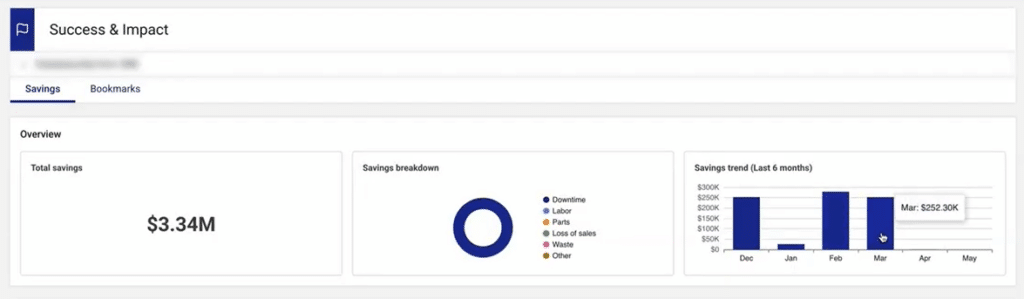
These tools give you a comprehensive view of your PdM program’s total value, including savings in labor and spare parts that often go unaccounted for. Data-driven dashboards deliver the proof you need to show a return on investment (ROI) to business execs, helping you secure buy-in to expand proven reliability strategies across every site.
Scale predictive maintenance technology across your enterprise
To minimize reactive work and protect your bottom line, you need predictive maintenance technology that scales. Augury is the partner that can help you get there. With a cloud-native, enterprise-grade architecture, our Machine Health Solutions are built for easy implementation. Having been deployed across hundreds of global facilities, our proven rollout strategy ensures your organization sees consistent results without adding unnecessary administrative overhead.
Augury’s interoperability-as-a-service also guarantees that your Machine Health data integrates with your existing IT and OT ecosystems. By connecting to your existing platforms, we create a unified information layer that simplifies governance across your global footprint.
The financial impact is clear: a Forrester Total Economic Impact™ study* found that organizations using our solutions realized a 310% ROI over three years.
Ready to see how Machine Health can scale across your organization? Get a demo to discover how Augury’s solutions can work for your specific use cases.

Frequently asked questions
What is predictive maintenance technology?
Predictive maintenance technology is a solution that combines IoT and artificial intelligence to monitor asset health in real time and identify signs of faults or early degradation before it leads to machine failure.
Wireless IoT sensors collect data from your machines, such as vibration, temperature, and magnetic flux patterns, then send it to a cloud environment where AI analyzes those signals for anomalies that may indicate the machine is not operating within spec. Having this foresight allows your plant-floor teams to prepare a maintenance schedule that targets only the assets truly at risk, reducing costs from emergency repairs and unplanned downtime.
What are the top industries benefiting from predictive maintenance technologies?
Industries that rely on capital-intensive machines in complex, continuous-production environments benefit most from predictive maintenance technologies. In these sectors, equipment doesn’t operate in isolation, and a single failure often triggers a cascade of product waste, safety risks, or total line stoppages that are difficult to restart.
By implementing predictive maintenance, enterprise organizations help stabilize high-volume production output and support their global supply chain commitments.
| Industries benefiting from predictive maintenance technologies | Primary benefits of PdM |
| Food and beverage | Minimized product loss and protected batch quality |
| Consumer packaged goods | Increased overall equipment effectiveness (OEE) across global, high-speed automated lines |
| Chemicals | Improved operational safety and minimized hazardous leaks |
| Building materials and cement | Maximized uptime for heavy, slow-rotating assets such as kilns |
| Pharmaceuticals | Supported equipment reliability for high-precision production cycles |
| Pulp and paper | Reduced emergency repair costs on continuous-run machinery |
| Metals and mining | Lowered utility spend by optimizing energy-intensive processes |
| Oil and gas | Enhanced equipment availability in high-risk refinery environments |
What should be the criteria for selecting predictive maintenance technology partners?
When evaluating predictive maintenance technology vendors, consider if they provide:
- Verified, high-confidence AI diagnostics: Your partner should demonstrate a proven track record of accurately identifying specific failure modes. This capability helps you ensure that your maintenance teams act only on validated faults, avoiding the “alarm fatigue” caused by systems lacking expert-backed precision.
- Comprehensive asset coverage: A viable partner must show they can provide visibility into your asset fleet so you avoid blind spots in your strategy. Select PdM solutions that cover a wide range of equipment, including “difficult-to-monitor” slow-moving assets or machines located in hazardous zones.
- Scalability and speed for global deployment: Look for a cloud-native architecture that allows for low-friction rollouts across sites. The system should scale without increasing your IT overhead.
- Native interoperability with existing IT/OT systems: Check for solutions that feature interoperability-as-a-service, ensuring that machine health data flows seamlessly into your CMMS or EAM platforms to create a single source of truth for asset health.
- Documented industry experience: Choose a vendor with an extensive library of industrial failure patterns monitored and a history of success in your specific sector. This depth of experience is what allows for AI accuracy.
Explore 9 tips on getting started with Machine Health.
How do I train staff on predictive maintenance technology?
To support long-term success and promote high adoption rates of predictive maintenance technologies, your training strategy can include:
- Baseline education: Inform the entire team about the technology’s purpose and data collection, even those not directly using the system. This step builds buy-in and helps prevent accidental interference with the new sensors installed on machines.
- Specialized technical training: Ensure the primary maintenance users receive in-depth training on platform navigation and hardware maintenance. Cross-training multiple team members helps you maintain program continuity during personnel transitions.
- Quantified success metrics: Train staff to document every win, such as avoided downtime and repair costs saved. Sharing these quantified results across the organization builds excitement and justifies the digital transition.
- Proactive engagement: Encourage technicians to log physical observations, such as unusual sounds, directly into the PdM platform. This approach combines a “boots-on-the-ground” perspective with AI diagnostics to provide the most accurate results for site-specific machines.
*“The Total Economic Impact™ Of Augury Machine And Process Health” commissioned study conducted by Forrester Consulting on behalf of Augury, July 2025. Results are based on a composite organization representative of interviewed customers over three years.