

Condition-based maintenance (CBM) triggers maintenance work for manufacturers when real-time equipment data shows a machine needs attention, instead of completing maintenance on a fixed schedule. Sensors track signals like vibration, ultrasound, temperature, and magnetic flux against a baseline for normal performance. When the system detects a developing issue, it alerts your team with the context to act. Maintenance and reliability teams use CBM to plan repairs on their own terms.
It’s 2 a.m. and your phone rings: a critical motor has failed. The carefully coordinated schedule you built for this week just went out the window. Unfortunately, this situation isn’t just bad luck. It’s the daily reality of a maintenance strategy built on reactive fixes or time-based calendars. It’s also how most manufacturers have to plan maintenance when they can’t actually see what’s happening with their equipment.
If you’re looking for a way to catch equipment issues earlier and focus your resources where they matter most, there’s a better approach: condition-based maintenance. Condition-based maintenance puts real-time machine data at the center of your maintenance program, which allows you to stop reacting to failures and start planning work on your own terms.
In this guide, we cover how maintenance based on condition works, how it differs from other approaches, and how sites like Coca-Cola Consolidated now use CBM to prevent failures and keep production on schedule. Whether you’re new to the concept or looking to optimize an existing program, you’ll find a practical roadmap for implementing a condition-based maintenance system that your floor team will actually trust.
Key highlights:
- Condition‑based maintenance (CBM) uses real‑time asset monitoring to assess equipment condition and support better work planning.
- In a Forrester Total Economic Impact™ study commissioned by Augury, the composite organization reduced maintenance spend by 15%.*
- The CBM lifecycle involves capturing high-frequency equipment performance data through IoT sensors, using AI to detect subtle anomalies, and scheduling repairs during planned windows.
- Augury’s Machine Health Solutions combine CBM with predictive and prescriptive AI capabilities that help you increase uptime and build more reliable operations.
What is condition-based maintenance (CBM)?
Condition-based maintenance (CBM) is a strategy that relies on real-time asset condition monitoring, using methods such as vibration and magnetic flux analysis, to guide when you should perform maintenance work.
Condition-based maintenance uses equipment health data to guide maintenance decisions. IoT sensors can track signals such as vibration, temperature, and magnetic flux, continuously or at intervals. By analyzing changes in context, teams can identify developing issues and plan maintenance before a failure disrupts production.
What are the advantages of condition-based maintenance for industries?
The main advantages of condition-based maintenance are reduced unplanned downtime, lower maintenance and repair costs, less product waste, longer asset life, lower risk during repairs, and a more predictable workday for your team. According to a Forrester Total Economic Impact™ study of Augury Machine and Process Health, the composite organization reduced maintenance spend by 15% by eliminating unnecessary work and emergency repairs.*

Advantages of condition-based maintenance include:
- Reduced unplanned downtime: By acting on clear alerts like bearing wear or misalignment early, you can maximize machine uptime and keep your production targets on track.
- Lowered maintenance and repair costs: Emergency parts and rush shipping drive up expenses. By fixing equipment problems before they escalate, you avoid unnecessary spending and focus your maintenance activities where they matter most.
- Minimized product waste: When machines slip out of spec, scrap and waste add up. Early detection lets you address performance dips before they impact quality, so you keep more on-spec product moving down the line.
- Extended asset life: Tackling emerging issues like excess heat or vibration early helps prevent lasting damage and keeps your machines running longer.
- Enhanced safety and risk mitigation: Tracking asset condition with machine health data helps you plan repairs during scheduled windows, reducing the unplanned, high-pressure situations where your maintenance and reliability teams face the greatest risk.
- Improved team morale with less emergency work: No one wants to stay late on a Friday due to a compromised belt. When your workday is more predictable, you reduce burnout and give your team time to focus on real wins rather than constant repairs.
Read our complete guide to learn why condition-based maintenance matters even more when everything else is unstable.
How does condition-based maintenance compare to preventive and predictive maintenance?
Maintenance can follow a fixed schedule, respond to changes in a machine’s health, or use data to anticipate a potential failure. Many plants still rely heavily on schedules, making it harder for teams to know which machines need attention first.
| Approach | How teams decide when to act |
|---|---|
| Time-based preventive maintenance | Perform maintenance at planned intervals, whether or not the machine shows signs of a problem. |
| Condition-based maintenance (CBM) | Use equipment health data to decide when maintenance is needed. |
| Predictive maintenance | Analyze equipment data and patterns to estimate when a failure is most likely to occur, giving teams more time to plan. |
The more teams know about machine health, the better they can prioritize work and plan maintenance around production.
According to Plant Services’ Machine Health Is Business Health report, 74% of respondents still rely on traditional preventive maintenance practices: some scheduled, but mostly reactive, manual maintenance.
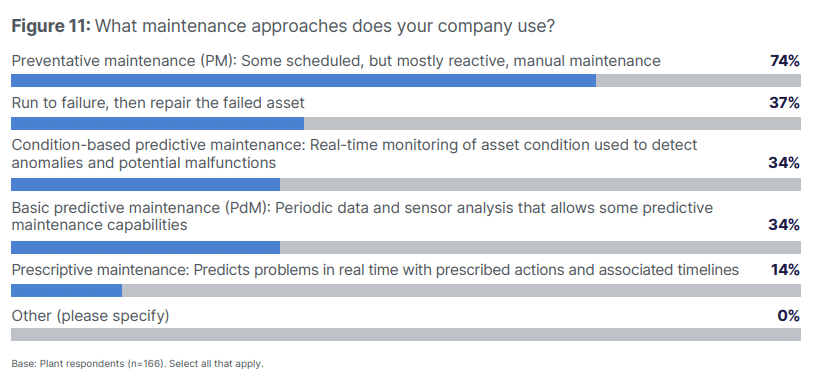
Here’s how CBM differs from other common maintenance approaches:
Condition-based maintenance vs. preventive maintenance
Preventive maintenance relies on fixed intervals, like changing a part every six months, regardless of its condition. This strategy often leads to over-maintenance, where you may increase spend by replacing perfectly good components. Condition-based maintenance, on the other hand, uses real-time signals to trigger work. When data indicates wear, misalignment, or another developing issue, actionable alerts help your team prioritize the machines that need attention.
Condition-based maintenance vs. predictive maintenance
Condition-based maintenance tells you when equipment health calls for action (e.g., a developing fault). Predictive maintenance adds a forecast of how an issue may progress, giving your team more time to plan a repair.
By combining these two approaches, you get the ability to see a developing fault, creating more foresight to plan the repair.
See also: Preventive vs. predictive vs. prescriptive maintenance
Types of condition-based maintenance techniques
Condition-based maintenance techniques include vibration sensing, temperature monitoring, magnetic flux analysis, and ultrasound detection, each tracking a different signal of equipment condition. Using different types of condition-based maintenance techniques gives you a more complete view of your assets, helping you catch developing faults before they become failures.
| Technique | What it measures and detects | How it helps you act earlier |
|---|---|---|
| Vibration sensing | Vibration monitoring systems track the movement of rotating components and identify patterns linked to developing mechanical issues. | Vibration data flags faults like imbalance, misalignment, and bearing wear weeks before a failure disrupts your production. This lets you schedule the repair on your own terms. |
| Temperature monitoring | Tracks surface and ambient temperatures to flag unusual heat patterns that may point to friction, lubrication, or cooling issues. | Spotting gradual thermal anomalies before they escalate to overheating allows you to intervene before a machine fails or begins affecting product quality. |
| Magnetic flux analysis | Magnetic flux monitoring techniques track the electromagnetic field around a motor to calculate speed and identify electrical faults (e.g., rotor issues). | By separating real faults from normal operating changes, magnetic flux data provides teams with the context needed to verify vibration spikes, helping you accurately diagnose resonance, detect early electrical problems, and minimize false alerts. |
| Ultrasound detection | Ultrasound sensors can capture high-frequency sound waves produced by air leaks, electrical arcing, or early-stage friction in ultra-low-RPM machines. | Ultrasound can flag friction and lubrication issues on ultra-low-RPM equipment early enough for maintenance to plan a repair before it becomes critical. |
What is an example of condition-based maintenance?
A clear example of condition-based maintenance is servicing a gearbox when its real-time signals show it needs attention instead of on a fixed interval. Gearboxes are critical to your facility. But if you’re following a traditional maintenance schedule, you’re likely taking them offline every 3-6 months, or per the manual’s recommended service interval, just to check the oil and inspect for wear, wasting limited resources.
With CBM, the asset’s actual performance guides your decisions on when and how often to perform maintenance. By monitoring real-time signals from the gearbox, you can see when it is running smoothly and safely extend its service interval.
Coca-Cola Consolidated (the largest Coca-Cola bottler in the US) runs six bottling lines nonstop at their Charlotte, NC plant. At that pace, one missed fault can affect the whole plant. Before moving to condition-based maintenance, their team depended on manual rounds and fixed schedules, which often missed issues developing between checks.
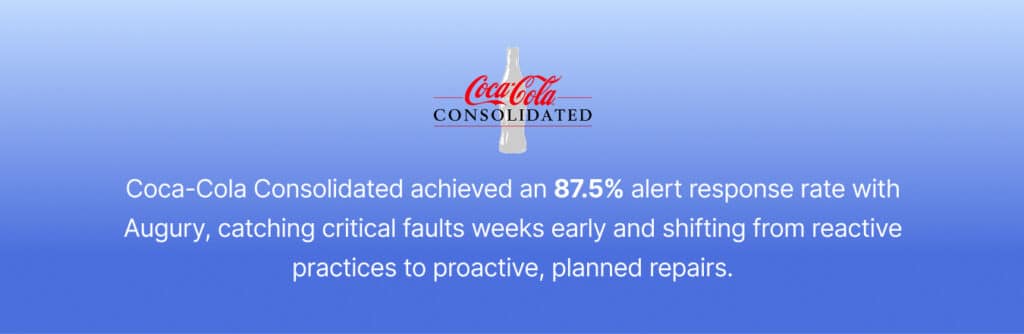
By adopting a proactive maintenance approach with Augury’s Predictive Maintenance AI, the Coca-Cola team identified an issue with a critical filler gearbox before it could have caused a major shutdown. They scheduled the repair during a planned window and kept production on track. With an 87.5% alert response rate, their team shows that when you have reliable diagnostics, you can move from constant firefighting to confident planning.
How condition-based maintenance works: the CBM lifecycle

Condition-based maintenance works by comparing real-time equipment data with a baseline for normal operation and triggering work when a machine crosses a set threshold. That logic runs continuously, so your team sees a developing fault early and plans the repair on its own terms.
This is how condition-based maintenance works step-by-step:
1. IoT sensors continuously capture machine data
IoT sensors give your team a continuous view of machine condition, so maintenance decisions start from current data rather than manual rounds. They run while your equipment runs, which feeds every later step in the lifecycle.
IoT sensors installed on your critical, balance of plant, or slow-rotating assets continuously monitor physical signatures like vibration, temperature, and magnetic flux. Sensors capture high-frequency performance data while your machines are running, providing a consistent digital record of their current state. Because these sensors transmit information wirelessly, or via cellular to a cloud-based platform, you no longer have to solely rely on manual inspections or point-in-time checks.
2. CBM systems detect issues by comparing data to baselines and thresholds
This is the step where a condition-based maintenance trigger alerts on changing patterns. Your system compares each new reading with what normal looks like and flags a deviation when a machine drifts outside it.
CBM systems can analyze vibration, temperature, and magnetic flux alongside each machine’s speed and load. This helps distinguish a developing fault, such as bearing wear, from a normal operating change and gives your team a diagnosis and repair guidance. Modern solutions like Augury’s Machine Health employ advanced AI algorithms to scan for subtle anomalies, accelerating issue detection beyond traditional rule-based methods.
3. CBM insights guide your maintenance planning
Planning is where a flagged deviation becomes a repair you schedule on your own terms.
CBM insights let the machine’s actual condition guide your schedule, so you can move away from time- or route-based checklists. With the data to justify every maintenance task to leadership, you can ensure you focus your resources on the assets that need the most attention.
What are the challenges of adopting condition-based maintenance?
The main challenges of adopting condition-based maintenance are fragmented data silos, alert overload, and technician adoption. The right support through both the technical and cultural changes keeps progress moving toward a return.
Set up your condition-based monitoring strategy for success by tackling these challenges first:
- Fragmented data silos: Disconnected maintenance systems make it difficult to scale your wins. Building a strong industrial data foundation is your first step toward long-term success.
- Alert overload: Generic alarms often lead to alert fatigue, which can cause your team to miss a critical asset failure. Using a reliable condition-based maintenance system helps you cut through the noise, giving you the specific insights you need to act with confidence.
- Technician adoption: Techs will trust a new monitoring solution when they see that the data helps protect their time. When a system consistently shows it can tell the difference between a healthy machine and a real fault, it builds confidence on the floor and helps create a more predictable, less stressful workday.
Learn why teams at every level of your organization are ready for a predictive maintenance program.
Best practices for implementing a condition-based maintenance system

A condition-based maintenance system delivers the most value when you start with a focused use case on your highest-impact equipment, choose a complete solution, and bring a trusted champion in early.
Consider these five best practices for implementation:
- Identify your specific CBM use case: Zero in on your facility’s challenges and define goals for your condition-based maintenance program. Maybe it’s cutting unscheduled downtime on line 5 fillers, or reducing urgent fixes on a crucial motor. When you focus on the equipment with the greatest impact, it’s easier to demonstrate the value of CBM and build momentum to roll it out site-wide.
- When partnering with Augury, you can work with certified CAT III and IV vibration analysts to diagnose asset criticality and build a plan to achieve maximum impact.
- Choose a complete solution: Opt for a CBM provider who handles the full journey, from hardware installation to ongoing support from industry pros who speak your language.
- Look for plant-floor-level insights: Machine health data is most powerful when your maintenance team has direct access to it. Prioritize platforms with dashboards that deliver the right information to everyone who needs it, from operators to managers.
- Select a champion to drive plant-wide adoption: Every plant has that go-to person. Someone who your team trusts and looks up to. Bring them into the CBM project early. Their buy-in will spark a culture shift and help the new mindset catch on.
- Track and share your maintenance wins: As your CBM rollout takes shape, measure its success against the goals you defined early on. Once you’ve built a track record, you’ll be ready to set even bigger targets for your program.
Putting these best practices into action is especially important when you’re dealing with complex machines, where physical constraints make traditional monitoring difficult.
A leading pet food manufacturer, for example, needed visibility into a critical extruder with no backup. The machine’s configuration limited where sensors could go, but early AI alerts still flagged subtle vibration changes pointing to mechanical looseness and misalignment.
Working with Augury’s vibration analysts, the onsite team stocked parts, lined up their crew, and created a work order. They replaced the motor before it failed, avoiding eight hours of unplanned downtime and more than $100,000 in replacement costs.
What should I look for in condition-based maintenance software?
Look for condition-based maintenance software with prescriptive diagnostics, expert review of AI findings, an easy-to-use interface, and CMMS integration, so your team gets specific insights instead of generic alerts.
The best condition-based maintenance solutions include:
- Prescriptive diagnostics: Clear guidance that tells your team what’s wrong and how to fix it
- Human-in-the-loop expertise: Certified vibration analysts who review AI findings, so your team can trust the results and avoid wasted effort
- Ease of use: An intuitive interface that your team can pick up quickly
- Integration capabilities: Direct connection with your existing CMMS, so insights become work orders without delay
Augury’s Industrial Solutions are built to be that comprehensive partner by providing you with the real-time visibility of a condition-based maintenance system, while layering on both predictive and prescriptive capabilities. With AI-driven insights, you know when a failure is likely to occur and get step-by-step instructions to fix it, with the help of certified CAT III and IV vibration analysts.
Augury’s comprehensive asset coverage lets you apply this data-driven approach across your entire facility, from everyday equipment to your most complex assets, so your team can see across the whole plant. Schedule a demo to see how Augury’s solutions can help you cut costs, modernize your maintenance program, and build more reliable operations.

*A commissioned study conducted by Forrester Consulting on behalf of Augury, July 2025. Results are based on a composite organization representative of interviewed customers over three years.
Frequently asked questions
What is the difference between time-based maintenance (TBM) and condition-based maintenance (CBM)?
Time-based maintenance (TBM) relies on fixed intervals or a set calendar for maintenance work, regardless of how your assets are actually performing. Condition-based maintenance (CBM) uses real-time data to trigger repairs only when an asset shows actual signs of wear or distress.
Take a critical gearbox, for example. With TBM, you might swap out the lubricant every six months, even if the oil is still in great shape. CBM lets you use oil analysis to check for viscosity, water, or wear metals. Changing the oil only when necessary reduces maintenance costs.
How do I set up condition-based maintenance triggers?
You’ll need a condition monitoring platform to set up condition-based maintenance triggers, but the general workflow looks like this: choose a critical machine, define what normal looks like, set the threshold signaling a problem exists, and set the alert to go to the right person. Start by recording typical readings (such as temperature and vibration) for each asset while it’s running normally. Set your alert threshold just outside this range.
With Augury’s Predictive Maintenance AI, these alerts can lead straight to action. For example, a leading pet food manufacturer uses early AI alerts to prompt the on-site team to create work orders for extruder motor replacements, which avoided eight hours of unplanned downtime.
How does condition-based maintenance work for rotating equipment?
Condition-based maintenance systems for rotating equipment (e.g., pumps, motors, fans, and gearboxes) track vibration, temperature, and magnetic flux against each machine’s normal operating baseline. A change in those signals points to a developing fault. As soon as a reading crosses over the “normal” threshold, your team gets an alert so they can take early action. A Reliability Agent can even complete approved actions on your behalf to increase productivity.
What causes alert fatigue on the plant floor?
Generic alarms that don’t tell teams what they need to know to act quickly can cause alert fatigue. When an alarm doesn’t say which machine has a problem, what the fault is, or how urgent it is, your team spends its time sorting alerts instead of fixing equipment, and a critical failure can slip through. Condition-based maintenance can cut down on alert fatigue by giving teams specific, actionable insights. With Augury’s Predictive Maintenance solutions, for example, certified vibration analysts review AI findings, so your team can trust the results and avoid wasted effort.
Can you overmaintain assets?
Yes, you can overmaintain assets, especially in facilities that stick to rigid preventive maintenance checklists. Every time you open up a healthy machine just because the calendar says so, you risk causing new problems like misalignment, seal damage, or contamination.
Condition-based maintenance helps you avoid these self-inflicted issues. Instead of relying on the calendar, you let real machine performance guide your decisions. That way, you only take equipment offline when there’s a clear reason, which optimizes asset care and keeps your team focused on the repairs that actually protect uptime.